
Why I Make My Students Defend Seneca with Their Own Voices
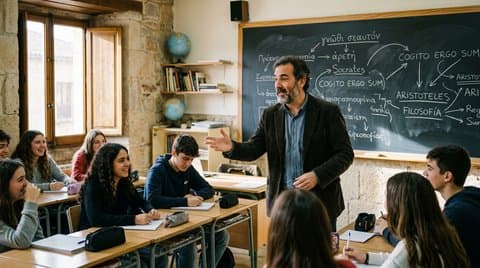
At eight o’clock on a Tuesday morning in late October, the light in Room 204 of our public secondary institute in Salamanca does not arrive from a screen. It arrives through four tall, narrow casement windows that overlook the stone spires of the old university quarter, cutting through the chalk dust that still hangs in the air from yesterday afternoon.
On the front desk sits a battered wooden lectern. There are no laptops open. There are no mobile phones humming on silent in the students' pockets; forty of them rest inside a locked wooden cabinet by the door, having surrendered their wireless tethers at seven-fifty-five.
Before me sit thirty-two seventeen-year-old boys and girls. For two years, they have lived through the greatest epistemic fog in human history: an endless, frictionless synthetic deluge where any question assigned by a teacher can be answered in four seconds by a server cluster in Virginia, formatted in immaculate, hollow paragraphs that mimic the appearance of thought without possessing a single drop of human blood.
Last autumn, I watched the traditional take-home essay die in real time. Students who could barely string three spoken sentences together during our seminar discussions were submitting six-page analytical dissertations on Kantian deontological ethics with pristine semi-colons, balanced periodic cadences, and flawless Harvard citations. When asked at the blackboard to explain what they meant by "the transcendental unity of apperception," they stared at the chalk ledge with blank, panicked eyes. The text had not passed through their minds; it had merely flowed from an algorithmic prompt box to an inkjet printer.
That was the morning I abolished written take-home essays forever.
The Death of Homework and the Return to the Agora
The administrative apparatus of modern secondary education has reacted to the generative crisis with pathetic cowardice. Rather than confronting the fundamental collapse of the homework compact, regional ministries and school boards have poured millions of euros into commercial "AI detection software"—Turnitin, Copyleaks, and their proprietary clones.
It is an obscene, bureaucratic farce. Every educator who has spent ten minutes testing these statistical detectors knows that they are worthless. They flag the essays of neurodivergent students or meticulous classical stylists as "synthetic" while passing prompt-engineered paraphrases with flying colors. Worse, they turn the classroom into a surveillance panopticon, poisoning the sacred trust between master and apprentice with reciprocal suspicion and mathematical paranoia.
The answer to synthetic text is not a synthetic detector. The answer to synthetic text is the living human voice.
Pedagogical Regime | The Take-Home Synthetic Default | The Socratic Viva Voce in Room 204 |
|---|---|---|
Epistemic Substrate | Unverified machine generation in bedrooms | Face-to-face oral dialectics under peer gaze |
Cognitive Friction | Zero; automated delegation to prompt box | High; real-time memory recall and oral refutation |
Verification Method | Flawed probabilistic software detectors | Immediate Socratic elenchus and cross-examination |
Moral Accountability | Ghostwritten evasion; plausible deniability | Sovereign responsibility; student owns every spoken word |
Civic Consequence | Passivity, cynicism, and cognitive atrophy | Oratory confidence, democratic courage, and critical agency |
In Room 204, an essay is no longer a document you hand across a desk on Friday morning. An essay is a position you must walk up to the lectern and defend with your own lungs, your own voice, and your own moral courage against twenty minutes of public cross-examination by your classmates.
The Anatomy of the Living Elenchus
When a student—let us call her Lucía—steps up to the lectern to defend Seneca’s De Brevitate Vitae, she cannot hide behind an anonymous language model. She holds in her hands only a pocket edition of the Latin text with her own handwritten annotations in graphite pencil.
Her task is deceptively simple: she must state Seneca’s thesis—that life is long if you know how to use it, and that humanity squanders its hours on frivolous ambitions—and then defend whether that thesis holds in a society where algorithmic feeds monetize adolescent attention spans.
The Mayeutic Dialectical Cycle: Thesis Assertion → Socratic Cross-Examination → Discovery of Inconsistency → Dialectical Crisis → Sovereign Intellectual Synthesis
The first three minutes are invariably terrifying. Without a teleprompter, without the cushion of a rehearsed script, the adolescent voice trembles. The filler words that pollute modern conversation—the nervous "o sea", the defensive uptalk, the linguistic shrugs—stumble into the silence of the room.
A classmate in the second row, Marcos, raises his hand. He does not attack Lucía; he attacks Seneca’s premise: "If Seneca says we are masters of our time, how can an apprentice in a Roman pottery shop or a warehouse worker in Salamanca be blamed for having their hours stolen by economic necessity? Isn't Seneca speaking merely as a wealthy patrician who never had to pay rent?"
Watch Lucía’s face in that moment. There is no search engine that can save her. There is no autocomplete that can whisper the counter-argument into her ear. She must reach down into her own reading, synthesize the historical context, confront the moral tension between stoic virtue and economic vulnerability, and formulate a reply in real time before thirty of her peers.
When she speaks—haltingly at first, then gaining cadence as the argument takes physical shape—her words do not smell of machine inference. They smell of chalk, of sweat, of teenage defiance, and of genuine intellectual discovery. She is not performing information retrieval; she is practicing the ancient art of citizenship.
The High School Must Remain a Fortress
We live in an epoch that actively despises the physical presence of bodies in rooms. Silicon Valley investors and administrative modernizers constantly preach that the traditional classroom is an obsolete relic of the industrial nineteenth century, ripe for "disruption" by adaptive personalized software and virtual headsets.
They understand nothing about human formation.
A school is not a delivery mechanism for instructional data. A school is a physical sanctuary established by a democratic society to protect children from the predatory commercial forces of their era. It is a room with four walls, a roof, and an open window where young human beings are forced to look at one another without the mediation of an algorithmic feed, to listen to opinions they despise without the ability to block the speaker, and to discover that truth is not a consensus algorithm, but a difficult, communal labor.
 Annotated Seneca Letters on Student Desk
When you replace the classroom with a screen, you do not democratize learning; you deliver the adolescent psyche into the hands of advertising brokers whose business model depends upon cultivating permanent emotional dysregulation and prefrontal fatigue.
The oral defense is our trench. When a boy stands before the blackboard and defends why Creon was wrong in Antigone, he is not merely completing a humanities requirement. He is training the vocal cords that will one day speak at a municipal council meeting, in a union assembly, in a courtroom, or at a hospital bedside. He is learning that an opinion that cannot survive three minutes of polite, rigorous questioning is not an opinion at all, but a prejudice borrowed from an algorithm.
The Unforgiving Light of the Human Voice
As the morning bell rings at eight-fifty-five, the students do not rush for the door. They linger by the desks, arguing about Seneca, about Marcus Aurelius, about whether an attention span can be reclaimed once it has been sold.
I wipe the blackboard clean with a damp felt eraser. The white chalk turns to grey water and then evaporates into the cool morning air, leaving the slate dark and clean for the next class.
The tech evangelists will tell you that memory is dead, that eloquence is redundant, and that the future belongs to those who know how to type instructions into a synthetic prompt harness. Let them sell their subscriptions to the gullible.
Here in Salamanca, beneath the cold stone of Castile, we know better. Empires of code will rise and collapse; cloud platforms will go bankrupt when their electricity bills outstrip their venture subsidies; and algorithms will choke on their own synthetic waste. But as long as there is a room where a teacher can look an adolescent in the eye and say, "Stand up, clear your throat, and tell me what you believe," the republic of letters will not fall.