

Why I Confiscated Forty Phones Before Reading Antigone
On Monday morning at eight-thirty, as the bells of the old sandstone cathedral echoed across the frosty rooftops of Salamanca, forty seventeen-year-old students filed into Room 204 for our double seminar on Greek tragedy.
Before a single backpack touched the floor, I placed a heavy, felt-lined pine carpenter’s box on the corner of my oak desk. It contains forty numbered wooden slots, built for me last winter by a retired cabinetmaker in the Barrio del Oeste.
"Power them down completely," I told the room, tapping the lid of the box with a stick of white calcium carbonate chalk. "Not airplane mode. Not silent vibration inside your coat pocket. Hold the side button until the screen goes black, slide the glass into your numbered slot, and take your seat with nothing on the desk but Sophocles, a paper notebook, and a pen."
A collective, involuntary groan rippled across the rows.
I watched Diego, a bright, restless boy in the third row, stare at his thumb as he slid his iPhone into slot number fourteen. His fingers twitched twice against his palm after letting it go, the phantom motor reflex of an amputee reaching for a missing limb. Next to him, Lucía looked at the wooden box with the expression of a diver being asked to unbuckle her oxygen tank before descending into a trench.
For the first eleven minutes of the hour, the silence in the classroom was not peaceful; it was prickly, electric, and almost unbearable. Knees bounced under the desks. Eyes darted toward the oak table where forty black rectangles lay entombed in pinewood.
And then, at eight-forty-two, we opened the worn paperback pages of Sophocles’ Antigone and began to read aloud.
The Phantom Vibration in the Pocket
Why has it become impossible to teach classical tragedy—or any sustained form of moral philosophy—while a smartphone remains within three meters of a teenager’s nervous system?
For a decade, well-meaning educational bureaucrats told us that we should "integrate" the device into the humanities curriculum. Let the students look up the Greek etymology of polis on their screens, they said. Let them collaborate on shared cloud documents during the seminar.
What those bureaucrats failed to understand is that a smartphone is not a neutral reference dictionary. It is a variable-ratio dopaminergic slot machine engineered by the most sophisticated behavioral psychologists on earth to prevent the human mind from ever dwelling inside a single uninterrupted thought for more than forty-five seconds.
Classroom Cognitive Dimension | Ambient Smartphone Presence (Even Silenced in Pocket) | The Phone-Free Socratic Sanctuary (Boxed & Powered Off) |
|---|---|---|
Prefrontal Attentional Allocation | 25% to 40% continuously diverted to monitoring pocket states | 100% available for sustained syntactic and dramatic immersion |
Saccadic Eye Contact | Evasive; downward glance toward lap every 90 to 120 seconds | Direct, sustained face-to-face gaze across the seminar circle |
Tolerance for Ambiguity | Low; urge to query an algorithm for an instant 3-bullet summary | High; willingness to sit inside an unresolved ethical aporia |
Emotional Vulnerability | Inhibited by fear of covert recording or social media mockery | Protected; the classroom becomes an unmonitored civic agora |
Argumentative Rhythm | Fragmented, reactive, defensive, meme-inflected | Deliberative, periodic, cumulative Socratic elenchus |
Tragic Empathy Capacity | Suppressed by ironic detachment and algorithmic cynicism | Awakened through shared vocalization and collective stillness |
Even when a teenager’s phone is turned face-down on a desk or tucked inside a denim pocket on silent mode, its mere physical proximity exerts what cognitive psychologists call brain drain.
A significant portion of the student’s prefrontal cortex remains locked in a state of low-grade, vigilant sentry duty: Did someone reply to my story? Did the group chat move on without me? Did a notification just buzz against my thigh?
You cannot enter the moral universe of Thebes while half of your mind is waiting for a webhook from California.
Tragedy requires something that the algorithmic feed is specifically designed to destroy: gravity. It requires the slow, suffocating accumulation of an irreconcilable moral conflict where two sacred duties—the unwritten law of familial piety and the positive law of civic order—collide without an easy exit.
The Wooden Box and the Chalkboard
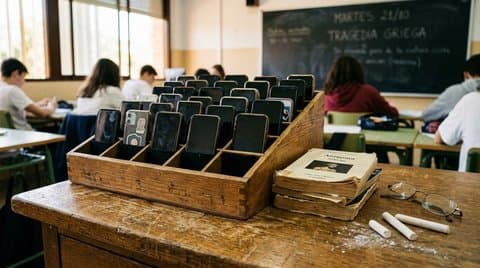 Compartmentalized wooden box filled with powered-off student phones beside paperback copies of Antigone and chalk
Look at the corner of my desk shown above. Inside that plain wooden crate sit forty silenced notification engines. Beside them lie the only technologies required for the formation of a free citizen: three dog-eared paperbacks printed on cheap paper, a pair of reading glasses, and a handful of chalk sticks.
Around nine o'clock—roughly twenty minutes after the phones were surrendered—a physiological shift occurred in Room 204. I have witnessed this exact transition every week for three years, yet it never ceases to move me.
The bouncing knees stopped. The shoulders dropped two inches. The breathing of forty adolescents synchronized into the slow, deep cadence of shared concentration.
We had reached line 450, where Creon demands to know how Antigone dared to transgress his royal edict by burying her brother Polyneices, and Antigone replies that Zeus did not proclaim such a law, nor did Justice (Dike), who dwells with the gods below, ordain such statutes among men.
The Socratic Awakening Sequence: Physical Confiscation of Notification Hardware → Twelve-Minute Dopaminergic Withdrawal → Shared Vocalization of Dramatic Text → Collapse of Ironic Detachment → Direct Ethical Confrontation in the Agora
I closed my book, walked to the center of the wooden floor, and looked directly at Diego—the boy whose thumb had twitched for his screen twenty minutes earlier.
"Diego," I asked quietly. "Suppose Creon is right. Suppose a city that has just survived a bloody civil war allows every citizen to disobey the law whenever their private conscience or family loyalty demands it. How long does that city survive before it descends back into slaughter?"
Diego did not look down at his lap. He did not reach for a search bar. He did not hide behind a smirk.
He looked across the circle at Lucía, who had been reading the lines of Antigone, and then back at me. His brow knotted. For eight full seconds, the classroom was so quiet we could hear the sparrows rustling in the ivy outside the tall windows.
"If everyone breaks the law for their brother, the city dies," Diego said slowly, weighing each Spanish syllable as if it were made of lead. "But if the city forces a sister to leave her brother’s body to the dogs... then the city isn't worth saving anymore."
From the opposite side of the room, Sofía raised her hand, her eyes bright with fierce intensity. "Then Creon isn't defending the city, Professor! He’s defending his own fear of looking weak!"
Within three minutes, eighteen hands were in the air. Voices overlapped—not in the venomous, performative shriek of social media comment threads, but in the apasionado, trembling earnestness of young human beings discovering that a twenty-four-hundred-year-old Greek play was speaking directly about their own lives, their own loyalties, and their own courage.
The Classroom as a Fortress of Unrecorded Life
There is a second, rarely discussed reason why the confiscation of smartphones is the prerequisite for genuine education.
A teenager who knows that forty cameras and microphones are active in the room can never risk being wrong.
In the contemporary digital panopticon, adolescence has been stripped of its right to ephemerality. A clumsy sentence, a naive question, a moment of unguarded emotion, or an unpopular philosophical hypothesis can be secretly recorded, clipped out of context, and broadcast to two thousand peers before the lunch bell rings.
To protect themselves from this permanent digital exposure, teenagers adopt the armor of ironic apathy. They speak in flat, non-committal monosyllables. They refuse to care aloud about anything, because caring is a vulnerability that can be turned into content.
When the forty phones go into the wooden box on my desk, that invisible surveillance apparatus is dismantled.
Room 204 becomes a sanctuary of unrecorded life. What is spoken between these four plaster walls evaporates into the air the moment the syllable ends, surviving only in the living memory of those who were present.
In that protected acoustic space, a seventeen-year-old boy can admit that he is afraid of dying in obscurity. A girl can weep over Antigone’s walk to the stone tomb without fearing that her tears will become a five-second video clip. They can test dangerous ideas, contradict themselves, retract their claims, and forgive one another’s confusion.
When the Bell Rings
At ten-twenty, the brass bell in the corridor rang to end the double period.
Nobody stood up.
Diego and Sofía were still leaning across the aisle, arguing fiercely over whether Haemon’s plea to his father was an act of filial love or political realism. I had to walk to the oak desk and lift the lid of the pinewood box myself to remind them that their next class was waiting.
One by one, they walked up to retrieve their devices.
I watched Diego pull his black glass rectangle from slot number fourteen. He held it in his palm without turning it on, looking at the dark screen with a strange, quiet detachment—as if he were looking at a toy from a childhood he had begun to outgrow.
"Professor," he asked as he slung his canvas bag over his shoulder, "on Thursday, when we read the final chorus... can we put them in the box again?"
"Every Thursday, Diego," I told him, wiping the white chalk dust from my hands onto my jacket. "As long as these walls are standing."