

When the Water Won't Stop
The call came at twenty past two on a Tuesday morning in October. In my line of work, a phone ringing after midnight is never a congratulatory message or a discussion about market dynamics; it is the sound of someone whose domestic world has suddenly liquefied. The address was an old residential block in the Eixample district of Barcelona, five storeys of hydraulic lime mortar and hydraulic cement built in 1912, where the ground floor had recently been converted into a co-working space for a venture-backed software firm.
When I pushed open the wrought-iron door to the cellar staircase, the smell hit me before I saw the water: damp pulverized plaster, thirty years of trapped boiler coal soot, and that unmistakable, metallic stench of pressurized tap water dissolving old limestone footings. The tenant, a young product manager wearing expensive fleece slippers and holding a glowing smartphone, was standing on the bottom three steps, pointing his screen at the ceiling.
"The smart building dashboard says the main solenoid valve is ninety-eight percent closed," he told me, his voice trembling with the peculiar helplessness of someone who has never touched a cold iron wrench. "The digital flow sensors show zero consumption across all six sub-meters."
I stepped off the third stair into three inches of cold, grey water, my heavy rubber work boots splashing against the submerged tiles. In the dark corner behind the electrical riser, water was not flowing through a digital sub-meter; it was screaming out of a fractured three-inch lead-to-brass wiped joint at six point two bars of hydrostatic pressure, whipping a fine vapor into the air that turned the beam of my halogen headlamp into a blinding white cone.
Water does not care about smart building dashboards. Water does not read API specifications. Under six bars of pressure, water searches for the single microscopic void where a soldering torch failed thirty years ago, and when it finds it, it tears through the building with the indifferent, mechanical violence of the physical universe.
The Arrogance of the Dry Hand
Our entire technical civilization is built upon an unspoken pact with subterranean plumbers, pipefitters, and hydraulic engineers whose names are never engraved on commemorative plaques. We live inside a fragile, drying fantasy: we assume that when we turn a polished chrome mixer tap on the fourth floor of an apartment building, the arrival of seventy-five liters per minute of potable water at three bars of pressure is an automatic natural right, rather than an ongoing, violent negotiation with gravity and friction.
Because modern plumbing is concealed behind drywall, suspended acoustic tiles, and subterranean service trenches, the intellectual class has developed what I think of as the arrogance of the dry hand. In software engineering, when a function fails, the system logs an exception, rolls back the transaction, and writes an incident ticket for the next sprint. If a memory leak occurs, an orchestrator spins up another virtual container and reclaims the RAM.
+---------------------------------------------------------------------------------------------------+
|                        SOFTWARE INDIRECTION VS. HYDRAULIC TRUTH UNDER PRESSURE                    |
+--------------------------------+---------------------------------+--------------------------------+
| Dimension                      | Software / Cloud Paradigm       | Hydraulic Plumbing Reality     |
+--------------------------------+---------------------------------+--------------------------------+
| Failure Consequence            | Logged error / Virtual retry    | Structural ceiling collapse    |
| Resolution Mechanism           | Patch / Hotfix / Config deploy  | Torch, hemp, and raw torque    |
| Verification Standard          | Synthetic unit test pass        | 10-bar hydrostatic pressure test|
| Tolerance for Friction         | Abstracted away by runtimes     | Unforgiving physical resistance|
| Authority Source               | Architectural documentation     | The non-negotiable leak        |
| Diagnostic Speed               | Millisecond telemetry stream    | Hours on knees in cold slurry  |
+--------------------------------+---------------------------------+--------------------------------+
In a domestic water main, there are no virtual containers. There is only a column of liquid weighing one thousand kilograms per cubic meter, pushed forward by municipal centrifugal pumps, seeking every hairline porosity in every solder run. If you leave a tiny sliver of zinc oxide flux uncleaned inside a capillary copper fitting, the acid will chew through the wall in six years. It will not notify your monitoring dashboard; it will quietly rot the timber joist underneath your oak parquet floor until your dining table drops eight inches into your neighbor's living room.
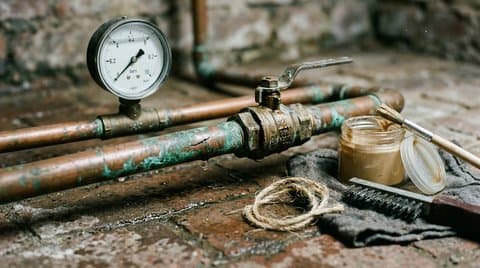 Ruptured brass ball valve and corroded copper coupling with verdigris patina on damp cellar floor
The Anatomy of a Solder Joint
To understand why physical matter resists the hubris of digital automation, you have to watch a fifty-year-old copper pipe being soldered under emergency conditions. You cannot simply point a flame at a pipe and expect it to hold. Soldering is an ancient, delicate physical transformation that demands complete sensory obedience from the worker.
First, the pipe must be dry. If there is a single teaspoon of standing water inside the line, the heat from your propane torch will simply boil the puddle into steam, preventing the metal from reaching the two hundred and forty degrees Celsius required for the tin-silver alloy to melt. You can heat the brass fitting until it glows dull cherry red, but the joint will remain cold, spitting hot acid flux onto your forearms while the solder beads up and falls uselessly into the mud.
The Invariant of the Molten Alloy: Mechanical Abrasion → Zinc Chloride Flux → Neutral Reducing Flame → Capillary Wicking → Hydrostatic Invariant
The pipe must be scrubbed with abrasive steel wool until the dull brown copper shines like a fresh coin. You apply the flux—a corrosive paste of zinc chloride that strips the microscopic oxide layer off the metal the instant the torch touches it. Then comes the flame: not a roaring, oxidizing blue jet that burns the flux into carbonized crust, but a soft, neutral cone held precisely two inches from the fitting sleeve.
When the metal reaches the exact thermal threshold, you touch the wire of ninety-seven percent tin and three percent silver to the back of the seam. If your heat is true, you do not need to guide the solder; the physical law of capillary action takes over. The liquid alloy is literally pulled into the micro-gap between the pipe and the socket against the force of gravity, wicking around the entire circumference in a silent, silver ring that freezes in three seconds.
If you rush that joint by five seconds, or if you touch the wire before the copper has expanded to meet the fitting, the joint is dead. It might hold water when you turn the valve back on at dawn; it might hold for three months while the building inspectors sign off on the occupancy permit. But the first winter night that the municipal main pressure surges to seven bars because three factories down the road closed their intake valves, that cold joint will fracture.
The Phantom Diagnostics of Smart Hardware
Over the past four years, plumbing trade supply shops across Europe have been flooded with "smart" water management systems: ultrasonic acoustic leak detectors, IoT motorized brass shutoffs, and cloud-connected pressure transducers that promise property managers total immunity from water damage.
I have spent the last eighteen months replacing these devices after catastrophic failures. The problem with electronic diagnostic overlays is that they confuse the measurement of an artifact with the physical state of the system:
Ultrasonic Ghost Readings: Acoustic leak sensors detect the high-frequency hiss of turbulent water escaping a small pinhole. But when a hot-water recirculating loop develops thermal expansion cavitation, or when a neighbor's toilet cistern has a worn flapper valve, the algorithm interprets the ambient noise as normal baseline consumption and suppresses the alarm.
Solenoid Scale Seizure: Motorized automated shutoff valves utilize plastic gears and low-torque twelve-volt servomotors. In hard-water Mediterranean municipalities where the water carries three hundred milligrams of calcium carbonate per liter, those motorized valves seize with mineral scale within fourteen months. When the catastrophic rupture occurs, the cloud sends a "close" command, the tiny plastic nylon teeth strip inside the actuator casing, and the valve remains wide open while the server logs report "Status: Valve Closed (100%)."
The Battery Depletion Blindspot: Wireless IoT sensors deployed in dark, unheated basement vaults suffer battery voltage collapse during humid winter weeks, going into unannounced sleep states while maintaining their last reported "dry" telemetry flag on remote web consoles.
+---------------------------------------------------------------------------------------------------+
|                         WHY IOT HARDWARE FAILS WHERE MECHANICAL INVARIANTS HOLD                   |
+------------------------------------+--------------------------------------------------------------+
| Electronic / IoT Failure Mode      | Classical Mechanical Countermeasure                          |
+------------------------------------+--------------------------------------------------------------+
| Scale seizure of motorized gears   | Heavy forged-brass quarter-turn lever valve (manual torque)  |
| Software latency during water surge| Spring-loaded diaphragm water hammer arrestor (inertial)     |
| Battery exhaustion in damp cellars | Gravity-fed drain sumps with mechanical float switches       |
| Algorithmic false negatives on leaks| Visible copper inspection risers and floor tell-tale weeping |
+------------------------------------+--------------------------------------------------------------+
When I explained this to the young tenant in the Eixample basement, he looked at his smartphone with genuine betrayal. The application interface was designed with soothing pastel colors, clean sans-serif typography, and animated graphics showing water flowing peacefully through green pipes. It was a masterpiece of digital design. But beneath his feet, the oak floor joists had absorbed four thousand liters of fluid, bowing the brick partition wall and cracking the plaster facade on the floor above.
The Solace of the Mechanical Seal
At five o'clock in the morning, the basement was finally silent. The fractured lead pipe had been cut back to clean metal with a handsaw, a heavy bronze compression transition coupling had been torqued down until the rubber gasket compressed into the lead casing, and a new section of hard-drawn twenty-eight-millimeter copper had been sweated into place.
I opened the street curb cock two turns. The pipe groaned as forty liters of air compressed into the risers, the needle on my test pressure gauge rose steadily to six bars, and then stopped.
I knelt in the puddle with a dry cotton rag and wiped the new joint clean. I waited five minutes in the cold darkness, listening. Not a hiss. Not a drop. Not a single microscopic bead of sweat on the silver seam.
In a world drowning in synthetic words, algorithmic predictions, and virtual promises that evaporate the moment pressure is applied, there is an immense, almost sacred dignity in a joint of copper and tin that does not weep. The water was there, pressing against the inner wall with six kilograms of force on every square centimeter, desperate to escape, desperate to destroy. But the metal held, because the metal had been honored on its own terms.
We can automate our prose. We can delegate our cognitive labor to machines. We can build computational architectures of astonishing complexity and retreat into digital rooms where everything happens smoothly and without friction.
But down beneath the floorboards, in the damp dark where the city actually lives, the water is waiting. And when the water comes, it will not ask what model you used to draft your thesis. It will ask only if your solder ran true, if your threads were clean, and if you had the courage to turn the wrench with your own bare hands.