
When the Synapse Refuses to Fire
On Tuesday afternoons in the outpatient neuropsychiatry clinic at Karolinska University Hospital, I see a specific cohort of patients who did not exist in the medical textbooks when I completed my residency in 2003.
They are mostly between twenty-four and thirty-eight years old. They do not present with endogenous melancholia, psychotic delusions, or structural lesions of the basal ganglia. Their blood panels—thyroid-stimulating hormone, serum ferritin, vitamin B12, morning cortisol—are unremarkable. Yet when they sit across from my oak desk in the quiet Nordic twilight, their faces exhibit a striking, mask-like hypomimia.
Yesterday, a twenty-nine-year-old quantitative systems architect sat in that chair, looked down at his hands, and described his condition with chilling clinical precision: "Doctor, I won a major industry award last Thursday, and I felt nothing. Yesterday my sister gave birth to her first child, and I stood in the hospital room feeling as though I were watching a grey television screen through soundproof glass. When I listen to Bach, it is just acoustic vibration. When I eat warm bread, it is just starch."
In popular parlance, he would be told that he has "burnout" and needs a weekend at a spa. In clinical neurobiology, however, we recognize this state by its exact diagnostic name: acquired dopaminergic anhedonia secondary to chronic receptor downregulation. His synapses have not forgotten how to work; they have pulled down their shutters in self-defense against an environment of relentless, unphysiological stimulation.
The Homeostatic Defense of the Post-Synaptic Membrane
To understand why a healthy young adult loses the capacity to experience joy, curiosity, or aesthetic wonder, one must abandon the vulgar self-help mythology of "dopamine hits" and examine the molecular physiology of the mesolimbic and mesocortical pathways.
Dopamine is not the molecule of pleasure; it is the neurotransmitter of salience and prediction error. Originating in the ventral tegmental area (VTA) and projecting into the nucleus accumbens and the prefrontal cortex, phasic bursts of dopamine signal to the organism that an unexpected, survival-relevant event has occurred, mobilizing metabolic energy to pursue it.
Throughout mammalian evolution, high-amplitude phasic dopamine spikes were rare, costly, and coupled to intense physical effort: spotting game after six hours of tracking through snow, finding ripe berries in late autumn, or hearing the voice of a returning companion. Crucially, each spike was followed by a long refractory valley of sensory quietude, during which vesicular monoamine transporters reloaded the presynaptic terminals and the postsynaptic D2 and D3 receptors returned to baseline sensitivity.
Neurochemical Dimension | Physiological Baseline (Natural Salience) | Chronic Algorithmic Hyper-Stimulation |
|---|---|---|
VTA Firing Pattern | Tonic baseline (2–4 Hz) with rare phasic bursts (15–20 Hz) | Continuous high-frequency phasic bombardment without refractory valleys |
Postsynaptic D2 Density | High striatal membrane expression; sensitive to subtle natural rewards | Beta-arrestin mediated receptor endocytosis (30–45% downregulation) |
Intracellular Transcription | Balanced CREB and immediate-early gene (c-Fos) expression | Accumulation of ΔFosB; blunted sensitivity to natural hedonic stimuli |
Prefrontal Executive Control | Intact top-down glutamatergic regulation of impulse and attention | Frontostriatal uncoupling; compulsive novelty-seeking without satisfaction |
Phenomenological Experience | Capacity for sustained contemplation, quiet joy, and patient effort | Clinical anhedonia, affective flattening, and restless dysphoria |
When an individual spends fourteen hours a day immersed in variable-ratio digital reinforcement schedules—algorithmic feeds calibrated by reinforcement-learning engines to maximize micro-surprises every four seconds, rapid-fire work messaging, real-time financial tickers, and synthetic media streams—the ventral tegmental area is forced into continuous phasic firing.
The postsynaptic neuron is not an inert wire; it is a living cell that must protect itself from excitotoxic calcium overload and metabolic exhaustion. Faced with an unrelenting flood of synaptic dopamine, the cell recruits beta-arrestin proteins to physically uncouple the D2 receptors from their G-protein signaling cascades and pull them inside the cell membrane via endocytosis, where they are degraded by lysosomes.
What the Radioligand Plate Reveals
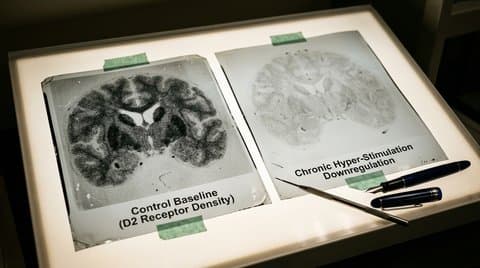 Autoradiography comparison of striatal D2 receptor density on hospital lightbox
Examine the silver-halide autoradiography plates on my consultation lightbox above, recorded using carbon-11 raclopride—a selective radioligand that binds specifically to available D2 and D3 receptors in the human striatum.
On the left is a healthy baseline coronal section: the caudate nucleus and putamen appear dark and dense, rich with open receptor binding sites ready to respond to the subtle pleasures of an ordinary day—the warmth of morning sun on cold skin, a complex paragraph of philosophy, the quiet satisfaction of finishing a physical task.
On the right is the striatal profile of severe chronic hyper-stimulation. The receptor field is pale, washed-out, depleted by nearly forty percent—a neurochemical landscape previously seen almost exclusively in chronic cocaine or methamphetamine dependence.
The Synaptic Desensitization Cascade: Variable-Ratio Digital Micro-Rewards → Sustained VTA Phasic Dopamine Flood → Beta-Arrestin Receptor Internalization → Striatal D2 Density Depletion → Clinical Anhedonia & Affective Flattening
When forty percent of your striatal D2 receptors have been internalized, the tonic baseline signal drops below the threshold required to sustain motivation or affective resonance. Ordinary life—a walk in the woods, a conversation without a screen, a slow movement of a string quartet—no longer generates enough post-synaptic current to cross the firing threshold. The world turns grey, flat, and weightless. And in a desperate attempt to feel something, the patient reaches back for the glowing glass rectangle, demanding ever-stranger, ever-faster, ever-louder stimuli to force a signal through a dying receptor field.
Why Philosophy Begins in Boredom
In his 1929 Freiburg lectures, Martin Heidegger argued that profound boredom—tiefe Langeweile—is not a pathology to be fled, but the fundamental attunement that awakens human beings to the question of Being. Only when the noisy chatter of everyday distractions falls silent do we confront the weight and temporal finitude of our own existence.
Neurobiology confirms what continental philosophy intuited a century ago, though in the language of synaptic vesicles and membrane proteins.
Human creativity, moral courage, and deep intellectual synthesis cannot occur in a brain whose reward circuitry is saturated by artificial micro-stimuli. For a slow, subtle thought to register as meaningful—for a scholar to spend six months wrestling with a single contradiction in Spinoza, or for a luthier to spend forty hours scraping a spruce soundboard to a thickness of two millimeters—the striatal receptor bed must be exquisitely sensitive. And high receptor sensitivity can only be maintained in an environment of low baseline stimulation.
You cannot hear the whisper of a single violin string inside a jet engine test cell. And you cannot feel the quiet warmth of human affection or intellectual discovery if your mesolimbic pathway is being hammered ten thousand times a day by synthetic novelty engines designed in California.
The Prescription of Salt and Shadow
When my twenty-nine-year-old architect asked me what medication I was going to prescribe to bring back his ability to feel, I closed my folder, capped my fountain pen, and looked him in the eye.
To prescribe a psychostimulant or a dopamine reuptake inhibitor to a brain suffering from environmentally induced receptor downregulation is like whipping a collapsed horse. You may squeeze a few weeks of artificial manic output from the remaining synaptic vesicles, only to deepen the subsequent crash.
The only cure for receptor downregulation is the one intervention that modern consumer capitalism cannot monetize: prolonged, unmediated sensory austerity.
I wrote him a six-week medical leave certificate—not to stay in his apartment scrolling through streaming platforms, but to go to his family’s unheated timber cabin in northern Dalarna without a smartphone, without a laptop, and without an internet connection. I instructed him to chop birch firewood with an axe, to cook simple meals over a cast-iron stove, to walk ten kilometers a day through the cold pine forests, and to sit in the evening twilight watching the shadows lengthen across the floorboards without reaching for a switch.
The first ten days of such a withdrawal are agonizing. Stripped of exogenous phasic spikes, the downregulated striatum plunges into acute dysphoric restlessness—an existential itch that feels almost unbearable.
But around the eighteenth day, a quiet biological miracle begins. In the absence of continuous bombardment, the postsynaptic neurons transcribe new messenger RNA. Fresh D2 receptor proteins are synthesized in the endoplasmic reticulum, packaged by the Golgi apparatus, and trafficked back to the dendritic spines.
When that patient returned to my office in late November, his skin was weathered by the northern wind and his hands had calluses from the axe handle. He sat down in the chair across from me and smiled—a genuine, unforced Duchenne smile engaging the orbicularis oculi muscles around his eyes. Four days earlier, he told me, he had been standing on the porch at dawn drinking a cup of black coffee when a flock of wild geese flew low over the frozen lake, crying out in the mist. For the first time in four years, tears had come to his eyes from the sheer, overwhelming beauty of being alive.