

When the Lead Pipe Weeps
At two in the morning, forty centimeters beneath the damp pine floorboards of a residential building constructed in the Eixample of Barcelona in 1912, there is no artificial general intelligence. There are no venture capital convertible notes, no cloud synchronizations, and no agile software standups.
There is only a forty-millimeter domestic lead water main, sweating cold condensation against the lime mortar, vibrating at fifty cycles per second with the relentless hydraulic pulse of the municipal water grid.
I am lying on my side on an old canvas tarp in a crawlspace barely fifty centimeters high. My knees are resting on century-old coal dust; my headlamp cuts a narrow oval of white light through cobwebs and flaking plaster; and my left hand, blackened with graphite paste and copper flux, is feeling along the underside of a wiped solder joint made by a master plumber whose bones have been dust in the Montjuïc cemetery since the Second Republic.
Water does not care about smart home apps. Water has density, momentum, and an incompressible bulk modulus of two point two gigapascals. When a valve closes four floors above, the kinetic energy of sixty liters of moving liquid has to go somewhere. If your solder joint was wiped by someone who understood capillary action and the plastic phase of molten lead, the pipe rings like a bell and holds. If it was installed by an automated home automation system relying on cheap plastic solenoid valves, the lead weeps, the mortar dissolves, and the ceiling downstairs collapses into the parlor.
The Chemistry of the Wiped Joint
Modern building contractors look at old lead plumbing with horror, primarily because they no longer possess the manual skill to touch it without breaking it. They send young technicians with battery-powered crimping tools and push-fit plastic couplings who promise the building committee that they can "modernize" the riser in an afternoon.
Six months later, I get the emergency call at midnight.
A crimped plastic fitting, subjected to the constant thermal expansion of domestic hot water and the micro-vibrations of the street traffic outside, creeps. The synthetic EPDM O-ring hardens, loses its elasticity, and begins to seep. Lead, by contrast, is a ductile, self-healing material that flows under stress without cracking, absorbing building subsidence over decades that would shear copper or shatter PVC.
Plumbing Material System | Expected Mechanical Lifespan | Primary Failure Mode | Maintenance & Repair Requirement |
|---|---|---|---|
Heavy-Wall Lead Main (Wiped Joint) | 80 to 120+ years | Slow galvanic corrosion; creep at high temperatures | Hand-wiped lead-tin solder tallow joint by master plumber |
Phosphorus-Deoxidized Copper (Hard Soldered) | 50 to 75 years | Pinhole pitting from soft water; erosion corrosion | Oxygen-acetylene torch brazing with silver-phosphorus alloy |
Cast Iron Soil Stack (Lead-Oakum Joint) | 90 to 150 years | Rust expansion at base hub elbow | Caulking with tarred hemp oakum and molten lead ring |
Cross-Linked Polyethylene (PEX-A) | 20 to 35 years | Chlorine oxidation; oxidative embrittlement under UV light | Proprietary mechanical expansion ring tool and plastic fittings |
Smart IoT Motorized Solenoid Valve | 2 to 5 years | Micro-switch burnout, firmware bricking, and capacitor leak | Complete module replacement; discarded as electronic waste |
The table above is not nostalgia; it is the physical ledger kept by anyone who works with pipe wrenches in old European cities. The lead-tin wiped joint—a mixture of two parts lead to one part tin, worked with a greased moleskin cloth while the alloy is in a pasty, semi-liquid state between 183 and 250 degrees Celsius—forms a metallurgical bond with the brass fitting that is chemically indivisible. It does not rely on glue; it does not rely on rubber gaskets; it relies on atomic diffusion.
Under Six Bars in the Dark
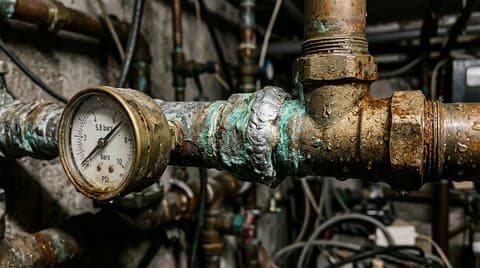 Aged lead-to-brass wiped joint with verdigris patina and analog pressure gauge
Look closely at the photograph above. That joint was wiped in 1934. The brass stopcock has turned dark olive with verdigris patina, but the solder bulb is smooth, solid, and completely dry under five point eight bars of hydrostatic pressure.
When a domestic pipe breaks, the homeowner's panic is visceral and ancient. Fire alarms irritate people; sirens make them nervous; but the sound of uncontained water rushing inside a wall at three in the morning triggers an immediate existential terror.
Water dissolves foundations. It short-circuits electrical risers, creating arc flashes inside conduits; it rots structural timber joists; and it turns expensive parquet flooring into warped, buckled waves within three hours.
The Hydraulic Shock Sequence (Water Hammer): Instantaneous Quarter-Turn Solenoid Closure → Kinetic Momentum Arrest → High-Pressure Wave Propagation (1,400 m/s) → Pipe Flexure & Mechanical Fatigue → Structural Joint Rupture
When an electric solenoid valve on a modern smart washing machine snaps shut in eight milliseconds, it sends a pressure shockwave traveling backward through the water column at fourteen hundred meters per second—the speed of sound in water. That pressure spike can easily reach twenty-five bars, four times the normal operating pressure of the city main.
If the plumbing was designed with generous sweeping copper bends and physical air chambers, the shock is absorbed. If the contractor eliminated air arrestors to save forty euros, that shockwave hammers relentlessly against the oldest, weakest joint in the riser until the metal gives way.
The Galvanic Betrayal and the Law of Anodes
There is another invisible enemy working inside domestic walls that no software diagnostic can predict: the galvanic potential series.
When amateur remodelers splice modern stainless-steel braided flexible hoses directly onto vintage galvanized iron risers without a dielectric brass insulating union, they set up an unintended electrochemical battery inside their own drinking water. The difference in electrolytic potential between iron and copper or stainless steel generates a microscopic direct-current voltage.
Under the laws of electrochemistry, the more active metal—the iron—sacrifices its electrons to the water. The pipe does not rust from the outside where a tenant might spot a reddish stain; it hollows out from within, eroding its internal bore until the five-millimeter pipe wall is reduced to an eggshell-thin crust of black magnetite that crumbles the moment an earthquake tremors through the city or someone slams a front door downstairs.
This is why old plumbing cannot be repaired with quick patches or miracle epoxies advertised on late-night infomercials. You have to respect the physical chemistry of the elements. You have to anneal hard-drawn copper tube with an open flame until it glows dull cherry-red at six hundred degrees, quench it in cold water to reset its crystalline grain, and let the molten solder follow the heat of the torch into the microscopic capillary clearance between pipe and socket.
The Dignity of the Unseen Trade
We live in a culture that worships the clean, the frictionless, and the abstract. Young people are taught that the only work worthy of intelligence takes place on glowing laptop screens in glass offices, manipulating symbols, optimizing marketing funnels, and building software agents to replace other software agents.
Meanwhile, the physical reality that allows those glass offices to exist—the sewage risers, the clean water feeds, the storm drains, the district heating steam lines—is relegated to an invisible underclass of manual workers whose labor is only noticed when something smells bad or water drips from the ceiling.
There is a profound philosophical dignity in the physical trades that the digital world has forgotten. When I tighten a union nut with a thirty-six-inch wrench, I cannot bluff. I cannot write a clever prompt to convince the pipe not to leak. If my threads are cross-cut by half a millimeter, water will spray into my face under six bars of pressure the instant the main valve is opened.
The pipe demands complete, unsparing honesty. It tests your patience, your physical strength, your knowledge of metallurgy, and your willingness to work covered in grease and cold water while the rest of the city sleeps.
When the Wrenches Are Put Away
At four in the morning, the leak is sealed.
I cut out the cracked section of weeping lead, dressed the ends with a rasp, and wiped a clean copper-to-brass transition using silver solder and a butane torch. The pressure gauge needle climbed back to five point eight bars and held perfectly still. Not a drop. Not a hiss.
I pack my wrenches back into the heavy leather tool bag. My lower back aches; my knuckles have fresh scrapes from the lime mortar; and my hair smells of burnt tallow and copper flux.
Outside on the street, the night is quiet. A municipal street-sweeping truck rumbles down the Gran Via, spraying clean water onto the asphalt. High above, through the curtains of the apartment building, the faint blue glow of a television screen flickers in a dark room.
The people sleeping in those beds will wake up at seven o’clock, turn the brass taps in their bathrooms, and clean water will flow—pure, clear, and abundant. They will never know my name; they will never know that an old wiped lead joint held their ceiling together while they slept; and they will never know the weight of iron in the dark. And that is exactly as it should be.