
When the Digital Text Rots in Ten Years
On the long wooden refectory table in the epigraphical study room of the Epigraphical Museum in Athens, two objects lie side by side under the pale morning light.
To my left rests a fragment of a decree of the Athenian Boule, carved into fine-grained Pentelic marble in the summer of 424 BCE. Its surface is lightly pitted by centuries of Attic dust, but the chiseled Greek uncial letters—EDOXSEN TEI BOVLEI KAI TOI DEMOI ("Resolved by the Council and the People")—are as sharp and unambiguous today as the hour the stonemason's iron chisel bit into the calcitic crystals. Anyone who has studied basic Attic syntax can read it directly with their naked eyes, requiring neither an electrical current, an operating system, nor a proprietary codec.
To my right sits an aluminum spool wound with half-inch magnetic recording tape, produced in 1991 as part of an international academic effort to digitize regional epigraphical archives onto optical and magnetic carriers. When I pick up the spool, a faint chemical scent—sour and vinegar-like—rises from the polymer backing. The urethane binder holding the gamma ferric oxide particles has absorbed ambient moisture, undergoing hydrolysis. When mounted on a transport deck, the tape does not sing with digital precision; the oxide flakes off in sticky, reddish-brown crumbs, clogging the ceramic playback heads and reducing decades of curated scholarly annotations to unrecoverable silence.
The marble inscription has survived twenty-four hundred and fifty years of wars, earthquakes, atmospheric soot, and political oblivion. The digital tape survived barely thirty-five years in an air-conditioned room.
Between these two extremes stands another humble analog miracle: the epigraphical squeeze. When field epigraphers document an inscription in the Peloponnese, we do not rely solely on digital photogrammetry or laser scanning. We soak heavy, unbleached German filter paper in clean spring water, lay it over the carved stone face, and beat it vigorously with a stiff horsehair brush until the wet cellulose pulp is forced deep into every incision. When dried under the Mediterranean sun, the peeled paper cast retains the exact three-dimensional topography of the chisel marks. In the Ashmolean Museum in Oxford, we have paper squeezes made by nineteenth-century travelers that remain as crisp, legible, and mechanically stable as the day they were pulled from the stone. Paper and mineral crystals endure; magnetic emulsions and proprietary operating systems decay.
The Great Inversion of Civilizational Memory
We are living through the most peculiar epistemic inversion in human history. Every previous epoch increased the physical durability of its cultural memory as its technology matured: from oral formulaic poetry to baked Mesopotamian clay tablets, from clay to papyrus rolls, from papyrus to animal vellum codices, and from vellum to rag paper printed with linseed oil ink. A parchment manuscript from the ninth century, preserved in the monastery of Saint Gall, can still be held, turned, and read with nothing more sophisticated than daylight.
In the twenty-first century, however, we have chosen to entrust the totality of our scientific knowledge, judicial jurisprudence, philosophical literature, and personal correspondence to physical carriers whose life expectancy is shorter than that of a domestic hamster.
Material Permanence of Human Inscription MediaInscription Medium | Expected Physical Durability | Environmental Vulnerability | Required Readout Infrastructure |
|---|---|---|---|
Pentelic & Parian Marble | 3,000 to 5,000+ years | Atmospheric acid precipitation; mechanical fracturing | Ambient daylight and the human visual cortex |
Baked Cuneiform Clay | 4,000 to 6,000+ years | Direct structural pulverization | Low-angle grazing light; zero external tools |
Animal Vellum (Parchment) | 1,000 to 1,800 years | Sustained high humidity, insect pests, and fire | Optical magnification lens and gentle handling |
Acid-Free Rag Paper | 400 to 800 years | Excessive moisture, mold, and direct sunlight | Ambient light; human linguistic competence |
Magnetic Storage Tape (LTO) | 15 to 30 years | Binder hydrolysis (sticky-shed); stray magnetic flux | Complex tape transport drive, SAS controller, and legacy firmware |
Enterprise Solid-State NVMe | 3 to 10 years (unpowered: < 12 mo.) | Floating-gate charge leakage; dielectric breakdown | PCI-e bus interface, proprietary flash translation layer, active power |
The table above is not a rhetorical provocation; it reflects the daily physical realities faced by archival conservators worldwide. The digital storage industry speaks casually of "infinite cloud replication." But replication is not durability. Replication is merely an administrative commitment to continuously spend electricity, purchase new silicon, and rewrite data from decaying media onto newer decaying media before the older formats become obsolete.
The Chemical Pathology of Bit Rot
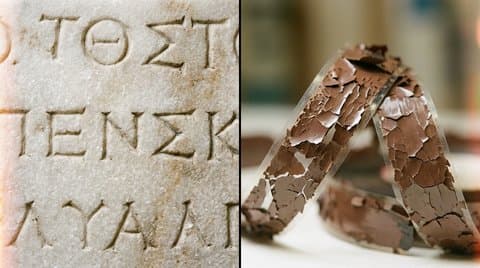 Macro comparison of chiseled marble versus flaking magnetic tape
Look closely at the macro photographic comparison above. On the left, the mineral lattice of calcium carbonate: dense, stable, crystallized under tectonic pressure millions of years before Athens was founded. The incision made by the chisel is a negative volume—a physical alteration of topography that remains legible even if the surface is scorched by soot or buried in wet soil.
On the right, notice the flaking tape ribbon suffering from sticky-shed syndrome. In digital storage, information is not carved into substance; it is stored as an impermanent state of microscopic excitation.
In magnetic storage, it is the alignment of microscopic magnetic domains in an iron oxide emulsion. In optical media, it is the optical reflectivity of an organic dye layer that breaks down under ultraviolet light. In solid-state flash memory, it is a few dozen electrons trapped inside the floating gate of a silicon transistor.
The Digital Information Entropy Funnel: Mechanical Creation → Proprietary Encoding → Physical Media Degradation (Charge Leakage / Hydrolysis) → Hardware Reader Obsolescence → Total Textual Silence
When flash memory is disconnected from electrical power and stored on an office shelf, those trapped electrons gradually tunnel through the thin silicon oxide insulation layer. Within two or three years in a warm room, the electrical potential decays past the sensing threshold. The drive does not present an error message warning of impending decay; it simply presents an unreadable, unmountable block of corrupted bytes. The text has not merely been erased; its physical carrier has forgotten that it ever contained a thought.
The Fragility of the Software Hermeneutic
Even if the physical bits on a magnetic or optical carrier could be preserved in perfect cryogenic suspension for two centuries, the digital text faces a secondary catastrophe that stone and parchment never encounter: the death of the interpretative machine.
To read an inscription on stone, a human being requires only their biological eyes and an understanding of the grammar and vocabulary of the language. To read an electronic document written in 1995, however, a researcher requires an entire archaeological pyramid of computational machinery:
A physical drive mechanism capable of spinning the obsolete cartridge.
A controller card compatible with bus standards that were deprecated in 1998.
An operating system written for CPU instruction sets that are no longer manufactured.
A software application capable of parsing proprietary, undocumented binary file formats whose creators went bankrupt before the turn of the century.
If any single layer in this fragile four-part stack is missing, the digital text is as utterly inaccessible as if it had been thrown into a volcanic crater. In our archives, we routinely encounter researchers weeping over floppy disks from doctoral dissertations completed in 1992. The magnetic oxide is intact, but the WordPerfect 5.1 binary formatting codes, combined with obsolete CP/M file allocation tables, turn the text into an indecipherable mosaic of scrambled punctuation.
The Ethical Call of Lapidary Gravity
When Callimachus of Cyrene compiled the Pinakes in the Great Library of Alexandria in the third century BCE, he understood that a library is not merely a warehouse of scrolls; it is a conscious architecture against oblivion. He classified human thought not by the speed at which it could be produced, but by the gravity with which it could be preserved.
Our civilization has done the reverse. We produce billions of words of synthetic, fleeting text every twenty-four hours—emails, instant messages, synthetic summaries, promotional articles, regulatory drafts—and we consign them to digital infrastructure designed to survive no longer than the quarterly accounting cycle of a cloud hosting provider.
We believe we are documenting everything, but future historians will view the early twenty-first century as a catastrophic "Digital Dark Age"—an era that left behind millions of tons of e-waste and discarded server racks, but remarkably few legible records of what its people truly believed, loved, and feared.
Perhaps it is time to rediscover the moral discipline of the chisel.
When you know that every letter you inscribe into Pentelic marble requires fifteen minutes of muscular labor, hammer blows, and physical sweat, you do not carve frivolous marketing drivel or unverified corporate press releases. You carve only that which is worth defending against three thousand years of winter frost, barbarian invasions, and the relentless indifference of time. The stone demands that we think before we write; and in that heavy, quiet resistance lies the salvation of human memory.