What the Roots Remember Under Drought
In late August, the clay hillsides of the Baixo Alentejo bake into a crust hard enough to ring under the steel blade of a mattock. At midday, the air temperature in the shade of the holm oaks reaches forty-three degrees Celsius, and the relative humidity drops below twelve percent. For fourteen weeks, not a single millimeter of rain has fallen from the brassy Iberian sky.
According to the telemetry dashboards sold by precision-agriculture vendors in Lisbon and Madrid, this landscape ought to be biologically dead. Their wireless capacitance probes, buried thirty centimeters in the upper topsoil horizon, register zero plant-available moisture. The automated alerts flash red on the tablet screen, instructing the landowner to open solenoid valves, pump fossil groundwater from two hundred meters down, and inject water-soluble ammonium nitrate into drip lines.
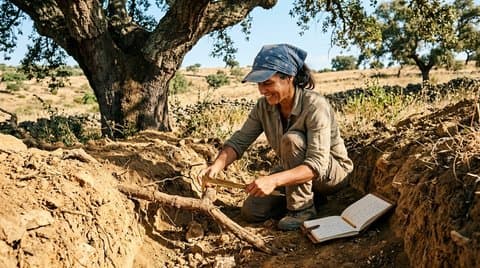
Yet when I climb down into the three-meter geological observation trench we excavated beside a two-hundred-year-old cork oak (Quercus suber) on our experimental dryland station outside Évora, my fingers encounter something that no shallow dielectric sensor can perceive. Three meters beneath the parched surface dust, wedged into fissures of fractured Paleozoic schist, the primary taproot is cool to the touch. Surrounding its suberized cortex is a felt-like sheath of ectomycorrhizal fungal hyphae—Pisolithus tinctorius—glistening with microscopic films of condensed water lifted overnight from the deep phreatic table.
The tree is not dying. It is executing a slow, silent hydraulic symphony rehearsed over ten million Mediterranean summers.
The Hydraulic Lift and the Subterranean Commons
Modern industrial agronomy treats a plant as a passive mechanical wick sitting in a pot of inert mineral sand: pour water and dissolved salts in at the top, harvest biomass at the crown. This reductionist model works on a spreadsheet for five years, until the shallow root zone salinizes, the aquifer drops below the pump intake, and the soil structure collapses into wind-blown dust.
A perennial Mediterranean forest-pasture—what we in Portugal call the montado and our Spanish neighbors call the dehesa—operates by an entirely different physical logic. An adult cork oak or holm oak invests up to seventy percent of its early photosynthetic carbon not in vertical trunk growth, but in driving a lignified sinker root straight down through weathered bedrock fractures, sometimes reaching depths of twelve to fifteen meters.
Below the sun-baked clay of the A and B soil horizons lies the saprolite—the chemically weathered zone of fractured slate, granite, and Paleozoic schist that acts as a hidden subterranean reservoir. Winter rains that infiltrate past the upper root zone percolate slowly into these narrow lithic joints, shielded from the fierce evaporative pull of the summer wind. While a shallow-rooted industrial crop sees only the upper forty centimeters of soil and panics the moment June arrives, the deep-rooted oak treats the entire geological profile as a multi-layered bank account, drawing conservatively on surface moisture in April and switching almost entirely to deep rock-held water from July through September.
Ecological Dimension | Deep-Rooted Perennial Montado (Quercus suber) | Shallow Precision-Irrigated Monoculture |
|---|---|---|
Rooting Architecture | Dimorphic system: lateral surface roots + 12m bedrock taproots | Superficial fibrous root mat confined to upper 40 cm drip zone |
Nocturnal Water Balance | Passive hydraulic redistribution lifting deep water to upper soil | Zero nocturnal recharge; continuous evaporative salt accumulation |
Hormonal Drought Response | Early root-to-shoot abscisic acid (ABA) stomatal regulation | Artificial turgor maintenance until sudden catastrophic xylem cavitation |
Mycorrhizal Symbiosis | Dense ectomycorrhizal mantle expanding effective absorptive area 100x | Suppressed fungal colonization due to synthetic phosphate and fungicides |
Multi-Decadal Resilience | Survives 5-year multi-annual drought cycles without external input | Total crop failure within 72 hours of irrigation pump or grid outage |
During the heat of the day, the oak partially closes the microscopic stomatal pores on the underside of its leathery, wax-coated leaves, arresting transpiration before the tension in its water-conducting xylem vessels reaches the threshold of cavitation. Then, after sunset, when the stomata seal shut and atmospheric demand falls to zero, an extraordinary phenomenon begins.
Driven by water potential gradients, the deep taproot continues drawing moisture from the damp fractured rock far below and releases it passively through its shallow lateral roots into the dry upper thirty centimeters of topsoil. Ecologists call this hydraulic redistribution. In a single August night, a mature oak can lift between forty and eighty liters of water into the upper rhizosphere, keeping its mycorrhizal fungal partners alive, hydrating neighboring native pasture grasses, and sustaining the nitrogen-fixing bacteria that will feed the tree when the October rains finally return.
Epigenetic Memory in the Xylem Wall
 Cross-section of cork oak root beside handwritten botanical field ledger
Look at the cross-sectional root specimen resting beside my field ledger above. Notice the tight, dense bands of late-wood xylem vessels formed during the severe droughts of 2005 and 2017.
A tree does not forget a drought. When a juvenile seedling grows up under the pampered regime of daily automated fertigation, it builds wide, thin-walled xylem conduits optimized for maximum hydraulic conductivity. The moment water is interrupted, air bubbles are sucked across the pit membranes—an embolism that permanently blocks water transport, killing the branch.
A dryland seed grown in unirrigated clay, by contrast, undergoes profound physiological and epigenetic conditioning during its first three summers of water stress. Histone modifications and DNA methylation patterns along stress-responsive genes remain permanently primed. The tree constructs narrower, thick-walled tracheids reinforced with dense lignin; it accumulates osmolytes like proline and trehalose in its living parenchyma cells to hold onto intracellular water against minus four megapascals of soil suction; and its roots synthesize abscisic acid at the earliest whisper of soil drying, sending a chemical telegram up the sap stream to throttle leaf transpiration days before the leaves show any visible sign of wilting.
The Dryland Physiological Survival Pathway: Deep Schist Capillary Suction → Root-Tip Abscisic Acid Synthesis → Xylem Sap Chemical Signaling → Guard-Cell Potassium Efflux & Stomatal Closure → Nocturnal Hydraulic Redistribution
This is biological intelligence in its purest, most durable form. It requires no lithium batteries, no cellular LoRaWAN gateways, no cloud subscription fees, and no venture capital. Its code is written in suberin, lignin, and mycorrhizal chitin.
What the Peasant Knew Before the Dashboard
Forty years ago, before European agricultural subsidies incentivized the ripping up of traditional dryland olive groves to plant hyper-intensive irrigated hedgerows, I used to walk these hills with my grandfather, Joaquim. He could not read English, and he never owned a moisture meter. Yet his knowledge of soil physics was more exact than any agronomic model I encountered during my doctoral work in Montpellier.
In March, before the spring weeds could go to seed and transpire the winter rain stored in the clay, he would pass a shallow blade just five centimeters beneath the surface—breaking the capillary channels through which subsoil moisture wicked upward to evaporate in the sun, creating what dryland farmers call a dust mulch. He spaced his olive and almond trees twelve meters apart, knowing that in a region of four hundred millimeters of annual rainfall, the horizontal root canopy must be three times wider than the leafy crown above.
When the agricultural extension engineers arrived in the nineties with their subsidized drip lines and high-density clone varieties, they mocked those wide spacings as "underutilized land." They planted two thousand trees per hectare where Joaquim planted eighty. For fifteen years, the yields were spectacular—for as long as the ancient fossil aquifer beneath the basin had water left to give.
Today, those high-density orchards are dying in bleached, brittle rows. The wells have gone brackish; the energy cost of pumping water from three hundred meters exceeds the market price of the olive oil; and the shallow, chemical-fed roots have no idea how to search for moisture in dry rock. Two hundred meters away, Joaquim’s widely spaced, unirrigated centenary trees are heavy with green fruit, their deep roots drinking quietly from the dark fissures of the earth.
The Courage to Trust Biological Time
Our technological civilization is terrified of slowness, and even more terrified of limits. Faced with an arid climate, our reflex is never to adapt our appetite to the carrying capacity of the watershed; it is to add another layer of digital instrumentation so that we can extract the very last drop of water with mathematical efficiency before the basin collapses.
Efficiency without restraint is merely an accelerator of exhaustion.
True ecological resilience cannot be purchased in a hardware catalog. It resides in the humble patience of the dryland peasant who leaves half the field fallow to rest; it resides in the dark symbioses of fungi and tree roots exchanging sugars for phosphorus in the dark; and it resides in the biological memory of living systems that have learned, through millennia of scarcity, how to endure the sun and wait for the rain.