
What the Functional Scan Reveals at Midnight
At twenty past three in the morning, the clinical reading room in the neurology wing of Karolinska University Hospital is wrapped in an uncompromising silence. The heavy sound-insulated door shuts out the murmur of the central corridor, leaving only the faint, low-frequency hum of the transformer banks feeding the magnet room down the hall. On the twin calibrated monitors before me, sixteen cross-sectional slices of a thirty-four-year-old human brain glow in high-contrast grayscale.
The patient—a senior infrastructure engineer who collapsed at his standing desk during a thirty-six-hour global incident triage—did not suffer an ischemic stroke or a ruptured intracranial aneurysm. The vascular trees of his middle cerebral arteries are clear, free of thrombi, unblemished by dissection. Yet his blood-oxygen-level-dependent (BOLD) functional signals tell an unmistakable, devastating story. Where the resting-state functional connectivity of a healthy mammalian brain exhibits a rhythmic, tidal ebb and flow between task-positive executive networks and the Default Mode Network (DMN), this scan presents a landscape of continuous, chaotic desynchronization.
The cortex is not a silicon substrate that can simply be clocked higher by providing clean line voltage and adequate fan airflow. It is a wet, fragile metabolic organ, heavily dependent on circadian pulses of cerebrospinal fluid, enzymatic housekeeping, and genuine physical rest. When sustained digital stimulus denies the brain its nocturnal metabolic reset, the biological machinery of thought does not degrade gracefully; it fractures along deep, non-negotiable evolutionary fault lines.
The Default Mode Network and the Illusion of Idle Time
For decades, classical neuroanatomy treated the resting brain as an inactive engine running in neutral. We now understand that the Default Mode Network—anchored in the medial prefrontal cortex, posterior cingulate cortex, and precuneus—is the most metabolically demanding system in human consciousness. It is the architect of autobiographical coherence, moral deliberation, ethical contextualization, and the consolidation of daily experiential traces into durable semantic memory.
When a human being steps away from a terminal, gazes out of an open window, or listens to rain against a windowsill without an external target, the DMN activates. It breathes. It restores internal equilibrium by integrating disparate emotional and factual signals acquired during focused exertion. But in an occupational regime where every interstitial minute is populated by backlit glass—push notifications, synchronized task dispatchers, chat threads scrolling at five lines per second—the brain never transitions into resting-state coherence.
Synchronized Circadian Equilibrium vs. Chronic Digital HypervigilanceDimension | Synchronized Circadian Architecture | Fragmented 24/7 Digital Hypervigilance |
|---|---|---|
DMN Connectivity | Coherent low-frequency oscillations (0.01–0.1 Hz) during resting wakefulness | Desynchronized functional coupling; perpetual dorsal attention suppression |
Glymphatic Clearance | High-amplitude cerebrospinal interstitial flushing during Stage 3 NREM | Truncated convective flow; interstitial retention of amyloid-beta and tau |
Prefrontal Perfusion | Restored morning blood-oxygen saturation across Brodmann areas 9 and 46 | Hypoperfusion of executive circuits accompanied by compensatory hyperarousal |
Micro-Arousal Burden | < 5 spontaneous physiological shifts per sleep cycle | 25–45 cortical micro-awakenings per hour induced by blue-light melatonin arrest |
Clinical Presentation | Intact working memory span; nuanced emotional regulation and moral stamina | Postural tremor, proprioceptive drift, severe anhedonia, and affective flattening |
The table above is not a theoretical abstraction compiled from wellness surveys; it is the forensic reality we observe when comparing healthy baseline cohorts with professionals subjected to uninterrupted on-call schedules. The dorsal attention network, designed for brief bouts of predatory alert or crisis avoidance, remains perpetually locked in the on position. The DMN, starved of metabolic bandwidth, begins to atrophy in its functional coupling. The patient does not merely feel tired; they lose the subjective continuity of the self.
When the Night Reading Refuses to Sleep
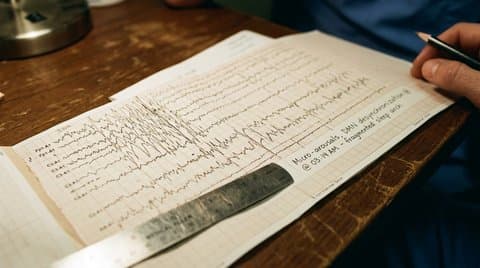 Clinical continuous EEG recording showing sleep fragmentation
Examine the continuous electroencephalogram strip recorded from our patient during his mandatory observation night. At first glance, a superficial observer might note periods of what appears to be stage 2 non-rapid eye movement (NREM) sleep. But look closely at the pencil annotations tracking across channels Fp1-A1 and C3-A1.
Every three to four minutes, a burst of high-frequency beta wave intrusion shatters the incipient delta rhythm. These are cortical micro-arousals. The patient’s eyes remain closed; his breathing does not arrest; he does not sit upright in bed. Yet his central nervous system acts as though a siren had sounded at the bedside. The sympathetic tone spikes, heart rate variability collapses, and the delicate neurochemical transition toward Stage 3 slow-wave sleep is instantly aborted.
The Neuro-Pathological Degradation Cascade: Retinal Blue Photons & Anticipatory Micro-Alerts → Melatonin Suppression & Sympathetic Overdrive → Fragmented Delta Wave Architecture → Interstitial Glymphatic Arrest → Synaptic Downregulation & Emotional Anhedonia
This cascade explains why sleep aids and sedatives fail so comprehensively in treating digital exhaustion. Hypnotic agents like zolpidem or benzodiazepines can force sedation; they can quiet the gross motor output of the skeletal muscles and induce an unresponsiveness that resembles slumber to an outside onlooker. But they do not restore slow-wave delta synchronization. In fact, they frequently suppress the very slow-wave amplitudes required to drive convective interstitial fluid through the brain tissue. The patient wakes with sixteen hours of chemical unconsciousness on the chart, yet histologically and metabolically, their cortex remains as encumbered by metabolic waste as if they had spent the entire night marching across an arctic tundra.
The Glymphatic Tide and the Mechanics of Debris
In 2012, Maiken Nedergaard and her colleagues at the University of Rochester demonstrated that the vertebrate brain possesses a dedicated waste clearance mechanism: the glymphatic system. Unlike peripheral tissues, which rely on extensive lymphatic vessels to sweep away cellular detritus, the central nervous system is enclosed within a rigid skull box. It cannot afford the hydraulic expansion that lymphatic drainage requires.
Instead, nature engineered an astonishing convective fluid exchange. During deep slow-wave sleep, glial cells—specifically astrocytes expressing aquaporin-4 water channels along their endfeet—shrink their cellular volume by nearly sixty percent. This sudden widening of the interstitial space allows cerebrospinal fluid (CSF) to surge through brain parenchyma like a clean subterranean river, flushing out metabolic waste products that accumulate during wakeful synaptic transmission. Among these metabolites are monomeric amyloid-beta, phosphorylated tau proteins, and extracellular lactate.
When a professional works through the night under the glare of calibrated 4K monitors, this river never runs. The astrocytes remain swollen, barricading the interstitial channels. The convective fluid pulse does not materialize. Day after day, week after week of fragmented micro-rest leaves neurotoxic residues lingering around synaptic terminals, degrading receptor sensitivity and promoting local microglial inflammatory responses.
When we observe these patients in the clinic, their cognitive profile mirrors the early stages of traumatic encephalopathy. They report an inability to read a dense technical paragraph without their eyes slipping repeatedly off the page; they lose the capacity to weigh deferred risk against immediate reward; they experience a flat, pervasive anhedonia that drains joy from music, food, and human conversation. They are not suffering from a character deficit or a failure of willpower. Their synapses are quite literally drowning in unwashed metabolic waste.
The Rejection of the Silicon Metaphor
In popular engineering culture, it has become fashionable to speak of the human central nervous system as a computing machine. People talk of "bandwidth," of "downloading context," of "depleted memory buffers," and of "optimizing cognitive throughput."
As a clinical neurologist who spends her nights examining damaged nerve tissue, I must state with all the empirical force at my disposal: this metaphor is catastrophic nonsense.
A central processing unit is an inorganic array of etched silicon gates. It does not possess an immune system. It does not synthesize its own neurotransmitters in vesicles that must be transported down axon tubes via kinesin motors. It does not rely on an enzymatic balance between glutamate and gamma-aminobutyric acid to prevent seizure activity. Above all, a CPU does not experience the existential horror of feeling its own capacity to love and comprehend quietly slip away under the assault of twenty-four-hour on-call rotations.
When we treat living nervous tissue as if it were a server blade that merely requires more energy drinks and brighter display backlights to maintain throughput, we commit a violent category error. The brain is not an engine; it is a delicate ecosystem evolved over half a billion years to function in concert with the rising and setting of the sun, the tactile resistance of physical materials, and the deep, restorative dark of the natural night.
Clinical Prescriptions for the Post-Digital Body
What, then, is the clinical response when an engineer, a jurist, or an architect is carried into our triage ward with functional desynchronization?
We do not prescribe nootropics. We do not recommend wearable trackers that gamify sleep stages into anxiety-inducing scores. We begin with the restoration of biological boundaries:
The Absolute Dark of the Fourth Hour: The human bedroom must be restored as an unmonitored sanctuary. No glowing standby LEDs, no vibrating handsets within arm's reach, no ambient backlit screens within ninety minutes of lying down. The suprachiasmatic nucleus must receive the unequivocal photic signal of total dusk to trigger the endogenous melatonin cascade.
The Reinstatement of Non-Instrumental Idleness: Daily life must incorporate intentional periods where the brain is given permission to wander without an agenda. Walking through an autumn forest, sitting on a bench in silence, peeling an orange with one's fingers—these are not lost hours; they are the metabolic prerequisite for DMN functional coherence.
The Acceptance of Biological Limits: No corporate infrastructure incident, no venture capital milestone, and no algorithmic benchmark justifies the chronic suppression of the glymphatic tide. When the body signals fatigue through postural drift and prefrontal heaviness, it is delivering an evolutionary mandate: lay down your tools, extinguish the light, and allow the quiet work of restoration to begin.
I sign the discharge summary for our engineer at dawn. Outside the hospital window, the gray morning light of Stockholm begins to filter through the bare birch trees along the canal. Down in the courtyard, the autumn wind rustles through damp leaves. His scans will be archived in the Karolinska database, a clinical testament to what happens when we demand of the human spirit that it burn without pause in the artificial day.