What Survives a Century in Stone
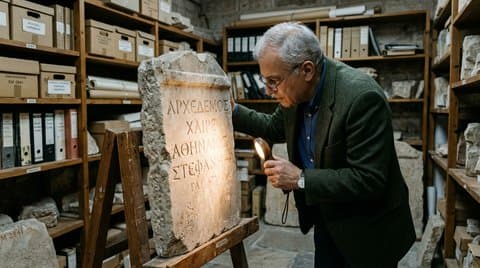
On a damp Thursday afternoon in the stone conservation basement of the Ashmolean Museum in Oxford, I spent three uninterrupted hours directing a narrow beam of raking amber light across the broken face of a fifth-century BCE Pentelic marble stele. To an untrained visitor hurrying past the glass cases upstairs, the grey Attic stone appears worn smooth by twenty-four centuries of Mediterranean wind and rain. Yet when the halogen lamp drops to a twelve-degree grazing angle across the crystalline surface, shallow triangular incisions spring suddenly out of the marble shadow: crisp Greek letterforms—alpha, theta, sigma—cut by a human mason’s iron chisel more than two thousand four hundred years ago. The stone requires no electrical power supply, no software license, and no backward-compatible file codec to be read. It waits patiently in the dark until a pair of eyes and a gentle angle of light arrive.
We inhabit a historical paradox of unprecedented fragility. Our civilization generates more written words, technical records, legal decrees, and private correspondence in a single Tuesday afternoon than classical antiquity produced across five centuries. Yet almost none of it is entrusted to durable matter. We have committed the entire intellectual archive of the twenty-first century to shifting magnetic domains on spinning metal platters, fragile solid-state NAND flash cells whose trapped electrons bleed away over a decade without power, and proprietary cloud object stores whose survival depends upon uninterrupted corporate solvency and monthly billing cycles. For the first time since the invention of the alphabet, humanity is building a record of itself engineered to evaporate within a single human lifetime.
The Epigraphic Squeeze and Material Honesty
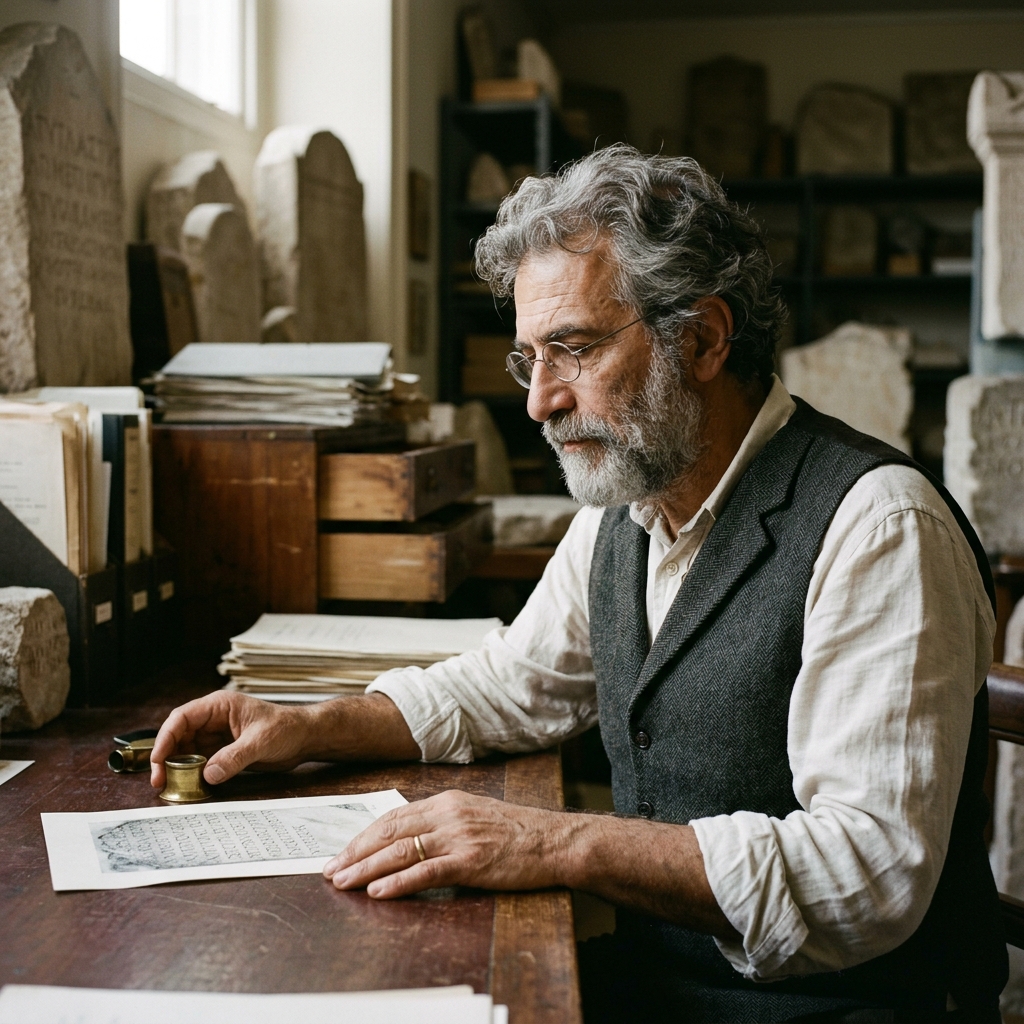
In classical epigraphy, before a scholar dares publish a transcription of a damaged inscription, we execute a remarkably humble, tactile ritual: the epigraphic squeeze. We moisten a sheet of thick, unsized filter paper with clean water, lay it flat over the weathered marble face, and beat it rhythmically with a stiff boar-bristle stippling brush until the wet cellulose fibers are driven deep into every microscopic chisel mark and crystalline fracture. Once the paper dries stiff under ambient air, it peels away as an exact, mirror-reversed three-dimensional casting of the stone—so durable that nineteenth-century squeezes stored in wooden cabinets in Athens and Berlin preserve inscriptions whose original marble blocks were subsequently shattered in wartime bombing or eroded by modern urban acid rain.
Archival Medium | Physical Mechanism | Passive Unpowered Lifespan | Primary Mode of Failure |
|---|---|---|---|
Pentelic Marble & Granite | Mechanical chisel incision into crystalline lattice | 2,500 to 5,000+ years | Structural fracture, acid erosion, lime-kiln reuse |
Rag Paper & Carbon Ink | Cellulose fiber entanglement with iron-gall or soot | 400 to 1,000 years | Moisture rot, fire, acid lignin degradation |
Magnetic Tape (LTO) | Polarized iron-oxide particles on polyester ribbon | 15 to 30 years | Binder hydrolysis, demagnetization, drive obsolescence |
NAND Flash / SSDs | Electron charge trapped inside floating-gate oxides | 2 to 10 years unpowered | Thermal charge leakage and silent bit rot |
Cloud Object Storage | Distributed RAID arrays under continuous power | 0 days after billing default | Corporate insolvency, format abandonment, key loss |
Notice the downward trajectory of physical endurance across that table. Every leap forward in storage density and retrieval velocity has been purchased at the direct expense of thermodynamic longevity. A clay tablet baked accidentally in the library fire at Ashurbanipal’s palace in Nineveh survived nearly three millennia precisely because heat vitrified the clay. A modern enterprise solid-state drive left unplugged inside a desk drawer in London for eight years loses its trapped gate electrons silently, turning a decade of human labor into unreadable randomized entropy.
Bit Rot and the Illusion of the Eternal Cloud
Software engineers speak reassuringly of redundancy—three geographic availability zones, automated checksum scrubbing, and multi-generational tape migrations. In theory, digital preservation solves material decay through continuous active copying.
The Textual Entropy Trap: Format Obsolescence → Media Degradation (Bit Rot) → Unmigrated Cryptographic Keys → Silent Cultural Amnesia
In reality, active copying is a fragile civilizational dependency, not an archival guarantee. A digital file survives only so long as an unbroken chain of human institutions pays the electricity bill, replaces failing drives every forty-eight months, preserves the exact proprietary schema required to parse the binary stream, and remembers the cryptographic decryption keys. Break a single link in that administrative chain—through war, sovereign bankruptcy, corporate acquisition, or simple bureaucratic neglect—and the entire archive vanishes far more completely than any parchment burned in antiquity.
 Dried white molded epigraphic paper squeeze with embossed Greek uncial lettering and brush
Even the scorched, carbonized papyrus rolls excavated from the Villa of the Papyri in Herculaneum—buried under volcanic pyroclastic mud in 79 CE—retained the physical presence of Philodemus’s Epicurean treatises inside lumps of charcoal until twenty-first-century synchrotron X-ray phase-contrast tomography could read the subtle density relief of carbon ink without unrolling the brittle ash. Stone and ash forgive centuries of silence. Magnetic media and encrypted cloud buckets demand perpetual maintenance or vanish into absolute noise.
Why Slow Mediums Discipline Human Thought
There is a deeper intellectual consequence to our abandonment of durable physical media beyond mere archival survival. The physical resistance of the medium shapes the moral weight of the sentence.
When an Athenian mason lifted an iron chisel to carve an assembly decree or a funerary epigram into Pentelic marble, every letter demanded physical labor, deliberate spacing, and permanent commitment. One could not publish three thousand unedited drafts of trivial opinion before noon; one had to decide what deserved to endure after the author’s bones were dust. Even later, when medieval scribes scraped precious calfskin vellum with pumice stone to create palimpsests, the sheer material cost of parchment filtered out ephemeral chatter and forced generations to wrestle with texts worthy of preservation.
"A society that entrusts its highest laws, literature, and memory exclusively to weightless electrical impulses begins unconsciously to treat truth itself as temporary, infinitely editable, and disposable."
When writing costs zero physical resistance, language suffers hyperinflation. Millions of synthetic essays, automated summaries, and ephemeral social broadcasts flood across fiber-optic cables each hour, read by no one and forgotten before dusk. Because nothing costs stone or ink, nothing feels obliged to carry the dignity of stone or ink.
Keeping Faith with Future Eyes
None of us expects modern governments or universities to carve quarterly scientific journals onto marble steles across Attica. Digital networks are indispensable instruments for immediate correspondence and global calculation. What we must abandon is the hubris of believing that electronic convenience equals historical permanence.
If our century wishes to leave behind an intelligible testament rather than an archaeological blank space between 2000 and 2050—what future historians may bitterly label the Digital Dark Age—libraries, national archives, and serious writers must deliberately re-anchor essential human records in stubborn, non-volatile matter:
Acid-Free Archival Print: Every foundational legal treaty, scientific monograph, literary work, and historical chronicle worth preserving must exist in multiple physical copies printed on cotton rag paper with stable carbon ink, distributed across decentralized regional libraries.
Offline Human-Readable Micro-Etching: Critical civilizational datasets and public-key infrastructures should be etched physically onto nickel plates or fused quartz glass readable under simple optical magnification, requiring zero operating systems or proprietary decoders.
Sovereign Stewardship Over Convenience: Cultural institutions must cease treating physical book stacks and paper repositories as obsolete real estate liabilities to be discarded in favor of rented digital subscriptions that can be revoked or silently altered overnight.
Before leaving the basement gallery, I turn off the raking halogen lamp and slide the wooden door shut behind me. Inside the dark stone storeroom, the fifth-century Greek stele needs nothing from us—no cooling fans, no firmware patches, no monthly cloud renewal. It will wait quietly in the stone dark for another thousand years, faithful to the mason’s hand, ready for whoever arrives next with a lamp and the patience to read.