
Under the Floorboards with a Blowtorch
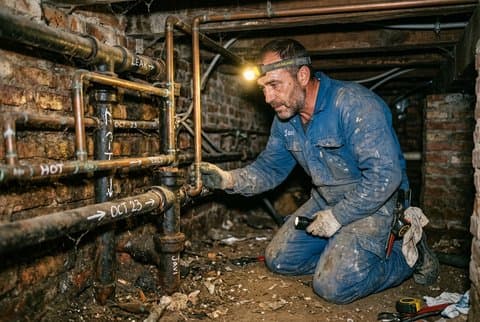
There is a particular kind of darkness that exists only forty centimeters beneath the suspended floorboards of a residential building constructed in 1968. It is not the clean, photographic darkness of an auditorium after the house lights dim, nor the cool, sterile darkness inside a server rack when the cabinet door clicks shut. It is a dense, mineral gloom compounded of pulverised brick dust, dry plaster, spider silk, and the faint, persistent sulfurous odor of decaying cast iron. When you pull yourself forward on your elbows, dragging a heavy canvas tool roll and a portable butane cylinder across the rubble, your forehead grazing the underside of the floor joists while footsteps rumble overhead like distant thunder, all the speculative abstractions of the contemporary world dissolve with astonishing velocity.
Upstairs, on the parquet floor, someone is speaking into a noise-canceling headset about cloud infrastructure, serverless latency, and continuous deployment. Down here, wedged between a crumbling foundation wall and a 110-millimeter horizontal sewer collector, the only cloud that matters is the grey vapor of sewer gas waiting behind an unseated seal, and the only deployment that exists is the physical delivery of six bars of pressurized municipal water through an oxidized copper elbow that was soldered three decades before the building’s current tenants were born.
The city above our heads believes it lives in an ether of information. It produces quarterly sustainability reports, models its emissions on digital twins, and assumes that because invoices and financial transfers are routed through subsea optical fiber, the civilization that hosts them has somehow emancipated itself from matter. But the city does not rest on code. It rests on gravity, atmospheric pressure, and the stubborn electrochemical behavior of transition metals. If a software engineer pushes a buggy commit to a remote repository, a rollback script can revert the state in thirty seconds. If a plumber overlooks a hairline crack in a soldered brass tee under seven atmospheres of static pressure, twelve thousand liters of boiling water will carve through the plasterboard ceiling by four in the morning, short-circuit the building’s distribution board, and render six apartments uninhabitable before breakfast.
Matter does not accept rollbacks. It does not read marketing decks, and it has never once agreed to renegotiate the second law of thermodynamics.
The Chemical Brutality of the Crawlspace
When you work with pipework long enough, you cease to see a building as an assemblage of rooms, rents, and aesthetic facades. You see it as a complex thermodynamic animal: an organism of continuous intake and violent evacuation, laced with arterial networks of pressurized domestic cold water, venous circuits of central heating, and cavernous, gravity-fed digestive tracts through which the metabolic waste of hundreds of human bodies must descend without lingering.
[Street Main: 6.5 Bars]
│
▼
┌────────────────────────┐
│ Pressure Reducing Valve│  (Static Calibration)
└────────────────────────┘
│
├───► [Copper Domestic Riser: 18mm]
│           │
│           ▼
│     (Thermal Expansion)
│           │
▼           ▼
┌────────────────────────────────────────────────────────┐
│ Crawlspace Junction: Dissimilar Metal Interface        │
│ Copper Tube (Cathode) + Galvanic Ferrous Union (Anode) │
└────────────────────────────────────────────────────────┘
│
▼
[Subterranean Discharge: Siphon P-Trap]
Every foot of pipe buried beneath the floorboards is engaged in a silent, unrelenting war against its environment. The primary weapon in this war is galvanic corrosion—a quiet, pitiless form of chemical suicide that occurs whenever two dissimilar metals are joined in the presence of an electrolyte like hard tap water. Join a modern piece of copper tube directly to an older galvanized iron riser without a dielectric union, and the copper will systematically devour the iron atom by atom, turning the pipe wall into a friable, crumbly sponge of rust while the outer surface appears completely intact.
Dimension | The Cloud Architecture | The Subterranean Sanitary Slab |
|---|---|---|
Primary Medium | Ephemeral optical pulses & virtual memory allocations | Heavy copper, lead, brass, and cast iron |
Failure Mode | Network timeouts, packet drops, software exceptions | Physical bursting, structural hydraulic rupture, rot |
Remediation Speed | Automated rolling restart via container orchestration | Arduous crawl on elbows with torch and hacksaw |
Feedback Loop | Abstract telemetry dashboards & error rate graphs | The visceral hiss of boiling steam & acoustic vibration |
Material Degradation | Zero wear on logical state; rapid silicon obsolescence | Pitiless electrochemical oxidation & mineral scaling |
Accountability | Distributed across vendors, microservices, and SLAs | Personal, binary, sealed with flux and molten tin |
In the crawlspace, there is no ambiguity about where the boundary of responsibility lies. You cannot blame upstream third-party dependencies when an installation leaks. Either the solder flowed completely around the socket through capillary action, or it did not. Either the fall on the waste pipe is precisely one point five centimeters per linear meter, or solids will settle, water will outrun them, and the system will choke on its own contents within six months.
Capillary Action and the Dignity of Fire
To make a soldered joint in copper is to participate in an ancient, tactile discipline where physics and manual patience converge. You cut the pipe square with a wheeled tube cutter, deburr the inner lip with a reamer until there is no restriction to fluid flow, and scour both the fitting and the tube with abrasive nylon wool until the metal shines with the raw, pinkish-orange brilliance of newly minted currency. Any speck of dust, any grease from a fingertip, any trace of moisture inside the pipe will ruin the joint instantly. Water in a pipe will absorb the heat of the blowtorch indefinitely, generating steam that blows pinholes through the molten solder before it can set.
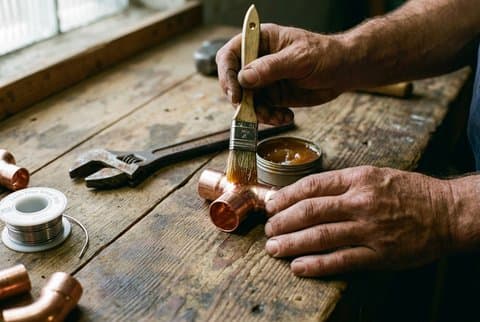 Plumber applying flux paste to copper pipe
Once the surfaces are pristine, you paint them with zinc chloride flux paste. The flux does not act as glue; it is an aggressive chemical scavenger that etches away the immediate microscopic oxide film that forms on bare copper when exposed to air. Then you light the butane torch.
The flame must not touch the solder. This is the first lesson every apprentice must learn through humiliation and wasted material: you do not melt solder with the fire of the torch. You heat the copper fitting until the metal itself reaches the melting point of the silver-tin alloy—roughly two hundred and thirty degrees Celsius. When the temperature is exact, you touch the wire to the seam opposite the flame.
What happens next feels miraculous even after twenty-four years of doing it in the mud. By capillary action, the molten alloy is drawn into the microscopic clearance between the socket and the tube against the pull of gravity, wrapping itself around the circumference in a continuous, silver ring of absolute hermetic sealing. It is a clean, permanent fusion of crystalline lattices.
The Galvanic Decomposition Pathway: Electrolyte Saturation → Anodic Electron Transfer → Intercrystalline Dezincification → Structural Wall Perforation → Uncontained High-Pressure Rupture
When the joint cools, you wipe away the corrosive flux residue with a damp rag. The joint will hold seven bars of pressure for fifty years without supervision. It will outlast the operating system on the laptop of the executive upstairs, it will outlast the company he works for, and it may well outlast the currency in which he is paid.
The Spectral Fatigue of the Intangible
Why is it that our culture holds the person who configures a virtual routing table in vastly higher esteem than the person who solders the hydraulic circulation lines of a hospital?
The sociologist Matthew Crawford noted in Shop Class as Soulcraft that modern white-collar work often induces a peculiar form of psychological unease: an unanchored exhaustion born of manipulating symbols whose connection to reality is entirely mediated by bureaucratic whim. The knowledge worker spends eight hours a day in a state of suspended epistemic uncertainty. Was the presentation good? Did the marketing campaign succeed? Did the sprint deliver value? The answers depend entirely on the shifting opinions of managers, client metrics, and corporate politics. There is no independent, objective test of reality against which the worker can verify the integrity of their effort.
In contrast, the craftsman’s relationship with reality is brutal, immediate, and utterly unpretentious. The pipe does not care about your self-esteem, your pedigree, or your communication skills. When you turn on the main stopcock after four hours of soldering in a freezing basement, the pressure gauge rises: two bars, four bars, six bars. If there is a fault, water will shoot across the cellar with the hiss of an angry serpent, mocking your pride. If the work was honest and true, the needles hold steady, the brass valves turn smoothly, and the heat begins to travel silently along the copper tubes into the radiators three floors above.
The fatigue that follows a day of crawlspace plumbing is heavy, muscular, and grounded. It is the exhaustion of an organism that has pushed its physical mass against the weight of the material world and left that world slightly more habitable than it was at dawn. It is an antidote to the derealization that haunts the screen-bound professional: a reminder that before a society can discuss artificial general intelligence, it must first guarantee that the human animal can drink water without ingesting its own effluent.
The Fragility Beneath the Marble
As I pack my tools into the steel cantilever box, blowing out the blowtorch and wiping the soot from the nozzle, I look at the network of pipes running through the shadows of the floor joists. Most of them are invisible to the people who inhabit the structure. They will walk across the oak floors tomorrow morning, turn the ceramic handles of their designer faucets, and take for granted that crystal-clear water at sixty degrees will flow instantly from the shower head.
They believe this miracle is an inherent property of modern life, as natural as sunlight or weather. They do not know that fifteen feet below their breakfast table, an old lead connection is slowly fatiguing under the hydraulic shock of an un-cushioned washing machine valve, or that a brass union is sacrificing its zinc to an acidic soil. They do not realize that the entire edifice of contemporary urban comfort is a temporary truce negotiated between gravity, metallurgy, and the calloused hands of men and women who are willing to crawl through the mud in the dark with a torch.
We are not entering a post-physical world. We are merely living in a culture that has grown dangerously contemptuous of the physical foundations that keep it alive. But down here, under the floorboards, where the butane hisses and the water hammers against the bends, the truth remains invariant: everything that matters has weight, everything that endures requires maintenance, and gravity never forgets a leak.