
Three Thousand Years on Pentelic Marble
When a fifth-century BCE Athenian stonemason pressed his iron chisel into the crystalline face of Pentelic marble on the southern slope of the Acropolis, he was not executing an administrative task; he was entering a covenant with deep geological time. The letters he cut—crisp, geometric uncials recording the alliance between Athens and Rhegion—were carved with a V-shaped stroke angled at precisely forty-five degrees to catch the raking light of the Mediterranean sun.
Twenty-five centuries later, in the basement archive of the Epigraphical Museum on Tositsa Street, I run the tip of a natural bone folder along that same incised stroke. The calcite crystals sparkle under the halogen lamp, sharp and uncorrupted. Beside my workbench hums a high-end enterprise server rack whose magnetic platters and NAND flash blocks will degrade into unreadable entropy within a single human generation unless continuous electrical wattage, temperature regulation, and proprietary operating systems intervene to prevent bit rot.
We congratulate ourselves on having constructed an information society capable of generating zettabytes of data per minute, yet we have entrusted our civilizational memory to the most fragile and ephemeral recording medium ever devised by the human species.
The Physics of Epigraphic Permanence
The durability of an inscription is determined not by the complexity of its encoding scheme, but by the thermodynamic stability of its physical substrate. Pentelic marble is a metamorphic rock composed of pure recrystallized calcite ($CaCO_3$). Under the immense heat and pressure of tectonic folding, limestone undergoes complete recrystallization, forming interlocking mosaic crystals of calcite that resist chemical weathering and mechanical shear.
When ancient legislators in Athens or Gortyn wished to promulgate a treaty or a constitutional code, they chose marble not for its aesthetic luxury, but for its lapidary finality. To publish in antiquity was to carve (anagraphein). Once an Athenian decree was incised into stone, it stood in the Agora as an unalterable civic anchor. It could not be retroactively edited by an executive decree; it could not be purged by an algorithmic update; it could not be revoked without physically smashing the stone with a sledgehammer—an act of sacrilege recorded in historical treaties with explicit legal curses against the defacer.
In contrast, digital memory relies on charge differentials trapped inside floating-gate transistors measured in nanometers. A flash memory cell stores a bit as a cluster of fewer than fifty electrons trapped behind an oxide insulator. Over five to ten years, quantum tunneling causes those electrons to leak into the substrate, corrupting the stored value without external mechanical disruption. The digital record does not require an invading army to be destroyed; it evaporates through the simple laws of statistical mechanics.
Epigraphic Dimension | Ancient Epigraphic Inscription (Pentelic Marble) | Cloud Enterprise Storage (LTO Tape / Solid-State Silicon) |
|---|---|---|
Material Substrate | Metamorphic recrystallized calcite ($CaCO_3$) | Polymer mylar with barium ferrite / NAND floating-gate oxide |
Energy Requirement | Zero watts; passive optical reflectance under ambient light | Continuous electrical grid power for data-center climate control |
Decoding Interface | Human ocular vision & tactile squeeze paper; open literacy | Closed proprietary codecs, device drivers, and firmware layers |
Longevity Half-Life | 2,500 to 5,000+ years without material degradation | 5 to 15 years before bit rot, media delamination, or hardware obsolescence |
Tamper Resistance | Irreversible subtractive physical incision into stone | Trivial, undetectable cryptographic modification of digital bits |
Civilizational Failure Mode | Fracture into durable epigraphic fragments decipherable by archaeology | Catastrophic binary opacity; unreadable magnetic hiss |
The Philological Art of the Epigraphic Squeeze
When an epigrapher confronts a weathered inscription where centuries of wind and water have softened the incision, we do not rely on machine-vision filters. We practice the tactile, meditative discipline of the epigraphic squeeze.
We moisten a sheet of pure rag filter paper with distilled water and lay it across the carved stone. Using a dense horsehair brush, we strike the paper repeatedly with firm, perpendicular blows, driving the wet cellulose fibers deep into every microscopic groove and chisel scratch. As the paper dries under the warm Aegean air, it contracts and hardens into a rigid, three-dimensional cast that captures details invisible to the naked eye.
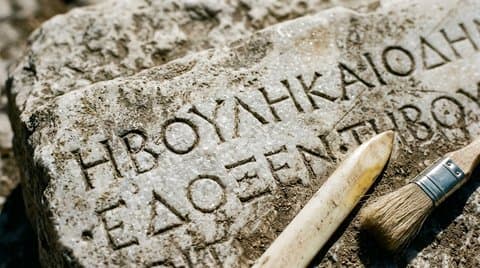 Macro photograph of ancient Greek uncial lettering chiselled into Pentelic marble
When you peel the dry squeeze from the marble, you hold in your hands the exact physical negative of human intention from twenty-four hundred years ago. The squeeze can be folded, mailed in an envelope, studied with raking lamp light fifty years later, and stored in a cedar drawer without requiring a software license or an electrical outlet. It represents a form of literacy that honors the human sensory apparatus instead of bypassing it.
The Deep-Time Epigraphic Preservation Sequence
The persistence of recorded knowledge across millenary timescales requires an architecture that survives the collapse of technological ecosystems:
Phase I: Mineral Extraction & Surface Polishing → Quarrying of homogeneous crystalline Pentelic or Parian marble; dressing with tooth chisels (gradine) to create a planar field devoid of fracture planes. Phase II: Lapidary Drafting & Chisel Incision → Scribe lays out geometric guidelines with ochre cord; master mason cuts V-shaped uncial letterforms at forty-five-degree facet angles; letters filled with vermilion pigment for ocular contrast. Phase III: Boustrophedon & Stoichedon Governance → Texts arranged in grid alignments (stoichedon) where each letter occupies an identical spatial cell; spatial symmetry prevents interpolation or fraudulent erasure. Phase IV: Submersion & Anoxic Burial → Earthquakes, silt, or volcanic tephra bury the stele in anoxic conditions, protecting calcite from atmospheric acid rain for two millennia. Phase V: Epigraphic Recovery & Physical Squeeze → Recovery by modern archaeology; tactile verification via three-dimensional paper squeeze; text restored to the open corpus of human history without proprietary gates.
The Herculaneum Paradox
The tragedy of the modern era was illuminated with extraordinary irony by the recent decipherment of the Herculaneum papyri. In 79 CE, the eruption of Mount Vesuvius buried the Villa of the Papyri beneath twenty meters of boiling volcanic mud. The library of Philodemus—hundreds of Greek philosophical scrolls—was carbonized instantaneously, transformed into fragile lumps of compressed charcoal that turn to dust at the touch of a fingertip.
For eighteen centuries, those carbonized cylinders were considered unreadable. Yet because carbon is chemically inert, the ink—also carbon-based soot suspended in gum water—remained intact within the interior wraps. Today, using synchrotron particle accelerators and X-ray phase-contrast tomography, physicists and classicists can read the thoughts of Epicurean philosophers trapped inside volcanic ash without unrolling the brittle organic fiber.
Consider the contrast: a carbonized scroll preserved by a cataclysmic volcanic eruption can be deciphered after two thousand years, while a digital dissertation written on an optical laser disc in 1998 cannot be read today because the drive interfaces, file formats, and operating system kernels have vanished from commercial distribution. We have engineered a civilizational blackout while mistaking data volume for historical memory.
Cultivating the Mind of the Quarry
To spend four decades reading ancient stone is to develop a profound immunity to the frantic velocity of modern media. The internet creates an illusion of infinite preservation while delivering maximum transience. Platforms delete entire libraries of cultural discourse during corporate restructuring; cloud vendors deprecate APIs without public consultation; links decay at an exponential rate of twenty-five percent every seven years.
If our civilization wishes to communicate anything of lasting value to the generations that will walk the earth three thousand years from now, we must recover the discipline of the lapidary surface. We must ask whether what we write deserves to be carved into the stone of the mountain, or whether it belongs to the fleeting digital flicker that vanishes when the breaker flips.
True civilization does not consist in the ability to produce a billion fleeting impressions per second. It consists in the courage to select what is worthy of endurance, and the patience to chisel it deep into the quiet face of the marble.