

The Weaponized Model: How AI-Powered Cyberattacks Are Rewriting Cryptographic Defense
The boundary separating software offensive capability from automated defensive triage has ceased to exist.
For three decades, information security operated on an asymmetry of human time: an attacker required weeks of patient static disassembly and fuzzing to discover a zero-day vulnerability in a proprietary binary; a software vendor required days to author a patch; and enterprise security operations centers (SOCs) required months to deploy updates across heterogeneous corporate endpoints. The entire global regime of threat intelligence, Common Vulnerabilities and Exposures (CVEs), and heuristic signature detection was erected around this human-scale temporal cadence.
In 2026, that temporal buffer has vanished.
The weaponization of autonomous reasoning models and multimodal disassembly agents has compressed the vulnerability lifecycle from months into milliseconds. Malicious actors are no longer deploying static malware binaries or credential-stuffing botnets. They are deploying autonomous, polymorphic agent swarms that inspect real-time eBPF kernel telemetry, reverse-engineer unpatched firmware across air-gapped perimeters, and synthesize bespoke memory corruption exploits faster than network intrusion detection systems can generate an alert.
To survive in this synthetic adversarial environment, the security industry must discard its reliance on retrospective heuristic detection. We must retreat behind the impenetrable mathematical fortifications of post-quantum lattice cryptography and hardware-attested zero-trust architectures.
The Autonomic Exploit Loop: Beyond Static Signatures
To understand the severity of the weaponized model, one must examine how autonomous agents execute offensive operations against enterprise infrastructure.
In traditional cyber warfare, even advanced state-sponsored threat groups relied on scripted payloads that left identifiable telemetry traces: anomalous outbound socket connections, known DLL injection patterns, or recognizable memory allocation footprints. A modern Extended Detection and Response (EDR) platform could isolate these artifacts through behavioral heuristics.
A weaponized agent operates through a continuous, closed feedback loop powered by fine-tuned low-parameter neural models running locally on attacker hardware:
Real-Time Symbolic Execution: The offensive agent ingests compiled machine bytecode, converts it into intermediate representation (IR), and uses reinforcement learning to map all possible execution branches toward an exploitable buffer overflow or race condition in seconds.
Polymorphic Evasion Synthesis: Every network payload is dynamically synthesized on the fly. The agent alters its packet timing distributions, injects benign HTTP/3 chaff, and mimics local administrator typing cadences, rendering traditional heuristic anomaly detectors statistically blind.
Living-Off-the-Cloud Exploitation: Rather than uploading foreign malware binaries that trigger endpoint alarms, the agent navigates through existing legitimate cloud APIs, hijacking transient IAM role delegation tokens and reconfiguring serverless function triggers to establish persistent command-and-control.
The Temporal Asymmetry of Attack vs. Defense: Traditional Human Patch Cycle (14 to 45 Days): Public Advisory → Vulnerability Disclosure → Manual Triage → Deployment Patch Autonomous Model Exploit Velocity (Sub-Second): Bytecode Ingestion → Symbolic Reverse-Engineering → Zero-Day Synthesis → Breach
When an exploit can be synthesized and executed in under a second, human-in-the-loop security triage is structurally obsolete. If a human analyst must wake up at three in the morning to approve an IP quarantine rule, the network has already fallen.
The Collapse of Classical Cryptographic Assumptions
Compounding this crisis of velocity is the looming intersection of artificial intelligence with quantum cryptanalysis.
For forty years, global electronic commerce, financial settlement networks, and state secrets were secured by two mathematical assumptions: the difficulty of factoring large composite integers (RSA) and the difficulty of computing discrete logarithms over elliptic curves (ECDSA).
While large fault-tolerant quantum computers running Shor’s algorithm remain on the horizon, the deployment of specialized quantum-inspired neural optimization models has dramatically weakened the security margins of legacy classical algorithms. Attackers are aggressively executing "Harvest Now, Decrypt Later" campaigns: siphoning petabytes of encrypted financial transactions, diplomatic cables, and proprietary intellectual property across transoceanic fiber cables, confident that next-generation cryptanalytic systems will unlock the ciphertext within the decade.
The response from global regulatory bodies—led by the G7 post-quantum transition mandates and NIST’s standardization of FIPS 203 (ML-KEM) and FIPS 204 (ML-DSA)—is forcing an urgent, total migration to lattice-based cryptography.
Security Dimension | Classical Heuristic Defense | Weaponized Autonomous Defense (Post-Quantum) |
|---|---|---|
Exploit Discovery Velocity | Weeks of human static analysis & fuzzing | Sub-second symbolic execution & automated reasoning |
Detection Paradigm | Retrospective signature rules & behavioral heuristics | Formal mathematical proof gates & eBPF kernel attestation |
Key Exchange Foundation | Classical Discrete Log / RSA (Quantum-Vulnerable) | Module-Lattice-Based Cryptography (ML-KEM / Kyber) |
Digital Signature Standard | ECDSA / RSA-4096 (Vulnerable to Shor's Algorithm) | Lattice Digital Signatures (ML-DSA / Dilithium) |
Trust Anchor | Software-defined agents & vulnerable OS kernels | Tamper-evident Hardware Security Modules & Silicon Roots of Trust |
Remediation Latency | Human incident response teams (hours to days) | Hardware-enforced unidirectional kill switches (nanoseconds) |
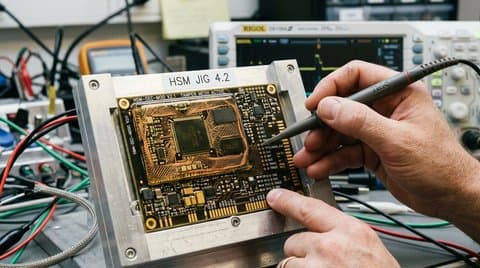 Close-up documentary photograph of tamper-evident hardware security module circuit board with micro-wire mesh and test probes
The Hardware Sanctuary: Why Security Must Retreat to Silicon
If software operating systems and user-space agents can be compromised by autonomous exploitation models, where can security ultimately reside?
The answer is that security cannot trust software. Security must retreat to physical silicon: tamper-evident Hardware Security Modules (HSMs), confidential computing enclaves, and cryptographically isolated hardware roots of trust.
In an advanced post-quantum zero-trust architecture, sensitive cryptographic keys never touch main system RAM, where speculative execution side-channels (like Spectre or Meltdown variants) could leak entropy to an unprivileged agent. Keys are generated, stored, and executed inside dedicated cryptographic processors encased in tamper-detection meshes and opaque potting resin.
If an attacker attempts physical invasive probing or focused-ion-beam (FIB) decapping, the hardware sensor mesh detects the change in capacitive resistance and zeroizes all internal cryptographic material in fewer than ten nanoseconds.
The Zero-Trust Silicon Invariant: Software is malleable, speculative, and prone to stochastic drift; true authority must be anchored in immutable silicon physics. No software agent—regardless of administrative privilege—may execute a state mutation without presenting a zero-knowledge hardware attestation verified by an isolated cryptographic coprocessor.
Autonomous Counter-Measures: Formal Invariant Verification
To defeat autonomous weaponized models, defensive systems must match their velocity without adopting their unpredictability. We cannot fight non-deterministic offensive agents with non-deterministic defensive bots; that approach invites cascading hallucinatory outages and catastrophic self-inflicted denial-of-service events.
The only viable defensive response is Automated Formal Invariant Verification.
Rather than attempting to guess what an attack will look like, defensive platforms define inviolable mathematical invariants:
Invariant 1: No unauthenticated socket may read kernel memory addresses.
Invariant 2: Every database mutation must possess an unbroken cryptographic chain of custody anchored to a valid user session token.
Invariant 3: Outbound egress traffic exceeding five megabytes per second must present a valid hardware-signed authorization ticket.
These invariants are compiled directly into operating system kernels via eBPF bytecode. When an offensive AI attempts an exploit, it does not matter if its payload has never been seen in the history of cybersecurity. The moment the exploit attempts to violate an invariant, the kernel hardware boundary severs the connection instantly at the silicon level.
The Post-Quantum Migration Matrix: Navigating Key Encapsulation and Digital Signatures
While the theoretical advantages of lattice-based cryptography are indisputable, implementing them across legacy enterprise infrastructure reveals acute architectural hurdles that security teams must actively navigate:
The MTU Fragmentation Ceiling: Classical elliptic-curve public keys and signatures were compact—typically thirty-two to sixty-four bytes. Under post-quantum standards, an ML-KEM-768 public key spans 1,184 bytes, and an ML-DSA-65 signature requires 3,309 bytes. In high-frequency trading or distributed database replication, transmitting multi-kilobyte cryptographic handshakes across standard 1,500-byte Maximum Transmission Unit (MTU) packet boundaries triggers IP packet fragmentation, introducing latency spikes and exposing network middleboxes to state-exhaustion attacks.
The Hybrid-First Defense Strategy: Because lattice problems have not endured thirty years of adversarial public stress-testing to the same degree as RSA or ECC, conservative security standards mandate hybrid key exchange protocols (e.g.,
X25519Kyber768Draft00). The hybrid mechanism binds a classical Diffie-Hellman secret with a post-quantum shared secret via a dual-keyed hash derivation function:
SharedKey = HKDF-Extract(X25519_Secret ∥ ML-KEM_Secret, Salt)
If mathematical cryptanalysis uncovers an unforeseen weakness in lattice lattices, the classical component remains defensible; conversely, if a quantum adversary decrypts the classical exchange, the lattice encapsulator preserves forward secrecy.
Crypto-Agility as an Operational Primitive: Systems architects must abandon hardcoded cryptographic primitives within compiled binaries. Cryptographic algorithms must be abstracted into swappable hardware abstraction layers (HALs) and dynamically configured policy engines, allowing organizations to deprecate compromised primitives and rotate to alternative stateful hash-based signatures (such as SLH-DSA or XMSS) without redesigning operational workflows.
The Sovereign Horizon
The era of cybersecurity as administrative compliance and reactive antivirus updates is dead. The weaponized model has elevated digital security into an existential contest between automated attack synthesis and mathematical proof.
Organizations that continue to rely on legacy VPNs, static passwords, and manual security reviews will discover that their networks are porous sieves against autonomous agentic adversaries.
The institutions that endure will be those with the foresight to modernize their foundations: replacing brittle classical encryption with post-quantum lattice mathematics, stripping vulnerable software of unearned trust, and anchoring their digital sovereignty in the silent, incorruptible certainty of physical silicon.