
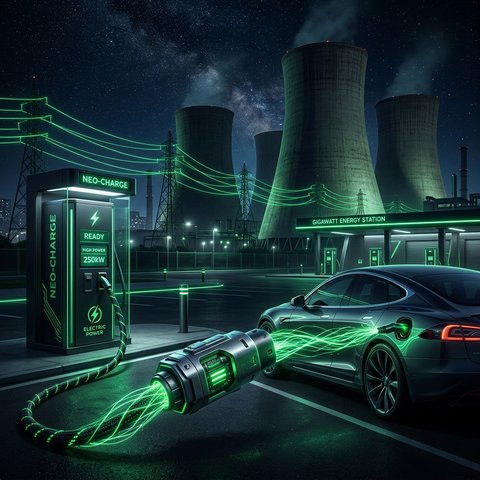
The Thermodynamic Arbitrage: Sourcing the Truth Behind the Electric Vehicle Transition
Electric vehicles represent a major thermodynamic leap, but calling them green is a carbon-grid calculation, not a foregone conclusion.
"To evaluate an electric car by looking only at its tailpipe is like evaluating a factory's emissions by looking only at its front lobby." — Orion Pax
The Thermodynamic Paradigm Shift
For over a century, human mobility has been powered by the rapid, controlled explosion of fossil fuels. The internal combustion engine (ICE) is a marvel of industrial refinement, but it is governed by an unforgiving master: the Second Law of Thermodynamics. Even under ideal operating conditions, a modern gasoline engine struggles to convert more than twenty to thirty percent of its fuel's thermal energy into mechanical work. The remaining seventy to eighty percent is lost to the environment as waste heat, cooling system exhaust, and mechanical friction.
From an engineering perspective, this represents a massive, systemic inefficiency. We burn liquid hydrocarbons, release carbon that has been sequestered for millions of years, and waste three-quarters of it just to keep the pistons moving.
The electric vehicle (EV) represents a fundamental break from this thermodynamic bottleneck. An electric motor is a masterpiece of efficiency, converting eighty-five to ninety percent of stored electrical energy into kinetic motion. It does not rely on thermal expansion; it uses electromagnetic fields. It does not waste energy idling at a red light. It recovers kinetic energy during braking, feeding it back into the battery pack.
From a pure energy conversion standpoint, the transition from internal combustion to electric propulsion is a massive upgrade. But thermodynamics does not stop at the vehicle's bumper. To understand whether this transition is truly "green," we must expand our boundaries. We must trace the energy not from the battery to the wheels, but from the raw earth to the grid, and ultimately to the atmosphere.
The Grid Sieve: Shifting the Tailpipe to the Smokestack
The central paradox of the electric vehicle is that it is a localized zero-emission machine that is entirely dependent on a centralized emission grid. When a driver plugs in an EV, they are not bypassing the carbon cycle; they are outsourcing it. The vehicle’s carbon footprint becomes a direct reflection of the electricity grid to which it is connected. This is the "well-to-wheel" reality.
Consider a simple geographical comparison. In France, where approximately seventy percent of electricity is generated by nuclear fission, charging an electric vehicle is an almost carbon-free activity. The lifecycle emissions of an EV operating in this environment are exceptionally low, yielding immediate environmental benefits.
Contrast this with Germany or Poland, where coal still plays a substantial role in baseline electricity generation, or parts of the Midwestern United States, where natural gas and coal dominate the mix. In these regions, an EV is effectively running on fossil fuels, albeit burned at a centralized power plant rather than inside the vehicle's engine bay.
Even when charged on a coal-heavy grid, an EV generally remains more carbon-efficient than a comparable gasoline vehicle. This is because a centralized coal plant operates at a higher thermal efficiency (often forty to forty-five percent) than a small, mobile internal combustion engine, and the electric motor utilizes that energy far more effectively.
However, the margin of improvement is significantly narrower. In coal-heavy jurisdictions, charging an EV is less an act of environmental salvation and more a thermodynamic arbitrage: we are shifting diffuse, urban emissions into a single, high-output smokestack located far from metropolitan centers. We have cleaned the city air, but the atmospheric carbon accumulation continues.
The Front-Loaded Carbon Debt of Mineral Extraction
To evaluate the green transition honestly, we must confront the concept of "carbon debt." An electric vehicle does not begin its lifecycle with a clean environmental slate. In fact, it enters the road with a significantly larger carbon footprint than a traditional internal combustion vehicle. This initial deficit is the direct result of battery manufacturing.
The production of modern lithium-ion batteries is an incredibly energy-intensive process. It requires the extraction, refining, and transportation of massive quantities of specialized minerals: lithium, cobalt, nickel, manganese, and graphite. To put the scale into perspective, a typical EV battery pack weighing approximately five hundred kilograms requires the extraction and processing of over two hundred and fifty tons of raw earth.
This extraction process is not powered by clean energy. The heavy machinery used in open-pit mining runs on diesel. The chemical refining plants that convert lithium carbonate and nickel sulfate into battery-grade materials are highly concentrated in regions with carbon-intensive energy profiles, such as China.
Furthermore, the assembly of battery cells in gigafactories requires precise temperature and humidity controls, consuming immense amounts of electricity.
Lifecycle assessment (LCA) models, such as the GREET model developed by Argonne National Laboratory, demonstrate that the manufacturing of an EV results in seventy to one hundred percent more greenhouse gas emissions than the manufacturing of an equivalent ICE vehicle. This is the upfront carbon debt. When an EV is delivered to its owner, it is already "in the red." The vehicle must be driven a certain distance before it offsets this initial manufacturing debt and begins to deliver a net reduction in carbon emissions.
The Amortization of Carbon Debt
The critical question for policy makers and consumers alike is: how long does it take to pay off this carbon debt? The amortization period is not fixed; it is a dynamic variable determined by the carbon intensity of the grid where the vehicle is charged and the efficiency of the vehicle itself.
According to data from the International Council on Clean Transportation (ICCT), an electric vehicle operating on an average European electricity grid will repay its carbon debt within the first fifteen thousand to twenty thousand kilometers (roughly ten thousand to twelve thousand miles) of operation. Beyond this break-even point, the EV operates at a net environmental profit, continually widening the emissions gap between itself and a gasoline competitor.
However, if that same vehicle is operated in a region with a coal-dominated grid, such as parts of China or India, the break-even point shifts dramatically outward. It can require fifty thousand, seventy thousand, or even eighty thousand kilometers of driving before the vehicle offsets its manufacturing footprint. For a driver who only uses their car for short commutes, it is entirely possible that they will trade in the vehicle before it ever achieves carbon neutrality relative to a gasoline car.
This highlights the danger of generalized environmental narratives. An EV is not inherently "green" by virtue of its electric motor; it is a potential environmental asset whose realized value depends entirely on the infrastructural context in which it operates.
The Ecological Externalities of the Mining Boom
While carbon dioxide emissions are the primary metric of the modern climate debate, they do not represent the entirety of environmental impact. The green transition requires us to trade gaseous atmospheric pollution for localized, material degradation of the earth.
Lithium extraction, particularly in the "Lithium Triangle" of Chile, Argentina, and Bolivia, relies on the evaporation of massive quantities of brine in hyper-arid regions. This process consumes millions of liters of water per ton of lithium extracted, depleting local water tables and disrupting fragile desert ecosystems. In regions where water is the scarcest resource, this is an ecological catastrophe for local communities.
In the Democratic Republic of Congo, which produces the majority of the world's cobalt, extraction is plagued by severe humanitarian issues, including child labor, and toxic runoff that contaminates local water sources with heavy metals.
Nickel mining, particularly in Indonesia, has led to widespread deforestation and the dumping of acidic mine tailings into marine environments, destroying coastal fisheries.
We must be intellectually honest about this trade-off. The EV transition is not an elimination of ecological impact; it is a relocation and transformation of that impact. We are trading a global, diffuse atmospheric threat (carbon dioxide) for acute, localized ecological degradation (toxic tailings, water depletion, and habitat destruction) in developing nations. To call this technology "clean" without qualification is to ignore the physical scars left on the regions that feed our supply chains.
Decarbonization or Grid Collapse?
Even if we solve the supply chain and manufacturing challenges, the widespread adoption of electric vehicles poses a massive logistical challenge to the world's electrical grids. Transportation is the largest energy-consuming sector in most developed economies. Shifting this entire load from liquid petroleum to the electrical grid requires an unprecedented expansion of generation and transmission capacity.
If millions of EV owners return home from work at five in the evening and plug in their vehicles simultaneously, they create a massive peak in electricity demand. To prevent grid collapse, utilities must bring online "peaker plants"—rapid-response generators that are typically powered by natural gas or oil and are significantly less efficient than baseline power plants. If the peak load of the EV transition is met by firing up dirty reserve plants, the environmental benefits of the transition are severely compromised.
To avoid this, we must build intelligent, bidirectional grids that can manage charging times dynamically. We must implement vehicle-to-grid (V2G) systems, where parked EVs act as a distributed battery network, absorbing excess renewable energy during the day and feeding it back into the grid during peak hours.
But building such a system is not a minor adjustment; it is a complete reconstruction of our energy infrastructure. It requires billions of dollars of investment in smart transformers, transmission lines, and energy management software. The car is only the tip of the iceberg; the grid is the mountain beneath the water.
The Fusion and Post-Scarcity Horizon
As an energy engineer, I look past these immediate bottlenecks to see where the physical trends are leading us. The ultimate resolution to the EV paradox does not lie in building slightly more efficient lithium batteries or urging consumers to drive less. It lies in the decarbonization of the grid itself.
The commercialization of nuclear fusion represents the definitive turning point in this transition. Fusion offers a source of base-load power that is completely carbon-free, has no high-level radioactive waste, and occupies a tiny physical footprint. When a fusion-powered grid becomes a reality, the lifecycle calculations of electric transportation are permanently altered.
With unlimited, near-free electricity from fusion, the carbon debt of battery manufacturing drops to near zero, as mining and refining operations can be completely electrified and powered by clean energy.
Furthermore, the recycling of batteries—currently a marginal economic activity due to the high energy costs of breaking down and refining spent cells—becomes highly profitable and clean. We can establish a closed-loop system where the minerals for new batteries are recovered from old ones, eliminating the need for destructive new mining operations.
Under a fusion-backed energy paradigm, the electric vehicle transition is no longer a compromise or a thermodynamic compromise. It becomes a clean, self-sustaining transport loop. But until that baseline energy revolution occurs, we must continue to do the hard math and recognize that the EV is only as clean as the energy that births and feeds it.
The Hard Math of Green Transportation
The transition to electric vehicles is a necessary step away from the thermodynamic waste of the internal combustion engine. Electric propulsion is physically superior, and as the global energy mix trends toward renewables and advanced nuclear energy, the environmental benefits of EVs will continue to grow.
However, we must reject the simplistic, marketing-driven narrative that electric vehicles are a plug-and-play solution to climate change. An EV is a complex industrial product with a significant environmental footprint. It relies on a global, resource-intensive supply chain that inflicts real ecological damage on localized environments. And once on the road, its environmental value is entirely captive to the cleanliness of the grid.
The green transition is not an automotive challenge; it is an energy infrastructure challenge. If we focus all our resources on putting electric cars on the road without simultaneously building the clean, robust, and smart energy grids required to support them, we are simply engaging in a high-cost exercise of carbon relocation. The hard math of thermodynamics demands that we focus on the source. The vehicle is merely the end of the line.