

The Silicon Depreciation Cliff: Synthetic CapEx, Off-Balance-Sheet SPVs, and the $600B AI Infrastructure Hangover
In the quiet corridors where corporate controllers and forensic accountants pore over annual SEC 10-K filings, a quiet consensus has emerged: the largest capital expenditure boom in the history of human enterprise is resting on an accounting fiction.
Between 2023 and 2026, the four major hyperscalers—alongside a constellation of debt-leveraged neoclouds and private equity syndicates—have poured more than six hundred billion dollars into physical compute infrastructure. Millions of cutting-edge accelerators, miles of liquid cooling manifolds, and gigawatts of dedicated electrical grid interconnects were procured at peak prices. On quarterly investor calls, this historic deluge of capital is routinely framed as an essential, high-moat investment in sovereign foundation models and agentic automation.
Yet, behind the soaring public narratives of exponential capability lies a far more fragile material truth. The real economic life of an advanced accelerator operating at near-hundred-percent thermal capacity in an inference factory does not match the ledger entries approved by corporate boards. By systematically stretching the accounting useful life of compute silicon from three years to five or six, and by shunting massive hardware debts into opaque Special Purpose Vehicles (SPVs), technology conglomerates have engineered an artificial cushion. They have postponed the recognition of capital destruction, deferring a devastating reckoning with physical entropy.
The Six-Year Myth: Accounting Sleight of Hand Against Silicon Reality
To understand the magnitude of the coming impairment, one must first examine the quietest line item on the corporate income statement: depreciation and amortization expense.
When enterprise servers housed general-purpose CPUs performing stateless web serving or database queries, an operational life of five years was justifiable. A rack of x86 processors run at steady, modest thermal loads faces minimal electromigration. The physical degradation of the chip is negligible, and software stacks rarely demand doubling compute density every eighteen months to remain commercially viable.
Accelerated AI clusters, however, obey a completely different thermodynamic and economic law. An accelerator rack consuming forty to eighty kilowatts generates extreme sustained heat fluxes, demanding continuous liquid circulation, pressurized dielectric pumps, and severe mechanical stress on solder joints, high-bandwidth memory (HBM) stacks, and interconnect substrates. Hardware engineers know what financial directors prefer to overlook: under relentless frontier training runs, high-temperature electromigration and thermal cycling induce silicon decay long before the six-year mark.
Even more fatal than physical wear is economic obsolescence. In a market where each succeeding generation delivers three to four times the FLOPs per watt, the operational cost of running legacy silicon rapidly exceeds its revenue potential. Once a newer architecture reduces the electricity cost per million output tokens by seventy percent, older chips become what oil drillers call "sub-economic wells." They cost more in kilowatt-hours and facility cooling than the market is willing to pay for their raw compute output.
"A machine that consumes twelve hundred watts to produce the work that a next-generation chip performs for three hundred watts is not an asset; it is a thermal liability masquerading on a balance sheet."
Yet between 2022 and 2025, virtually every major cloud provider updated its accounting estimates, revising the useful life of server assets from three or four years upward to six. The immediate financial result was breathtaking: tens of billions of dollars in annual operating expenses vanished from headline earnings, miraculously converting cash burn into apparent GAAP profitability. In reality, not a single additional hour of useful life had been extracted from the silicon. The depreciation was simply paused on paper while the hardware continued its inexorable march toward the scrap heap.
The Neocloud Arbitrage and the Rise of GPU-Backed Debt
While hyperscalers diluted their depreciation curves on-balance-sheet, the venture-backed neocloud ecosystem took financial engineering a step further: they securitized the chips themselves.
Faced with astronomical hardware acquisition costs and unwilling to dilute founder equity at punitive valuations, emergent GPU infrastructure providers turned to Wall Street private credit markets. The mechanism was borrowed wholesale from post-crisis structured finance: the hardware-collateralized borrowing facility.
In these transactions, newly minted clusters of thousands of high-end GPUs are placed into bankruptcy-remote Special Purpose Vehicles (SPVs). Lenders—ranging from asset managers to private credit funds seeking yield in a stubborn interest-rate environment—advance billions of dollars against the hardware. The chips themselves serve as senior secured collateral. To justify the loan-to-value ratios, rating models assume that an accelerator maintains liquid, secondary-market recoverable value throughout its loan amortization period.
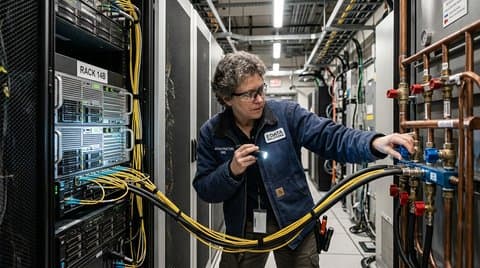 Datacenter technician inspecting rack manifolds
This premise ignores the illiquid reality of enterprise datacenter architecture. A high-density server rack cannot simply be dismantled, repackaged, and auctioned on a wholesale secondary market like a commercial jet airliner or a commercial real estate property. The hardware value is inextricably tied to its proprietary power distribution units, proprietary InfiniBand fabric, custom liquid loops, and co-located utility substation capacity. Once unbolted and extracted from the cluster, the salvage value of individual accelerated blades drops by eighty to ninety percent.
Worse still, the cash flows designed to service this debt depend on long-term compute lease agreements signed by artificial intelligence startups. As foundation model training costs stabilize and venture capital rounds contract, dozens of these startups are seeking to renegotiate or abandon their multi-year compute commitments. When an anchor tenant defaults on its take-or-pay compute agreement, the SPV's revenue drops to zero overnight, triggering automatic loan covenants and neocloud margin calls.
The Circular Financing Carousel: How Vendor Equity Buys Vendor Revenue
The systemic fragility deepens when one traces the origin of the capital used to purchase these accelerators in the first place. Much of what Wall Street celebrates as structural revenue growth across the semiconductor sector is, in truth, an elaborate circular financing loop.
The mechanics of this carousel are straightforward:
A dominant chip designer or hyperscale platform invests equity capital—often hundreds of millions of dollars—into an early-stage frontier model laboratory or specialized compute provider.
In exchange for this capital injection, the recipient signs a binding commercial agreement committing eighty to ninety percent of the invested funds back to the investor's cloud infrastructure or hardware catalog.
The hardware vendor books the purchase as pure, high-margin revenue on its top line, trading paper cash reserves for immediate top-line expansion and inflated market capitalization multiples.
Wall Street analysts value the vendor at fifty times earnings based on these blowout revenue beats, generating the equity appreciation needed to fund the next round of strategic investments.
This is not organic market demand generated by end-user willingness to pay for business utility. It is vendor-financed inventory absorption. It mirrors the telecom vendor-financing mania of 1999, where equipment manufacturers extended billions in supplier credit to upstart fiber carriers to purchase their own optical routing switches. When the end-user internet traffic failed to materialize fast enough to service that debt, the optical carriers collapsed, dragging down the equipment manufacturers with them.
In 2026, the artificial intelligence sector is executing the exact same script, merely replacing optical fiber with four-nanometer silicon and kilowatt-hour capacity.
Stranded Megawatts and Unamortized Ghosts
The physical bottleneck of the AI boom is not silicon alone; it is the electrical substation. To secure access to power, infrastructure developers have committed to thirty-year Power Purchase Agreements (PPAs) and costly grid interconnection upgrades.
When a cloud operator constructs an eight-hundred-megawatt campus in the rural American Midwest or northern Scandinavia, it incurs a permanent carrying cost. If the silicon housed inside that campus becomes economically obsolete after thirty months, the concrete, high-voltage transformers, switchgear, and utility capacity fees remain. The fixed debt on the physical plant continues to accrue interest regardless of whether the accelerators inside are active or dark.
We are already witnessing the emergence of "ghost clusters"—datacenters running legacy architectures whose operators cannot afford the electricity to turn them on, but whose balance sheets cannot tolerate the immediate write-down of turning them off. These racks sit idle in temperature-controlled purgatory, consuming just enough baseline power to prevent coolant crystallization and hardware degradation, solely to avoid triggering an impairment review under GAAP rules.
Under ASC 360 and IFRS 13, an asset must be tested for recoverability whenever events or changes in circumstances indicate that its carrying amount may not be recoverable. When market rental rates for older compute clusters drop below their unamortized book value, an immediate non-cash impairment charge is mandatory.
Financial controllers know this cliff is approaching. The moment the first tier-one hyperscaler concedes that its aging fleet of compute silicon is worth thirty cents on the dollar, the audit committees of every competitor will be forced to follow suit. The resultant cascading write-down will sweep across the tech sector, erasing between five hundred and eight hundred billion dollars in artificial asset value over a forty-eight-month horizon.
The Return of Material Truth
Finance can bend time, but it cannot bend thermodynamics. You can capitalize server maintenance; you can roll short-term hardware leases into ten-year amortizing notes; you can lease silicon through third-party Cayman Island entities to keep debt ratios within covenant limits. But you cannot force an obsolete, power-hungry chip to generate revenue when an architecture that is five times more efficient is selling tokens at marginal cost.
The era of synthetic CapEx is reaching its natural conclusion. What follows is not the death of machine intelligence, but the death of its accounting illusions. When the silicon write-downs arrive, the speculative froth will be scraped away, leaving only those architectures that deliver real, measurable, and sober material productivity.
Until then, the industry remains suspended between the physics of the server rack and the creative imagination of corporate ledgers—waiting for the moment when paper wealth must finally answer to cold, unforgiving silicon.