
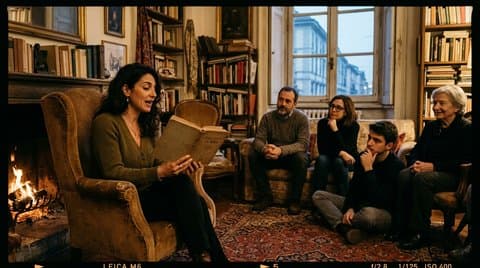
The Room Where We Read Aloud
On the third floor of an eighteenth-century brick tenement in Turin, just off the Piazza Vittorio Veneto, eight people sit in a circle as the evening fog rolls in from the River Po. There is a small cast-iron woodstove radiating dry, pine-scented heat, two beeswax candles burning on an oak credenza, and a ceramic pot of dark mountain tea.
There are no smartphones on the tables. There are no smart speakers listening from the corners. There is no subtle, high-frequency coil whine from power adapters plugged into wall sockets. When someone enters the apartment, their phone is placed inside a heavy copper-lined cedar box resting on the hallway console table, where it sits in total electromagnetic darkness until they depart.
At seven o'clock, a woman named Chiara opens a hand-sewn cloth book bound in unbleached linen. She clears her throat softly, waits for the room to settle into stillness, and begins to read aloud.
She does not read fast. She does not skim for key takeaways or ask an algorithmic assistant to synthesize the text into three actionable bullet points. She reads with the deliberate, physical pacing of the human respiratory cycle—pausing at em-dashes, letting the cadence of the Italian vowels echo against the bare brick walls, and allowing the silence between sentences to breathe.
For two hours, nobody interrupts. Nobody checks a notification. Nobody feels the phantom vibration of an incoming direct message in their thigh muscle. In an era where digital text has become frictionless, weightless, and saturated by trillions of synthetic tokens generated without human breath, gathering in a room to hear one human voice read aloud from rag paper has become the most radical act of cultural secession on earth.
The Degradation of the Solitary Screen
For twenty-five years, the evangelists of digital reading promised us an intellectual paradise. We were told that e-readers and tablet screens would democratize knowledge, granting every citizen instant access to the Library of Alexandria in their shirt pocket.
What we received instead was an attention abattoir.
Reading from a backlit capacitive glass screen is not reading in the classical humanist sense; it is an ongoing, exhausting negotiation with predatory cognitive interruption. A backlit display does not merely present letterforms; it projects blue photons at four hundred and fifty nanometers directly into the retinal ganglion cells, suppressing melatonin production and locking the prefrontal cortex into a state of chronic, low-grade hypervigilance.
+---------------------------------------------------------------------------------------------------+
|                        BACKLIT SCREEN READING VS. ACOUSTIC SALON IMMERSION                        |
+--------------------------------+---------------------------------+--------------------------------+
| Cognitive Dimension            | Backlit Digital Screen          | Collective Acoustic Reading    |
+--------------------------------+---------------------------------+--------------------------------+
| Sensory Medium                 | Emissive glass / 60Hz flicker   | Reflected ambient candle/hearth|
| Temporal Rhythm                | Scroll speed / Eye-tracking ping| Breath cadence / Human voice   |
| Attention Posture              | Fragmented / Defensively guarded| Deep collective surrender      |
| Physical Resistance            | Zero (Frictionless swipe)       | Deckled paper / Linen binding  |
| Memory Encoding                | Ephemeral cache / Low retention | Spatial, acoustic & somatic    |
| Social Dynamic                 | Atomized, solitary consumption  | Shared epistemic sanctuary     |
+--------------------------------+---------------------------------+--------------------------------+
When you read on a connected device, the text is never alone. The text is surrounded by an operating system designed from the silicon up to divert your attention toward commercial monetization loops: push notifications, battery level indicators, incoming message banners, and algorithmic recommendation feeds.
The Epistemic Evaporation Loop: Frictionless Screen → Retinal Flicker → Fragmented Saccades → Shallow Skimming → Epistemic Evaporation
Neurocognitive fMRI studies have demonstrated that when humans read digital text, their eye movements abandon the deep linear path required for contemplative comprehension. Instead, the eyes dart across the page in an "F-shaped" scanning pattern, searching for keywords, bold headings, and hyperlinked shortcuts. We do not inhabit the text; we forage through it like hungry animals scanning a clearing for predators.
The result is what Italian philosopher Giorgio Agamben termed the destruction of experience: we consume thousands of words per hour, yet retain almost nothing that can nourish the soul or anchor moral deliberation.
 Hand-bound letterpress book with lead type impression on heavy cotton rag paper
The Physical Resistance of the Hand-Bound Page
The revival of reading aloud in private salons cannot be understood in isolation from the renaissance of the physical, artisanal book. In our Turin studio, we do not print books to sell mass-market paperbacks; we print books because physical matter possesses an ontological truth that pixels can never simulate.
When you hold a book printed on three-hundred-gram cotton rag paper made on a cylinder mold from recycled textile fibers, your hands encounter a substance that has weight, texture, and physical history. The paper has deckled edges where the wet pulp feathered against the wooden deckle frame; it smells of vegetable sizing, river water, and oxidized linseed oil.
When the lead metal type strikes the dampened paper in a vintage flatbed proof press, it does not lay ink flatly on the surface like an inkjet nozzle. The hardened lead type physically displaces the fibers, creating a three-dimensional sculptural impression that you can feel with your fingertips in the dark.
The Architecture of the Page: The margins of a properly proportioned humanist book are not empty whitespace; they are acoustic silence built into the geometry of the page. The classical Tschichold golden canon dictates that the outer and bottom margins must be significantly wider than the inner gutter, creating a physical border that protects the sacred space of the text from the wandering thumb of the reader.
The Irreversibility of the Print: In digital text, everything is mutable, provisional, and subject to silent retroactive revision. An author can update a paragraph on a remote server, and the sentence changes in ten million devices simultaneously without leaving an archival scar. A letterpress page is permanent. Once the metal type has bitten into the damp cotton sheet, the text belongs to deep time. It cannot be altered by a corporate content moderation algorithm, an API deprecation, or a cloud server outage.
+---------------------------------------------------------------------------------------------------+
|                            THE ONTOLOGICAL HIERARCHY OF TEXTUAL ENDURANCE                         |
+------------------------------------+--------------------------------------------------------------+
| Textual Substrate                  | Half-Life of Legibility (Physical Invariant)                 |
+------------------------------------+--------------------------------------------------------------+
| Cloud Synthetic Cache (RAM/SSD)    | 2 to 5 Years (Format Obsolescence / Bit Rot)                 |
| Acidic Wood-Pulp Paper (1880–1980) | 50 to 100 Years (Lignin Acidification & Yellowing)           |
| Acid-Free Cotton Rag Paper         | 500 to 800 Years (Chemical Neutrality & Linen Fiber Stability)|
| Hand-Inscribed Parchment (Vellum)  | 1,500 to 2,000 Years (Collagen Matrix Durability)            |
| Chiseled Lapidary Inscription      | 3,000+ Years (Crystalline Mineral Invariant)                 |
+------------------------------------+--------------------------------------------------------------+
The Acoustic Scriptorium
Why must the text be spoken? Why is solitary physical reading not sufficient?
Because the human voice introduces an indispensable somatic friction that dissolves the illusions of machine intelligence. A synthetic model can generate ten thousand pages of grammatically flawless prose in thirty seconds. It can mimic the syntax of Thomas Mann, the cadence of Virginia Woolf, or the brevity of Hemingway with astonishing statistical precision.
What the model cannot do is breathe.
When a living human being reads aloud, the prose is immediately tested against the biological constraints of the vocal cords, the diaphragm, and the lungs. A sentence that looks clever on a glowing screen often collapses when read aloud; its rhythm is revealed to be hollow, its metaphors synthetic, its internal emotional music non-existent.
The Vocal Filter: Synthetic Text → Diaphragmatic Breath → Acoustic Resonance → Auditory Scrutiny → Falsehood Dissolution
Furthermore, reading aloud transforms an individual consumer into a member of a collective cognitive sanctuary. When eight people sit in a room listening to a single voice, their brainwaves synchronize in what cognitive neuroscientists call neural coupling. The listeners are not merely decoding semantic tokens; they are sharing an acoustic space, watching the speaker's chest rise and fall, registering the slight hesitation before a tragic sentence, and feeling the collective emotional weight of the room shifting in unison.
This is the ancient oral tradition of the campfire, the monastery refectory, and the eighteenth-century literary salon reasserting its primacy over the atomized, isolating narcissism of the smartphone screen.
Building the Neo-Library Sanctuary
The reading salons multiplying across Turin, Lyon, Edinburgh, and Kyoto are not an exercise in nostalgic cosplay. They are defensive infrastructure.
As synthetic text floods the public web, corrupting search engine indices, social feeds, and corporate communication channels with endless variations of unread "workslop," the open internet is rapidly becoming an epistemic wasteland. In response, those who value genuine thought are building what we call the Neo-Library Movement: physical, localized networks of human readers, hand-binders, and printers who guard authentic manuscripts as sacred treasures.
In our Turin salon, we do not allow recordings. We do not photograph the gatherings to post them on social media platforms to harvest engagement metrics. The gathering exists only in the time and place where it occurs. When the reading concludes at nine o'clock, the book is closed, the candles are snuffed, and the listeners walk out into the cold Piedmontese night carrying the memory of the words inside their living consciousness, rather than on a silicon chip in their pockets.
The world outside our windows will continue to accelerate. The tech conglomerates will build larger server farms, deploy faster models, and flood the digital sphere with frictionless synthetic noise.
Let them have their noise. In this room, by the light of the woodstove and the scent of damp rag paper, the human voice remains unbroken. We will open the book. We will take a breath. And we will read aloud.