
The Room That Breathes Between the Notes
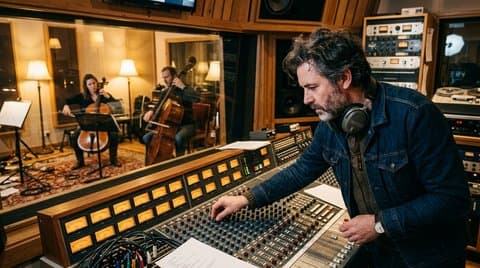
Before a bow touches a cello string in the live room of our studio in St Pauls, Bristol, I ask the four musicians to sit in their wooden chairs for sixty seconds without making a sound.
If you push the faders up on a pair of matched Coles 4038 ribbon microphones hanging three meters above the parquet floor, you quickly discover that an unplayed room is never silent.
You hear the low, sub-audible rumble of the rain draining through the Victorian cast-iron guttering outside; the gentle sixty-hertz hum of the transformer in the bass amplifier warming up; the creak of pine floorboards adjusting to the weight of human bodies; and, just before the downbeat, the collective, synchronized inhalation of four people drawing the same damp West Country air into their lungs at the exact same millisecond.
That shared breath—captured across the figure-eight magnetic field of a corrugated aluminum ribbon—is not background noise to be scrubbed away by a spectral denoising plugin. It is the physical architecture of musical time.
Today, if you turn on a commercial streaming playlist or listen to the flood of algorithmically generated background tracks filling cafés, hotel lobbies, and video feeds, that room has been entirely murdered.
In its place sits an airless, quantized, pitch-flattened vacuum where every transient snaps mathematically to a sixteenth-note computer grid, every vocal syllable is ironed flat to 440.00 Hertz, and the acoustic bleed between human beings is treated as a hygiene violation.
We have never had higher digital sampling rates in the history of recorded sound, and yet contemporary music has never felt more suffocatingly dead.
The Tyranny of the Visual Grid
To understand how popular and independent music lost its physiological pulse, one must look at what happened when recording migrated from an auditory medium (magnetic tape) to a visual medium (the Digital Audio Workstation timeline).
When a musician records onto a computer screen, time is no longer experienced as a living, elastic current governed by the human heartbeat and respiratory cycle. Time is rendered spatial: a rigid horizontal spreadsheet of vertical bar lines governed by an unrelenting digital clock.
If a drummer rushes the chorus by four milliseconds because their adrenaline is surging, or if a cellist lingers behind the beat on a minor sixth to let the wood of the instrument weep, the visual grid displays that human micro-timing as a graphical error—a transient waveform sitting slightly to the left or right of a gray pixel line.
And because the eye is a far more anxious bureaucrat than the ear, the producer reaches for the mouse, highlights the region, and presses Quantize: 100%.
Acoustic & Temporal Dimension | Quantized Digital Grid & Algorithmic Audio | Live Room Ensemble on Two-Inch Magnetic Tape |
|---|---|---|
Temporal Architecture | Rigid mathematical metronome (0.0 ms drift); static BPM | Elastic human rubato; micro-timing push and pull between players |
Inter-Channel Bleed | Total isolation in dead booths or synthetic stem generation | Acoustic phase coupling; every mic hears the entire shared room |
Pitch Intonation | Hard-snapped to equal temperament via phase-vocoder correction | Natural harmonic beating, expressive vibrato, and blue-note tension |
Dynamic Crest Factor | Crushed to -6 LUFS brickwall limiting for phone speakers | Wide 18–24 dB dynamic range; real silence between transients |
Harmonic Saturation | Sterile linear digital clipping or algorithmic emulation | Nonlinear ferric-oxide magnetic hysteresis and transformer warmth |
Listener Nervous Response | Rapid auditory cortex habituation and background fatigue | Involuntary sympathetic autonomic entrainment and goosebumps |
When you snap every drum hit, bass pluck, and piano chord to an absolute mathematical grid, you do not make the rhythm tighter; you destroy the groove.
Groove is not precision. Groove is the microscopic, conversational tension between four human nervous systems negotiating time together in real space.
When a bass player plays twelve milliseconds behind the snare drum while the ride cymbal dances four milliseconds ahead, that triangular friction creates forward kinetic momentum. The listener’s motor cortex leans forward in anticipation.
When an algorithm or a grid-editor eliminates those twelve milliseconds of human discrepancy, the music ceases to walk; it marches like a clockwork automaton, and within ninety seconds the human brain tunes it out as mechanical wallpaper.
Two Inches of Ferric Oxide
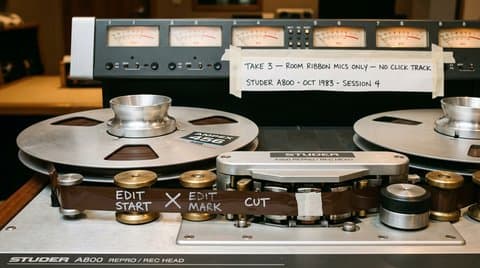 Transport deck of a Studer A800 two-inch magnetic tape recorder with aluminum reel and china-marker edit marks
Examine the transport deck of our Studer A800 machine above, where a ten-and-a-half-inch aluminum reel of two-inch magnetic tape travels across the brass guides at fifteen inches per second.
Notice the white grease-pencil marks on the tape and the handwritten track sheet taped to the steel meter bridge: Take 3 — Room Ribbon Mics Only — No Click Track.
Why do young bands in their twenties—kids who grew up with infinite undo histories on their laptops—keep coming to our cold studio in Bristol, pooling their bar-shift wages to buy a four-hundred-pound reel of two-inch ferric-oxide tape that gives them only thirty-three minutes of recording time?
It is not fetishism for vintage chrome. It is the psychological transformation that occurs when a finite physical medium is moving across a record head.
The Analog Performance Commitment Loop: Finite Physical Magnetic Tape Reel (33 Minutes) → Elimination of Infinite Digital Undo → Heightened Adrenaline & Mutual Auditory Attention → Acoustic Phase Bleed in Shared Room → Irrepeatable Human Performance
When a band knows they have fifty tracks of virtual hard-drive space and infinite takes, nobody listens to anyone else. The guitarist stares at their pedals, knowing the engineer will composite a solo out of fourteen separate passes next Tuesday. The drummer plays defensively to a cold click in their headphones. Nobody is truly present, because no single moment matters.
When the red record lamp lights up on a two-inch tape machine, however, time becomes expensive and irreversible.
There is no computer screen in the room. There is no click track. If the trumpet player cracks a note in the third bar of the bridge—the way Miles Davis cracked the opening note on Kind of Blue—you do not stop and open a pitch-correction window. You listen to the way the pianist responds to that cracked note with a sudden, compassionate chord voicing that turns an accident into transcendent beauty.
The Sacred Contamination of Bleed
In the orthodoxy of modern commercial production—and even more so in synthetic audio generation—bleed is the enemy.
If the vocal microphone picks up the rattle of the snare wires across the room, or if the cello microphone captures the percussive thump of the upright bass player’s fingers hitting the maple fingerboard, the modern engineer considers the recording contaminated. If you want to replace the snare drum later with a digital sample, or slice the vocal into a different arrangement, acoustic bleed makes surgical editing impossible.
Yet as the late, great engineer Steve Albini spent forty years demonstrating, acoustic bleed is the very thing that convinces the human ear that an event actually occurred in the physical world.
In real life, sound does not travel through isolated, phase-locked vacuum tubes into your eardrums.
When a snare drum is struck in a wooden room, the pressure wave radiates outward at 343 meters per second. It strikes the spruce soundboard of the piano, causing the unplayed strings to vibrate in sympathetic resonance; it bounces off the plaster ceiling and arrives at the overhead ribbon microphones six milliseconds after the direct hit; it enters the vocal microphone slightly off-axis, coloring the air around the singer’s voice.
When you listen to Mark Hollis’s Spirit of Eden or John Coltrane’s A Love Supreme—recorded by Rudy Van Gelder in a single afternoon in Englewood Cliffs—you are not listening to four isolated instruments pasted onto a sterile canvas. You are hearing the air of a specific room on a specific afternoon in history, vibrating as a single, indivisible acoustic organism.
Listening After the Flood
We are currently living through the great synthetic deluge of sound.
Every day, more than a hundred thousand algorithmically synthesized tracks are uploaded to streaming servers—lo-fi beats generated to pad corporate royalty pools, synthetic ambient washes designed for sleep playlists, and dead-eyed pop imitations scrubbed of every human breath, finger squeak, and tempo fluctuation.
Let the algorithms have the background wallpaper. They are welcome to the elevator, the supermarket aisle, and the corporate hold-music queue.
The unintended gift of this synthetic flood is that it has stripped away the middle ground of mediocre, over-polished digital production, leaving behind a sharp, unmistakable hunger for the real.
Last night at eleven o'clock, after the rain finally stopped over Bristol, we played back Take Three from the two-inch master tape through the studio monitors.
In the quiet passage before the final verse, you could hear the cellist’s bow hair catch slightly on the gut C-string, followed half a second later by the unmistakable sound of the drummer letting out a slow, involuntary breath through his nose.
Nobody reached for a fader to mute it. We sat in the dark behind the console and let the tape run all the way to the paper leader, listening to the sound of four human beings proving they were alive.