
The Rentier Cloud Must Starve
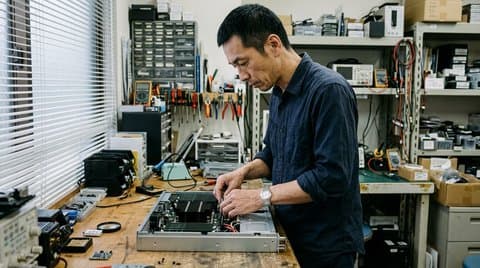
At five-fifteen on a Tuesday morning in a third-floor workshop behind the Sotokanda electronics market in Akihabara, the quietest revolution in modern computing does not announce itself with a press release. It announces itself with a single, sharp metallic click.
The click comes from the mechanical release of an RJ-45 copper Ethernet jack being pulled firmly from the rear socket of a custom anodized aluminum chassis.
For twenty years, the technology industry has operated under the unexamined dogma that computing is an incorporeal service best rented from an oligopoly of cloud hyperscalers. Corporate executives were persuaded to surrender their servers, scrap their private data centers, and wire their operational autonomy to remote server farms located in the Virginia suburbs or Dublin industrial parks. In return, they received an endless stream of variable API invoices, mandatory platform telemetry, and the humiliating reality of asking permission from a third-party landlord every time an employee typed a prompt into a terminal.
When you unplug the network cable from the machine on my bench, the screen does not freeze. The terminal prompt does not flicker. The inference stream does not pause for a single millisecond.
On the local memory bus, running across seventy-two gigabytes of high-bandwidth unified silicon at four hundred gigabytes per second, rests an open-weights frontier reasoning model quantized down to four bits per parameter. It draws twenty-two watts of electricity from a standard wall outlet. It runs entirely within the perimeter of physical copper and aluminum that I own, examine, and control. It sends zero packets to Silicon Valley. It costs zero yen in monthly token subscriptions.
The rentier cloud, with its multi-hundred-billion-dollar capital expenditure bubbles and its parasitic data monetization schemes, has met its physical limit.
The Economics of Feudal Compute
To understand why the public cloud must starve, one must strip away the marketing mythology and inspect the balance sheet of the modern data center.
A hyperscaler does not build a sixty-megawatt facility in northern Virginia to provide cheap utility computing to humanity. It builds it to establish an extractive tollbooth over the cognitive workflows of global enterprise. In the SaaS era of 2015, the rental model offered a defensible compromise: small teams could avoid the capital cost of purchasing physical servers by renting elastic virtual instances.
With machine intelligence, that economic logic inverted into debt-fueled peonage.
Architecture Dimension | The Hyperscaler Rentier Cloud | Sovereign Unified Silicon (Local NPU) |
|---|---|---|
Marginal Serving Cost | $0.03 – $0.12 per complex multi-agent prompt | $0.00 (Zero marginal token cost once hardware is owned) |
Operational Latency | 180ms – 650ms (TLS handshake, queue, network routing) | 8ms – 14ms (Direct on-die memory bus transfer) |
Data Sovereignty | Transits multi-tenant third-party infrastructure | Never leaves physical on-premise motherboard |
Power Consumption | 800W – 1,200W per server blade plus cooling overhead | 18W – 35W unified SOC under sustained inference |
Capital Dependency | Perpetual variable SaaS subscription; uncapped cloud debt | One-time hardware acquisition; fully amortized in 90 days |
When an enterprise runs its analytical pipelines through commercial cloud APIs, it is effectively writing an open-ended blank check to a third-party landlord. Every customer query, every internal document summary, every automated code review incurs a metered toll. As the enterprise scales its internal operations, its computing bill does not flatten; it compounds geometrically.
Worse, the customer does not own the weights. If the cloud vendor decides to deprecate an API endpoint, modify the system alignment prompt behind the scenes, or increase inference pricing to protect its own compressed margins, the enterprise has zero recourse. It has become a digital sharecropper, tilling silicon fields that belong to someone else.
The Physics of the Unified Memory Breakthrough
For years, the hyperscalers defended their monopoly by pointing to the sheer physical footprint of frontier models. A four-hundred-billion-parameter neural network represented in standard sixteen-bit floating-point precision (FP16) requires nearly a terabyte of high-speed memory simply to load into memory. No standard consumer motherboard or discrete graphics card could accommodate such a monster without daisy-chaining eight enterprise GPUs costing forty thousand dollars apiece and drawing three kilowatts of three-phase power.
That engineering moat evaporated when two distinct technological forces collided: advanced post-training quantization and unified high-bandwidth memory architectures.
The Sovereign Silicon Efficiency Loop: Non-Linear Weight Quantization (FP16 → Int4) → Elimination of Memory Bus Serialization → Unified Zero-Copy Memory Access → Sovereign Local Execution
When you quantize a model from sixteen-bit float down to four-bit integer using modern second-order error-compensation techniques (such as AWQ or GPTQ), the model footprint compresses by seventy-five percent with a negligible degradation in reasoning benchmark performance. A seventy-billion-parameter model that previously demanded four high-end server cards now fits comfortably into forty gigabytes of RAM.
Simultaneously, the industry abandoned the obsolete architecture of discrete PCI-Express graphics cards, where weights had to be laboriously serialized and transferred across a bottlenecked 16-lane bus between the CPU and GPU. On unified system-on-chip (SOC) architectures, the central processor, the graphics engines, and the neural processing cores share a single pool of wide, multi-channel memory. The weights sit directly in high-bandwidth memory, accessible simultaneously by all execution units with zero copy latency.
Suddenly, a workstation that draws less power than an incandescent reading lamp can generate forty tokens per second of high-density analytical prose entirely offline.
The Security Illusion of the Virtual Boundary
Beyond the undeniable arithmetic of hardware amortization lies the far more urgent question of institutional sovereignty.
Every corporate security officer who permits employee prompts to transit public cloud APIs is living in a state of willful institutional delusion. A contractual "enterprise privacy guarantee" signed by a California tech conglomerate is not an architectural boundary; it is a piece of paper that will be shredded the moment an automated subpoena, an insider threat, or a misconfigured multi-tenant container breach occurs.
When corporate data leaves your local local-area network, you have lost custody. You do not know which physical rack in which jurisdiction holds your memory pages; you do not know which third-party logging pipeline captures the input tokens; and you cannot prove in an adversarial court that your trade secrets have not leaked into synthetic training checkpoints.
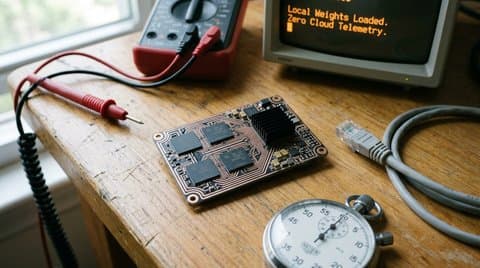 Compact Edge NPU Silicon Circuit
True security is not a compliance checklist certified by an accounting firm. True security is an air gap.
When a hospital processes patient pathology scans on a sovereign workstation in the radiology suite without an external gateway, the medical record cannot be ransomed by an international hacking syndicate through a compromised cloud API key. When a maritime shipping firm calculates its commercial freight arbitrage on a local server blade in Rotterdam, its cargo margins cannot be monitored by competing sovereign intelligence services.
The Thermal Limits of Centralized Monopolies
Beyond memory bus constraints lies the insurmountable thermodynamic bottleneck of centralized hyperscale facilities. A modern high-density AI data center requires between forty and one hundred megawatts of continuous power—the equivalent electrical consumption of a European city of eighty thousand inhabitants. Over forty percent of that power does not perform computation; it is burned running chilled-water cooling loops, evaporative cooling towers, and massive heat exchanger arrays simply to prevent the silicon dies from melting through their substrates.
When an enterprise runs localized inference on unified twenty-watt silicon, the cooling apparatus is a single silent copper heatpipe and an aluminum fin stack cooled by ambient airflow. The thermal dissipation is so negligible that the machine can sit directly upon an engineer's wooden desk without raising the room temperature by a fraction of a degree. By distributing the computational load across thousands of local sovereign nodes rather than concentrating it inside a handful of suburban thermal blast furnaces, the enterprise achieves an order-of-magnitude reduction in thermodynamic waste.
The Starvation of the Rentier
The financial consequences for the technology industry will be catastrophic.
Wall Street has priced the hyperscale cloud providers under the assumption that they will extract permanent monopolistic rents from the entire knowledge economy of the twenty-first century. Venture funds have poured tens of billions of dollars into data centers whose equipment depreciates to scrap value within four years, banking on enterprise customers remaining too lazy or intimidated to run their own infrastructure.
That illusion is crumbling. Across engineering teams in Tokyo, Berlin, Zurich, and Seoul, the most capable architects are doing what serious engineers have always done when faced with an extractive middleman: they are self-hosting.
They are buying quiet, efficient silicon workstations, downloading open-weights model weights verified by cryptographic SHA-256 signatures, and severing the external telemetry feeds. They are discovering that owning your silicon is not a burdensome operational chore, but the ultimate expression of professional self-respect.
The rentier cloud was a historical parenthesis—an expensive, wasteful detour into centralized feudalism. The future belongs to the quiet machine sitting under the desk, humming softly in the dark, answering to no master except the human hands that built it.