
The Invisible Clock of Retroactive Decryption
In the cold logic of modern espionage, the value of a secret is not measured by its current protection, but by the lifespan of its relevance. For years, we have lived under the comfortable illusion that encryption is a binary state: it is either secure or it is broken. But as we navigate the complexities of 2026, we are forced to confront a more unsettling reality. The encryption that guards our national secrets, our financial systems, and our private identities today is already, in a very real sense, leaking. We are living through the era of 'Harvest Now, Decrypt Later' (HNDL), a massive, silent operation where encrypted data is collected in bulk by adversaries who are betting on the inevitable arrival of cryptographically relevant quantum computers (CRQCs).
The clock did not start with the first stable qubit. It started the moment we began transmitting sensitive data over networks protected by RSA and ECC—algorithms that we now know have an expiration date. For a forensics specialist, this is the ultimate cold case. We are watching the digital memory of humanity being stolen in real-time, destined for a future where its locks will simply evaporate. This is not a 'future threat'; it is a current exposure of historical significance.
The Economic Logic of the Harvest
Why would an adversary spend billions of dollars today to store data they cannot read? The answer lies in the plummeting cost of storage and the compounding value of intelligence. In 2026, the cost of storing a petabyte of encrypted traffic is negligible compared to the potential payoff of decrypting a single diplomatic cable or a proprietary semiconductor blueprint five years from now. HNDL is not just a technical tactic; it is an industrial-scale investment in future leverage.
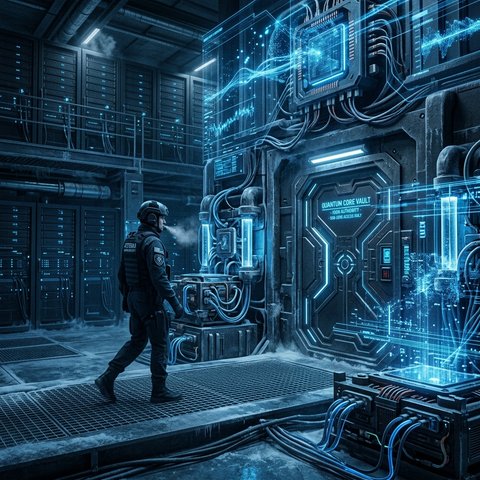
State-sponsored actors have optimized their 'collect-and-hold' pipelines. They are no longer looking for specific targets; they are vacuuming up the entire spectrum. This 'Architecture of Accumulation' means that if your data was on the wire in the last decade, it is likely already sitting in a sub-zero server farm in a jurisdiction beyond your reach, waiting for Q-Day. The vulnerability is retroactive. We are not just securing our future; we are in a desperate race to re-secure our past.
Beyond NIST: The 2026 Mandate for Crypto-Agility
The finalization of NIST’s post-quantum standards—FIPS 203, 204, and 205—was a watershed moment, but it was only the beginning of the struggle. In 2026, the conversation has shifted from 'which algorithm?' to 'how fast can we move?'. The industry has embraced the concept of 'crypto-agility'—the ability of a system to swap cryptographic primitives without a total architectural overhaul. But the reality on the ground is far from agile.
Legacy systems are the primary friction point. We find encryption embedded in places where it was never meant to be audited: hard-coded in IoT firmware, buried in ancient database schemas, and hidden in proprietary network stacks. The primary forensic task of 2026 is not investigation, but 'discovery.' We are using Automated Cryptography Discovery and Inventory (ACDI) tools to map the cryptographic surface of enterprises, often finding that the most sensitive data is the least prepared for the quantum transition.
Hybridization is our current bridge. By layering classical algorithms with post-quantum ones (like ML-KEM or Dilithium), we ensure that a failure in the new, relatively untested PQC standards doesn't leave us completely exposed. It is a 'defense-in-depth' strategy that acknowledges our uncertainty while mitigating our risk. But even a hybrid approach cannot protect data that has already been harvested. For those records, the damage is already done.
Forensics in the Quantum Shadow
As a forensics specialist, my work has traditionally been about reconstructing the past. In the post-quantum era, my work is about predicting which parts of the past will remain secret. We are now classifying data based on its 'Confidentiality Lifespan.' Financial data may only need to remain secret for seven years; health data for a lifetime; and nuclear launch codes indefinitely. The quantum threat is an existential crisis for data with long lifespans.
We are seeing the rise of 'Quantum-Resistant Vaults'—physical and digital infrastructures designed to protect the 'Digital Memory of Humanity.' These are not just server racks; they are sovereign archives where the most sensitive historical records are being re-encrypted with PQC and shielded from future decryption attempts. But the scale of the task is overwhelming. How do you re-secure an entire planet's worth of legacy data?
Q-Day: The Event Horizon
When will Q-Day arrive? The estimates are compressing. In early 2026, breakthroughs in error correction and qubit stability have pulled the timeline closer than many expected. Some analysts suggest that a cryptographically relevant quantum computer could be operational by 2029. This is the event horizon of digital security. Beyond that point, the current foundations of the internet—the protocols that secure our commerce, our privacy, and our trust—will simply cease to function.
The urgency is not about the day the computer turns on; it is about the years of exposure that precede it. If Q-Day is 2030, and you have data that must remain secret for ten years, you are already five years late to the transition. The quantum threat is a time-traveling attack. It reaches back from the future to break the secrets of the present.
The Architecture of Silence and Resilience
At Soogus, we advocate for an 'Architecture of Silence'—a design philosophy that prioritizes minimalism and local agency. In the context of cybersecurity, this means reducing the data footprint and ensuring that sensitive information is processed locally whenever possible. The more data we transmit over the global grid, the more we feed the HNDL silos of our adversaries. Resilience in 2026 is about choosing what not to store just as much as it is about how to encrypt it.
The transition to a post-quantum world is the most significant technological migration in history. It requires more than just new math; it requires a new mindset. We must move from a world of static security to one of dynamic crypto-agility. We must treat our digital archives not as static piles of bits, but as living organisms that must evolve to survive. The Post-Quantum Vault is not a physical place; it is a commitment to the permanence of truth in a synthetic age.
Conclusion: Guarding the Memory
The digital memory of our species is our most precious asset. It contains our discoveries, our art, and the record of our existence. To allow it to be retroactively decrypted and manipulated is to lose our connection to reality. As the quantum clock ticks toward Q-Day, our primary duty is to ensure that the secrets of today remain the foundations of a secure tomorrow. The vault is being built, but the doors are already closing. It is time to move beyond the harvest.