

The Nuclear Parasite: Co-Located Compute, Grid Securitization, and the Great Fossil Backslide
In the regulatory filings submitted to the Federal Energy Regulatory Commission (FERC) and regional transmission operators, a profound transformation of the electrical grid is taking place without public debate: the cannibalization of civilian baseload clean power by private artificial intelligence clusters.
Over the past eighteen months, the world’s largest technology conglomerates have confronted the ultimate physical ceiling of their infrastructure ambitions. It is not a shortage of silicon or a limitation of cooling fluid, but the multi-year queue required to interconnect a new gigawatt-scale facility to the high-voltage transmission grid. In major regional transmission zones like PJM Interconnection—which covers thirteen eastern states from New Jersey to Illinois—the timeline to secure a new grid interconnection permit now stretches beyond 2031.
Unwilling to pause their capital expenditure race, hyperscalers have engineered an aggressive regulatory circumvention: "behind-the-meter" co-location. Rather than financing and constructing new generation facilities, cloud operators are purchasing existing, operational nuclear power stations outright, physically walling off reactors from the public grid, and redirecting hundreds of megawatts of zero-carbon baseload electricity directly into private inference clusters.
On investor presentations, this strategy is marketed as an eco-friendly triumphs of green computing. In the physical reality of the power grid, however, it represents an parasitic extraction. By severing existing clean generation from public transmission lines, Big Tech is starving civilian grids of decarbonized electrons, forcing regional utilities to delay the retirement of century-old coal plants, and socializing billions of dollars in stranded transmission costs onto residential ratepayers.
The Co-Location Gambit: Skipping the Seven-Year Queue
To understand the mechanics of the nuclear parasite, one must examine how high-voltage transmission grids balance power and finance capital.
When a nuclear power plant like Susquehanna or Three Mile Island was constructed, it was capitalized through state-sanctioned utility monopolies and ratepayer-backed bonds. Generations of ordinary residential and small commercial consumers paid higher monthly utility bills to construct the high-voltage substations, 500-kilovolt transmission corridors, and spinning-reserve infrastructure necessary to integrate that gigawatt of reliable baseload power into the regional grid.
In an open-access grid, electricity flows according to Kirchhoff's laws. The power generated by a reactor enters the regional transmission pool, lowering wholesale electricity prices for the entire geographic footprint and displacing carbon-intensive marginal generation—primarily open-cycle gas peakers and pulverised coal boilers.
Under a behind-the-meter co-location agreement, a cloud conglomerate acquires the physical acreage adjacent to the nuclear switchyard. It connects its high-density computing clusters directly to the generator's busbar, before the power ever reaches the regional transmission grid.
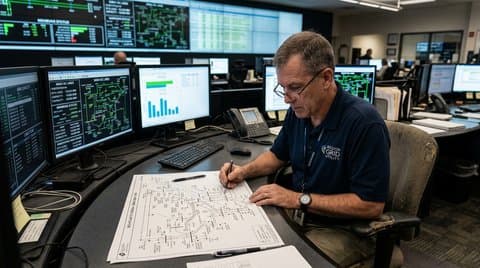 Utility control room dispatch monitoring
The advantages for the technology company are immense:
Queue Evasion: The datacenter avoids the six-to-eight-year FERC interconnection queue, securing nine hundred megawatts of firm capacity in twenty-four months.
Regulatory Bypass: By remaining technically "behind the meter," the facility attempts to exempt itself from paying regional transmission tariffs, ancillary service charges, and grid reliability fees.
Marketing Sovereignty: The enterprise claims that its frontier foundation models are powered by "one hundred percent carbon-free clean energy."
Yet in electrical engineering, subtraction is never neutral. When nine hundred megawatts of firm nuclear power are yanked from the regional transmission system, that energy does not disappear from public demand. The homes, hospitals, water treatment plants, and factories that relied on that baseload generation still demand their power.
The Fossil Backslide: Resurrecting Coal to Feed the Cloud
The vacuum left by co-located nuclear power is not filled by intermittent wind turbines or solar arrays that produce power only thirty percent of the day. A transmission grid operating at sixty hertz requires instantaneous, dispatchable, physical inertia.
When an AI cluster monopolizes a nuclear reactor's full output twenty-four hours a day, 365 days a year, regional grid dispatchers are forced to call upon the only remaining dispatchable assets capable of running at continuous capacity factors: legacy fossil units.
Across the PJM territory and the Southeast, utility integrated resource plans (IRPs) have undergone an emergency reversal:
Coal Plant Life Extensions: Electric utilities that had legally committed to decommissioning gigawatt-scale coal-fired generating stations between 2024 and 2026 have petitioned state public utility commissions for ten-to-fifteen-year operating extensions.
Gas Turbine Buildouts: Over thirty-five gigawatts of new combined-cycle natural gas generation have been proposed to backfill the civilian grid deficit created by datacenter demand.
Emissions Rebound: Regional carbon intensity curves, which had declined steadily for fifteen consecutive years through coal-to-gas switching and renewable integration, have flattened and begun climbing upward.
The irony is acute. While a hyperscaler displays sleek corporate dashboards showing net-zero emissions at its campus gate, the neighboring rural county experiences smog alerts and increased particulate pollution because a 1970s-era coal facility fifty miles away was forced to increase its burn rate to maintain grid voltage.
"To claim an AI cluster is green because it sits behind the meter of a nuclear reactor, while the surrounding town burns sub-bituminous coal to keep the lights on, is not carbon accounting; it is carbon laundering."
The Ratepayer Securitization Trap
The environmental regression is matched by an economic injustice: the privatization of benefits and the socialization of grid costs.
An electrical transmission grid is a shared physical commons. Its transformers, transmission lines, and frequency regulation reserves must be engineered to withstand peak simultaneous load. When a hyperscale campus connects to a nuclear plant, it does not truly sever its relationship with the broader grid. It relies on the regional grid as an emergency backup.
If the nuclear reactor undergoes an unplanned scram or shuts down for scheduled refueling every eighteen months, the datacenter cannot afford to go dark. In a fraction of a cycle, high-speed automated switchgear throws the compute load onto the public transmission system. The public grid must maintain hundreds of megawatts of "spinning reserves"—generators idling on hot standby—ready to absorb that massive load at a microsecond's notice.
+-------------------------------------------------------------------------+
|                  THE CO-LOCATED COMPUTE ENERGY DIVIDE                  |
+-------------------------------------------------------------------------+
| Nuclear Generation Monopolized (Behind-the-Meter):   800 - 1,200 MW     |
| Grid Reliability Deficit Left for Civilian Grid:     Equal Megawatt Gap |
| Compensatory Fossil Capacity Kept Online:            Coal & Peaker Gas  |
| Regional Transmission Tariffs Shifted to Homes:      $140M - $220M/yr   |
+-------------------------------------------------------------------------+
Under existing utility tariff structures, the fixed capital costs of maintaining these standby reserves and reinforcing regional transmission lines are rolled into general rate bases. State utility commissions are seeing requests for double-digit residential rate increases directly linked to transmission upgrades required by AI corridors.
Working-class households living in northern Virginia, central Ohio, and eastern Pennsylvania are discovering that their monthly electricity bills have surged thirty to forty percent over thirty-six months. They are directly subsidizing the transmission infrastructure that allows multinational software giants to train multimodal models at zero transmission tariff.
The SMR Mirage and the HALEU Bottleneck
Faced with mounting regulatory scrutiny from FERC and pushback from state consumer advocates, technology executives frequently point to a futuristic horizon: Small Modular Reactors (SMRs).
On social media and technology podcasts, SMRs are depicted as compact, factory-fabricated atomic engines that will be delivered by railcar and installed directly behind every datacenter by 2028. This narrative ignores the punishing realities of nuclear engineering and fuel cycle chemistry.
First, advanced SMR designs—such as high-temperature gas-cooled or molten-salt reactors—require High-Assay Low-Enriched Uranium (HALEU), enriched between five and twenty percent U-235. Currently, there is virtually no commercial-scale HALEU enrichment capacity operating outside the Russian Federation. Western domestic enrichment projects are years behind schedule and billions over budget.
Second, the regulatory licensing path through the Nuclear Regulatory Commission (NRC) for any unproven reactor architecture remains a decadal endeavor. Not a single commercial SMR is currently delivering commercial electrons to an AI datacenter in the Western world, and realistic engineering timelines suggest that fleet deployment before 2035 is a statistical impossibility.
SMR announcements are corporate theater: a promissory note used to soothe environmental investors today while technology firms continue their predatory cannibalization of existing 1980s-era nuclear infrastructure.
Re-Anchoring the Grid in Common Good
Electricity is not a speculative digital token. It is the fundamental physical prerequisite of human civilization. It pumps municipal drinking water, warms infant incubators in neonatal wards, powers regional transit networks, and heats homes through freezing winter nights.
The preemption of public, ratepayer-funded clean energy by private capital represents an existential challenge to the principle of utility governance. If the regulatory system permits hyperscalers to ring-fence the cleanest, most reliable power generation for autonomous code execution while leaving the civilian population to breathe coal emissions and pay inflated tariffs, the social contract of the public utility will rupture.
The solution is technically and legally clear:
Mandate Additional Generation: If a datacenter operator desires gigawatt-scale clean energy, it must finance, permit, and construct new, additive zero-carbon capacity rather than expropriating existing ratepayer assets.
Enforce Fair Transmission Tariffs: Any co-located facility that depends on the public grid for backup reliability must pay its full pro-rata share of regional transmission and spinning reserve expenses.
Grid-First Dispatch: During peak summer heatwaves and winter freezes, public utility commissions must retain the authority to curtail non-essential inference compute, returning clean nuclear megawatts to the civil grid where human lives depend on them.
The transition to post-scarcity energy cannot be built upon the re-pollution of the commons. If machine intelligence is to have a future, it must learn to pay its own thermodynamic freight.