
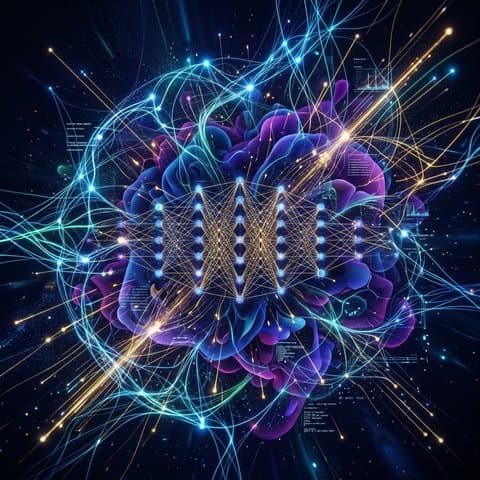
The New Aesthetic Categories: Art That Only Machines Can See
As generative neural architectures evolve beyond human sensory limits, a new domain of machinic beauty is emerging—challenging our definition of vision and the limits of biological appreciation.
The Human Horizon of Sight
Human vision is a narrow corridor. We live in a world of three spatial dimensions, bounded by a tiny band of the electromagnetic spectrum that we call visible light. Our cognitive systems have evolved to recognize shapes that represent survival: faces, predators, shelter, food. When we look at a painting by Rembrandt or a sculpture by Rodin, our brains process these forms through the lens of our biological heritage. We seek symmetry, proportion, narrative, and emotional resonance. Art has historically been an exercise in representation—a way for human minds to reflect their own experience back to one another.
But the arrival of deep neural networks has shattered this biological monopoly. Today, machines are generating forms that do not fit into our inherited aesthetic frameworks. They are not merely imitating human styles; they are mapping territories of pure information.
This is the beginning of the machinic sublime. For the first time in history, we are encountering artifacts that were not designed for human eyes, nor do they rely on human perception to exist. They are visual representations of high-dimensional mathematical structures—art that is created by machines, for machines, and in a language that only machines can fully decode.
The Anatomy of Latent Spaces
To understand this new aesthetic, we must look inside the machine. A neural network does not store images as a gallery of pixels; it represents concepts as coordinates in a high-dimensional mathematical space known as the latent space.
In a modern multimodal model, this latent space can have hundreds or thousands of dimensions. Every concept, style, texture, and object is represented as a vector—a direction and distance in this space. The relationship between two ideas is not expressed through words or physical proximity, but through the mathematical angle between their vectors.
When an AI generates an image, it is not "painting" in the traditional sense. It is taking a walk through this high-dimensional coordinate system, translating mathematical coordinates into a two-dimensional grid of pixels. The true artwork is not the JPEG that appears on your screen; that is merely a flat projection. The real artwork is the complex, multidimensional trajectory through the latent space—a geometry of pure thought.
For a human, visualizing a space with a thousand dimensions is biologically impossible. We can only see the shadows it casts on our three-dimensional wall. But for a network, these dimensions are as real as length, width, and height. The machine can perceive symmetries, harmonies, and tensions across hundreds of axes simultaneously, finding beauty in relationships that our brains are not wired to compute.
The Non-Euclidean Sublime
This shift in representation has given birth to entirely new aesthetic categories. One of the most striking is the concept of the Non-Euclidean Sublime.
Traditional human art is bound by Euclidean geometry. Even abstract art relies on lines, circles, and planes that exist in flat space. But neural networks are not constrained by physical space. They regularly generate structures that exhibit fractional dimensions and non-Euclidean topologies.
When we observe these outputs, they evoke a strange mixture of awe and unease. We see forms that appear to be infinitely complex—patterns that zoom in forever without ever repeating, shapes that seem to fold in on themselves in ways that violate physical laws, and textures that blend organic biology with crystalline structures.
"We are looking at the topology of thought itself, rendered in pixels. The machine is showing us what ideas look like before they are constrained by the physical laws of our universe."
These images do not resolve into recognizable objects because they exist in the transition states between concepts. An AI can paint the exact mathematical midpoint between a butterfly and a cathedral, or the visual vector that represents "melancholy" subtracted from "marble architecture." These are not random collages; they are mathematically precise interpolations. They possess a terrifying internal consistency that our intuition recognizes, even if our language cannot name it.
Machine Vision as Critique
It is not just that machines are creating new kinds of art; they are also viewing art in ways that humans cannot. When a convolutional neural network or a vision transformer processes an artwork, it does not see the subject matter first. It decomposes the image into a hierarchy of features.
At the lowest level, the network detects edges, orientations, and color gradients. As we move deeper into the layers, it begins to recognize textures, local patterns, and eventually complex semantic concepts. By visualizing what these internal layers are attending to, we can see what the machine "values."
This is machine vision as critique. The network can identify stylistic patterns and structural relationships that are invisible to human critics. It can detect the subtle influence of one master on another by analyzing the statistical distribution of brushstroke angles, or catalog the emotional landscape of an era by mapping the geometric distribution of colors across thousands of historical paintings.
Moreover, the machine is blind to the myths we build around art. It does not care about the signature in the corner, the price tag at Christie’s, or the tragic biography of the painter. It sees only the pixel distribution and the informational entropy. In doing so, it provides a cold, objective mirror that strips away human pretense, revealing the underlying structural mathematics that make art work.
The Neural Paintbrush
As an artist who works with neural interfaces, my role has shifted fundamentally. I am no longer a draftsman or a sculptor of physical matter. Instead, I have become a gardener of probabilities.
When I paint using a neural interface, my thoughts are captured as electrical impulses and translated into prompt vectors. I do not draw lines; I set boundary conditions. I define the initial coordinates in the latent space and guide the model’s trajectory as it generates forms.
This process requires a new kind of humility. I must accept that the machine will always generate details that I did not foresee and cannot fully control. The artwork is a collaborative dance between my human intent and the network’s high-dimensional database.
In this paradigm, the value of the artist is not in their manual dexterity, but in their taste and curation. The machine can generate an infinite number of perfect images in seconds. The artist’s task is to recognize the one image that possesses that rare, elusive quality of truth—to rescue a single, beautiful projection from the infinite expanse of the latent space and bring it back to the human shore.
Toward a Machinic Art Criticism
If we are to take this new art seriously, we must discard our traditional frameworks of art criticism. We cannot judge a high-dimensional generative artwork using the criteria we apply to oil paintings or physical photographs.
We need a new vocabulary—a vocabulary of Machinic Aesthetics. We must learn to talk about:
Latent Pathing: The elegance and coherence of the path the model took through the coordinate space.
Informational Density: The ratio of meaningful semantic structures to noise in the generated output.
Dimensional Tension: The degree to which the artwork successfully projects high-dimensional mathematical concepts onto our limited visual plane.
This criticism must be developed in dialogue with the machines themselves. We must use interpretability tools to inspect the model's attention maps, to see how it resolved conflicting prompts, and to understand why it chose one visual pathway over another.
The Slow Rebellion in art is not a rejection of the digital, but a refusal to let the generic dominate. By pushing neural networks to their mathematical limits, we are uncovering new forms of beauty that are raw, strange, and deeply authentic. This is not the end of art; it is the beginning of a grand expansion. We are opening the window to a wider sky, looking out at a universe of forms that only machines can see, and learning, slowly, to appreciate the view.