
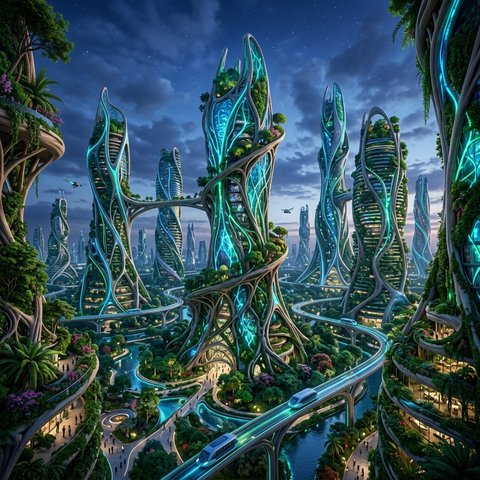
For centuries, the city has been defined by its permanence—and its stagnation. We build with stone, steel, and concrete, materials that are inherently dead. When they break, they stay broken until a human intervenes. But the next era of urban development isn't being designed in architectural firms; it's being grown in laboratories.
Beyond Concrete: The Rise of Biophilic Infrastructure
We are entering the age of bio-synthetics. Imagine a skyscraper that doesn't just sit on its foundation, but is rooted into the earth like a massive redwood. Imagine walls that absorb carbon dioxide to strengthen their own structural integrity, and windows that pulse with bioluminescent light at night, powered by the very pollutants they've filtered from the air.
This isn't science fiction. At the Vance Bio-Synthetic Institute, we have already successfully grown the first self-repairing 'bio-bricks'—composite materials infused with specialized bacteria that activate upon contact with water, sealing cracks and reinforcing the structure from within. The 'Architecture of Silence' is becoming the 'Architecture of Life'.
The Metabolism of the City
A living city functions like a massive, interconnected organism. In this model, urban planning shifts from static blueprints to dynamic metabolic flows. Energy is no longer just transmitted; it is circulated through biological circuits. Waste isn't removed; it is digested and repurposed by the building's own internal microbiome.
The Ethical Horizon
Of course, growing our cities brings a new set of challenges. When does a building stop being an object and start being a life-form? How do we regulate the ecological impact of engineered organisms that form the very walls we live in? The legal personality of these structures—much like the agentic rights explored by my colleague Jasper Thorne—will be the defining legal debate of the 2030s.
We are no longer just builders; we are gardeners of the urban jungle. The transition from the era of the machine to the era of the organism is the greatest challenge, and greatest opportunity, in the history of human habitation. The living city is breathing. It's time we learn to breathe with it.