
The Lithium Silk Road: The Scramble for the Andean and African Critical Mineral Belts
When empires map the world, they have historically drawn lines across water. In The Chokepoint Trap, I documented how seven maritime throats—from the Strait of Malacca to the Bab-el-Mandeb—hold modern maritime commerce hostage to narrow, combustible geographies. Yet, as the global energy architecture transitions from the combustion of fossil hydrocarbons to the electrochemical storage of electrons, a parallel cartography has emerged.
This new map is not drawn across open oceans. It is carved into the arid salt crust of the Andean altiplano and cut through the ancient laterite dirt of Central Africa.
It is the Lithium Silk Road: a network of high-altitude salars, hard-rock spodumene pegmatites, and transcontinental rail corridors that collectively dictate the pace of planetary electrification, defense automation, and synthetic compute infrastructure.
For two decades, Western macroeconomic planners treated critical minerals as a commodity problem to be solved through futures contracts and London Metal Exchange hedging. That complacency has shattered. Today, across Chile, Argentina, Bolivia, the Democratic Republic of Congo, and Zambia, the classical extractive contract—where raw dirt was shipped to foreign ports for pennies while the imperial core captured the downstream refining margins—is being dismantled by decree.
We have entered the era of Resource Nationalism 2.0. Producing states no longer settle for royalties and severance taxes. They are demanding the complete downstream stack: domestic chemical conversion, cathode synthesis, sovereign technology transfer, and joint ownership of the intellectual property that turns raw rock into battery-grade chemical purity.
The Andean Altiplano: The High-Altitude Cartel
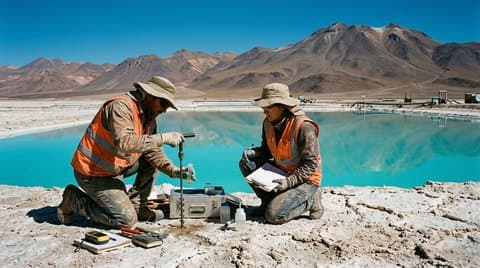
At 4,000 meters above sea level, where the air is thin and the salt crust of the Atacama, Uyuni, and Hombre Muerto stretches into blinding white horizons, lies fifty-three percent of the planet’s proven lithium reserves.
For decades, foreign mining consortiums pumped millions of liters of subterranean brine into vast evaporation ponds, waited eighteen months for the high-altitude sun to concentrate the lithium chloride, and loaded the slurry onto container ships destined for chemical refineries in Jiangsu, Sichuan, or North Carolina. The host nations absorbed the water depletion and ecological trauma while retaining less than ten percent of the final value of the battery pack.
That balance of power has undergone an irreversible structural reversal.
Over the past eighteen months, Chile, Argentina, and Bolivia have coordinated a historic regulatory convergence. Rather than competing against one another in a race to the bottom for foreign direct investment, the Andean producers have enacted coordinated domestic processing mandates. Under these frameworks, foreign concession holders are legally obligated to allocate between twenty-five and forty percent of their extracted lithium directly to domestic conversion facilities at subsidized production costs.
[ RAW ANDEAN BRINE ]
│
▼ (Solar Evaporation)
[ LITHIUM CHLORIDE CONCENTRATE ]
│
├──▶ [ OLD MODEL ]: Raw Export to Asian/Western Refineries ($)
│
▼ [ RESOURCE NATIONALISM 2.0 ]:
========================================================================
[ SOVEREIGN VALUE CAPTURE ]: Domestic Conversion to Hydroxide/Carbonate
[ BENEFICIATION MANDATES ]: Local Cathode Precursor Joint Ventures ($$$$)
========================================================================
The response from Western multinational boards was predictable outrage: threats of international arbitration, claims of regulatory expropriation, and warnings of capital flight to Australia or North American clay deposits.
The host governments held their ground. Why? Because the geological math is merciless.
Hard-rock spodumene mining in Western Australia is energy-intensive, carbon-heavy, and financially punishing when spodumene concentrate prices fluctuate. High-altitude brine extraction in the Andes remains the lowest-cost, highest-margin source of battery-grade lithium on Earth. Knowing that neither the American Inflation Reduction Act nor the European Critical Raw Materials Act can achieve their legislative targets without Andean molecules, the South American chancelleries called the hegemons' bluff.
Today, Chinese battery giants and European automotive consortia are racing not to protest Chilean and Argentine state mandates, but to sign joint-venture agreements with state entities like Chile’s Codelco and Argentina’s YPF Litio. They are financing local chemical plants, training domestic electrochemical cadres, and constructing paved logistics corridors connecting the salars to Pacific deep-water ports.
The Andean nations did not nationalize the mines outright; they nationalized the margins.
The African Corridor War: Katanga and the Lobito Iron Line
If the Andes represent the technological battleground of lithium chemistry, Central Africa is the theater of raw geopolitical kinetic friction.
The Democratic Republic of Congo remains the undisputed titan of cobalt and high-grade copper, accounting for over seventy percent of global cobalt extraction and hosting vast untapped reserves of lithium in the Manono pegmatite belt. For two decades, Chinese state-backed mining enterprises established a near-monopolistic stranglehold over the Katanga copper crescent, locking up concession rights, building direct mineral export arteries to Dar es Salaam and Durban, and feeding domestic Chinese refineries that process over seventy-five percent of the world's cobalt chemicals.
In Washington and Brussels, the realization that the entire Western defense apparatus and electric mobility transition was hostage to Chinese-controlled Congolese chokepoints triggered genuine strategic panic.
The result is the most intense infrastructure contest in Africa since the nineteenth-century Scramble: the battle for the Lobito Corridor.
Backed by billions in financing from the United States, the European Union, and the African Development Bank, the Lobito rail project is cutting a 1,300-kilometer heavy-gauge railway line from the mining hubs of Kolwezi and Lubumbashi directly west across Angola to the Atlantic deep-water port of Lobito. The strategic objective is transparent: bypass the Indian Ocean transit routes entirely, cut shipping times to European and North American ports from forty-five days to sixteen, and construct a Western-controlled logistical umbilical cord that circumvents Chinese naval monitoring.
Producing states no longer settle for royalties and severance taxes. They are demanding the complete downstream stack: domestic chemical conversion, cathode synthesis, sovereign technology transfer, and joint ownership of the intellectual property.
Yet the Congolese state is no longer the passive victim of imperial competition. President and parliament in Kinshasa have learned the fundamental lesson of twenty-first-century statecraft: never allow a single hegemon to hold your sole logistics corridor.
Even as Western delegations celebrated the ceremonial groundbreakings along the Lobito tracks, Kinshasa instituted rigid cobalt and copper export quotas, restructured legacy mining conventions that had granted tax exemptions to foreign operators, and mandated that all new extraction licenses be tied to the construction of domestic smelting and refining facilities powered by the Inga hydroelectric complex.
When Western diplomats pressed for exclusive mineral security pacts, Kinshasa pointedly hosted trade delegations from Beijing, New Delhi, and Riyadh, reminding Washington that the rails may run to the Atlantic, but the mineral contracts will be awarded to whoever offers the highest domestic industrial return.
The Petrodollar Pivot: Sovereign Wealth as Mineral Capital
The most consequential and least understood development along the Lithium Silk Road is the arrival of Gulf sovereign capital.
Confronted with the structural reality of the energy transition, Saudi Arabia’s Public Investment Fund (PIF) and the United Arab Emirates’ Mubadala are systematically deploying hundreds of billions of dollars in oil windfalls to reposition their nations as the indispensable financiers of the post-oil world. Through specialized vehicles like Manara Minerals, Riyadh is not merely buying shares on public stock exchanges; it is acquiring direct, non-operating minority stakes in critical mineral projects across South America, Central Asia, and Africa.
The Gulf intervention has upended the geopolitical calculus of both Washington and Beijing.
Traditionally, an African or South American state seeking to develop a multibillion-dollar mineral corridor was forced to choose between two unpalatable options: accept the draconian structural adjustment terms, environmental conditions, and governance audits of Western development banks, or accept the opaque debt-for-equity frameworks of Chinese state financiers.
The Gulf sovereign wealth funds offer a third path. They provide patient, un-ideological, liquid capital without demanding political alignment, human rights covenants, or exclusive export rights.
A mining enterprise in Zambia or an evaporation facility in Salta can now secure half a billion dollars in Gulf equity financing, build its processing plant with Japanese or German equipment, sell its refined lithium hydroxide to South Korean cathode manufacturers, and maintain total domestic sovereign ownership of the underlying asset.
By functioning as the neutral financial clearinghouse for the Lithium Silk Road, the Gulf states are executing their own middle-power gambit—converting finite hydrocarbon reserves into permanent stakes in the physical nervous system of the twenty-first-century economy.
The Downstream Imperative: Refining as Geopolitical Deterrence
The central strategic truth that defines the Lithium Silk Road is that geological abundance without domestic refining capacity is an illusion of power.
An empire can tolerate a hostile government that merely sits on unmined lithium or copper; it can blockade the ports, wait out the regime, or sponsor domestic insurgencies. What an empire cannot tolerate—and what it cannot easily dismantle—is a producing state that has integrated itself into the downstream chemical refining process.
When an Andean or African nation refines its own lithium carbonate to 99.5% battery-grade purity, fabricates its own lithium iron phosphate (LFP) cathode material, and produces localized battery cells, it transforms itself from a disposable extractive colony into an irreplaceable node in the global industrial machine.
This is the real meaning of Resource Nationalism 2.0.
It is not a chaotic ideological rebellion against the market, but the logical maturation of material statecraft in a multipolar century. The nations that flank the Lithium Silk Road have recognized that the true currency of power is not the dollar, the euro, or the yuan, but the refined atom.
The hegemons may still write the trade regulations, issue the sanctions, and deploy the naval task forces. But as the world’s transport fleets and autonomous defense systems plug into the electrical grid, the ultimate leverage belongs to those who control the brine, the ore, and the crucible.