
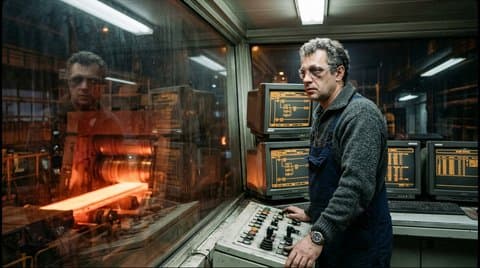
The Latency of Molten Steel
At forty-seven minutes past eleven on a damp Thursday night in November, continuous casting line number four at a heavy metallurgical works near Duisburg ceased to obey the laws of German industrial engineering and entered the realm of modern software architecture. The consequence was not an exception trace or a corrupted database record; it was three hundred and twenty metric tons of liquid carbon steel, heated to one thousand five hundred and forty degrees Celsius, solidifying into an immovable monolith inside the oscillating water-cooled copper mold.
The plant was nine months into an enterprise modernization initiative heralded by its corporate management as the "Autonomous Autonomous Cloud Mill." A Silicon Valley industrial software consortium had convinced the supervisory board that traditional Programmable Logic Controllers (PLCs) running cyclical ladder logic on isolated DIN rails were legacy relics of the twentieth century. In their place, the plant had deployed a containerized, cloud-connected edge inference harness running on a cluster of enterprise server blades located in an air-conditioned data center eight kilometers away in Düsseldorf.
The edge harness promised predictive optimization: an artificial intelligence agent would monitor thermal optical sensors, adjust the hydraulic withdrawal roll pressure, and modulate the flow of secondary cooling spray water in real time to minimize internal slab segregation.
On paper, the system was an architectural masterpiece of modern distributed computing. In the physical reality of continuous steel manufacturing, it failed for a reason so elementary that every apprentice boilermaker in the Ruhr valley understood it: a piece of red-hot carbon steel moving through a rolling stand at four meters per second does not wait for a TCP/IP packet retransmission.
The Illusion of the Soft Real-Time Cloud
For twenty-five years, enterprise software engineering has operated within the comfortable domain of soft real-time. In enterprise web development, an API response latency of one hundred and fifty milliseconds is considered performant; if a garbage collection pause in a runtime introduces a twenty-millisecond jitter spike, the end user staring at their mobile browser does not even register the delay. Modern cloud computing was designed from the silicon up to tolerate non-determinism: virtual memory paging, speculative execution, out-of-order CPU instruction scheduling, and asynchronous message queues all trade temporal precision for aggregate compute throughput.
Heavy industrial automation operates on the exact opposite axiom: hard real-time determinism.
+---------------------------------------------------------------------------------------------------+
|                     HARD REAL-TIME AUTOMATION VS. ENTERPRISE CLOUD ARCHITECTURE                   |
+--------------------------------+---------------------------------+--------------------------------+
| Dimension                      | Hard Real-Time PLC / Fieldbus   | Enterprise Cloud / Edge Agent  |
+--------------------------------+---------------------------------+--------------------------------+
| Execution Model                | Deterministic cyclic task (1 ms)| Event-driven asynchronous loop |
| Worst-Case Jitter Tolerance    | < 5 microseconds (strictly zero)| 10 to 80 milliseconds (common) |
| Memory Management              | Static pre-allocated registers  | Dynamic heap allocation / GC   |
| Networking Protocol            | Isochronous Profinet / EtherCAT | TCP/IP over TLS / HTTPS / gRPC |
| Failure Containment            | Hardwired mechanical watchdog   | Orchestrator container restart |
| Physical Consequence of Delay  | Zero (Invariants held hard)     | Mechanical explosion / Wreck   |
+--------------------------------+---------------------------------+--------------------------------+
In a heavy rolling mill, a slab of steel passing through a roughing stand generates separation forces exceeding four thousand metric tons. The hydraulic gap regulation cylinders must respond within five hundred microseconds to variations in steel thickness and temperature. If the hydraulic servovalve does not receive its correction signal within that exact cyclic window, the hydraulic cylinder cannot adjust, the roll neck experiences torsional overload, and a forged steel roller weighing eighteen tons can shear its main drive bearing with a sound like artillery fire.
The Hard Real-Time Invariant: Deterministic 1ms Scan Cycle → Pre-Allocated Static Registers → Isochronous Copper Bus → Hydraulic Stability
A hard real-time system is not a system that is merely "fast"; it is a system whose mathematical correctness depends as much upon the exact instant of delivery as it does upon the logical output of the computation. An answer that arrives three milliseconds late is not a slow answer; in heavy industry, it is a catastrophic failure.
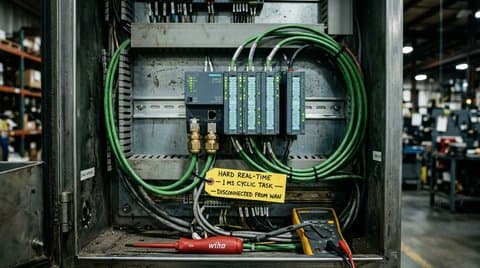 Open heavy industrial steel electrical cabinet showing DIN rail PLC modules with Profinet copper cabling
Post-Mortem of a Hydraulic Freeze
The forensic investigation into the Duisburg incident revealed a textbook anatomy of architectural hubris. The root cause was not a broken hydraulic line, an electrical short circuit, or a mechanical bearing seizure; it was the accumulation of four microscopic software latencies that compounded into a catastrophic control blindspot:
The Telemetry Serialization Penalty: High-speed thermal infrared cameras on the continuous caster were streaming uncompressed raw pixel arrays to an edge gateway. To transport the data across the corporate fiber link to the inference container, the gateway had to serialize the telemetry into JSON-RPC over TLS, introducing four point six milliseconds of parsing overhead.
Container Garbage Collection Jitter: The foundation model orchestrating the withdrawal speed was executing inside a containerized runtime environment that performed periodic heap compaction. At 23:46:12, a major garbage collection cycle stalled the inference thread for thirty-two milliseconds.
The Bufferbloat Lag: While the container was paused, the physical sensor telemetry queued inside an enterprise network switch buffer. When the inference thread resumed, it evaluated sensor readings that were forty-eight milliseconds out of date, treating a cooling slab that had already reached the hydraulic withdrawal pinch rolls as if it were still inside the secondary spray chamber.
The Missing Watchdog Hard-Trip: In classical PLC design, every output module is governed by a hardware watchdog timer that automatically drops the safety relays into a fail-safe mechanical posture if a cyclic heartbeat pulse is missed within two milliseconds. In the modernized "software-defined" architecture, the hardware watchdog had been replaced by a software timeout threshold of one hundred milliseconds to accommodate cloud latency variances.
By the time the edge model calculated its hydraulic correction and dispatched the command over the network, the cooling shell of the steel strand had ruptured inside the mold. Liquid steel breached the copper jacket, poured over the hydraulic lines, vaporized the hydraulic fluid into a ball of white smoke, and welded the entire withdrawal stand into a solid mass of iron.
The direct financial damage exceeded twenty-four million euros. The indirect cost—eight weeks of downtime on a primary blast furnace line supplying the European automotive sector—was nearly quadrupled.
The Revenge of the DIN Rail
Following the Duisburg catastrophe, the metallurgical group did not purchase more cloud compute, hire more prompt engineers, or upgrade its enterprise Kubernetes clusters. The supervisory board took an immediate, radical step: they terminated the digital transformation contract, physically severed the fiber cables connecting the production floor to the enterprise WAN, and ordered the restoration of traditional, un-virtualized industrial automation.
I spent four months in that Duisburg pulpit working with the original German electrical technicians. We reinstalled what the technology consultants had dismissed as obsolete:
Cyclic, Deterministic PLCs: Siemens S7-1500 and Beckhoff TwinCAT systems mounted directly on heavy steel DIN rails inside vibration-dampened cabinets. No operating system. No containers. No dynamic memory allocation. A single cyclic task running every single millisecond, scanning inputs, executing deterministic logic written in structured text and instruction lists, and setting outputs with sub-microsecond jitter.
Air-Gapped Isochronous Fieldbuses: Industrial Profinet IRT and EtherCAT running over shielded, oil-resistant copper cables. Every packet in an isochronous network has a reserved time slot on the physical wire; a sensor reading cannot be delayed by an email burst, a software update, or an authentication handshake, because the physical medium is locked to a shared hardware clock.
Mechanical and Hardwired Interlocks: Safety circuits that do not pass through software of any kind. If hydraulic oil pressure drops below ninety bars, a heavy mechanical spring physically opens the safety valve, bleeding the accumulator directly to the reservoir and halting the roll drives before any algorithm can debate the merits of the intervention.
+---------------------------------------------------------------------------------------------------+
|                        PHYSICAL AUTOMATION TRUTH AFTER THE DUISBURG AUDIT                         |
+------------------------------------+--------------------------------------------------------------+
| Modern Digital Transformation Myth | Hard Metallurgical Reality                                   |
+------------------------------------+--------------------------------------------------------------+
| "Everything should be software-    | Software without physical determinism breaks steel mills     |
| defined and cloud-native"          |                                                              |
| "Predictive AI optimizes better    | Predictive models cannot violate thermal conduction laws     |
| than classical PID loops"          |                                                              |
| "Edge containers reduce CapEx by   | Server blade downtime costs €180,000 per hour on cast lines  |
| eliminating proprietary PLCs"      |                                                              |
| "Unified IT/OT convergence unlocks | IT/OT convergence creates an attack surface for mill wrecks  |
| enterprise agility"                |                                                              |
+------------------------------------+--------------------------------------------------------------+
When the casting line restarted in March, the control pulpit had returned to the silence of true industrial mastery. The flickering browser dashboards and cloud performance graphs had been uninstalled. In their place sat two monochrome industrial monitors displaying simple, functional ladder logic rungs and analog motor amperage gauges.
The Limits of the Virtual
The tragedy of the modern technological imagination is its profound detachment from the physical physics of primary industry. The architects who design cloud runtimes and agentic frameworks live in a world where mistakes can be undone with a command-line flag, where physical inertia does not exist, and where mass is an abstraction that someone else worries about.
They do not know the smell of vaporized hydraulic oil in an enclosed control room. They have never felt the floor shake beneath their boots when three hundred tons of steel cool into a solid brick because a network socket timed out.
We will continue to hear grand promises about the total digitization of manufacturing—about autonomous factories running without human workers, guided by cloud foundation models that optimize every process from the other side of the planet.
Let those promises be made in the keynote auditoriums and the glass conference rooms of technology hubs. But in the heavy mills, in the chemical synthesis towers, in the hydroelectric turbine halls where human survival actually depends upon the reliable containment of immense physical forces, the copper cables will remain shielded, the DIN rails will remain bolted to solid steel, and the scan cycle will continue to tick, one millisecond at a time, completely indifferent to the illusions of the cloud.