
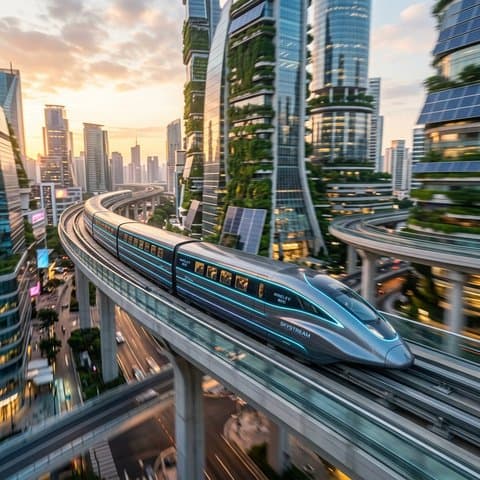
The Last Mile at 600 km/h: How Maglev Is Killing Short-Haul Aviation
As vacuum-tube and superconducting magnetic levitation corridors reshape continental transit, the carbon-heavy legacy of regional turboprops and jets is facing a sudden, structural demise.
The Terminal Velocity of Short-Haul Flight
For nearly a century, short-haul aviation enjoyed an unchallenged monopoly on regional speed. If a traveler needed to cross seven hundred kilometers in under three hours, a regional jet or turboprop was the only practical choice. Civil engineering on the ground, bound by the physics of steel wheels on steel tracks, struggled to exceed three hundred kilometers per hour without encountering massive maintenance costs and wheel-rail adhesion failures. We built airports on the peripheries of our cities, established complex security systems, and accepted the structural inefficiencies of flying.
But regional aviation is fundamentally flawed. When you fly a thousand kilometers or less, a disproportionate amount of fuel is burned during taxying, take-off, and the steep climb to cruising altitude. The aircraft rarely spends more than twenty minutes at its optimal fuel-efficient ceiling before it must begin its descent. Furthermore, the total travel time is artificially inflated by the logistics of the airport: the forty-minute trek from the city center to the terminal, the security queue, the early boarding call, and the baggage retrieval loop. A one-hour flight quickly becomes a four-hour ordeal.
At six hundred kilometers per hour on the ground, the math changes completely. When a maglev train can connect city-center to city-center in seventy minutes, the short-haul flight becomes a relic. It is not just about the velocity of the vehicle; it is about the structural efficiency of the entire transit network.
Superconductivity and Ground Dynamics
The breakthrough that unlocked these speeds was the transition from traditional rail dynamics to magnetic levitation (maglev) powered by high-temperature superconductors (HTS).
Traditional maglev systems, such as the German Transrapid or early electromagnetic suspension (EMS) models, relied on precise, active sensor control loops to maintain a tiny gap of fifteen millimeters between the train and the track. While functional, these systems are electronically complex and highly sensitive to thermal expansion and seismic shifts.
Modern high-speed corridors leverage electrodynamic suspension (EDS) systems utilizing superconducting magnets. By cooled superconducting coils onboard the train, the system creates a massive magnetic field that interacts with passive ground coils built into the guideway guide-walls. As the train moves forward, the opposing magnetic fields generate a natural, passively stable levitating force that lifts the train one hundred millimeters off the ground.
This larger gap changes everything. It makes the system virtually immune to minor track misalignments, seismic tremors, and snow accumulation. Because there is no physical contact, there is zero friction, zero mechanical wear, and a radical reduction in noise. The only barrier to speed is atmospheric drag. By removing the physical wheel-rail interface, we have unlocked a clean, silent, and structurally durable pathway across the landscape.
The Global Maglev Belt
We are witnessing the emergence of the Global Maglev Belt—a series of highly coordinated, continental-scale infrastructure projects that are redrawing the economic map.
In Japan, the L0 Series Shinkansen running on the Chuo Shinkansen line is connecting Tokyo and Nagoya at operational speeds of 505 km/h, with plans to extend the line to Osaka. What was once a multiple-hour journey is becoming a simple commute. In China, high-speed maglev lines are linking the megacity clusters of the Yangtze River Delta and the Pearl River Delta, creating single, integrated economic zones where millions of people can move seamlessly across hundreds of kilometers in less than an hour.
In Europe, the focus has shifted toward modular, cross-border corridors. Governments are realizing that instead of building new airport runways or subsidizing unprofitable regional flights, it is far more sustainable to fund high-speed ground transit. By linking major capitals—Paris, Brussels, Amsterdam, Berlin—with dedicated maglev guideways, the continent is creating a transportation spine that makes regional flights within Europe not just obsolete, but illegal under new environmental mandates.
"The sky was a temporary solution for regional transit. The ground, freed from the friction of wheels, is where the future of speed belongs."
Energy Footprints and Transit Economics
The environmental argument against short-haul aviation is well known, but the economic dimension is even more compelling.
An aircraft must lift its own weight, its fuel load, and its payload against gravity, requiring a massive expenditure of energy. A maglev train, suspended by passive magnetic fields, requires energy only to overcome aerodynamic drag and maintain propulsion. When we compare the energy consumption per passenger-kilometer, the maglev train is up to eighty percent more efficient than a regional jet.
Furthermore, maglev systems are fully electrified. They can draw power directly from clean, local microgrids powered by solar, wind, or nuclear fusion, bypassing the fossil fuel dependency of aviation. The capital expenditure of building a maglev guideway is undeniably high, but the operational costs are exceptionally low due to the complete absence of mechanical wear. A maglev guideway built today will operate for half a century with minimal maintenance, whereas an airport runway requires continuous resurfacing and an aircraft fleet requires constant, expensive structural inspections.
The Rebirth of the Linear City
The geographical impact of maglev is profound. Airports require vast, flat expanses of land far outside city centers, forcing a suburban sprawl of car parks, hotels, and logistics warehouses. Maglev stations, because they require a fraction of the footprint and can run underground, can be integrated directly into existing central train stations.
This integration triggers the rebirth of the linear city. When you can travel from downtown Tokyo to downtown Nagoya in forty minutes, the two cities merge into a single metropolitan corridor. Businesses can distribute their operations across different nodes, housing can be built in lower-density regions without isolating workers, and cultural institutions can serve a vastly wider audience.
This is a structural shift away from the hub-and-spoke model of aviation. Instead of forcing travelers to travel out to a peripheral hub only to fly to another peripheral hub, maglev creates a continuous, high-speed line where passengers can board and alight at multiple urban nodes with zero friction. The city is no longer a isolated island; it is a node on a high-speed continental spine.
The Quiet Corridor
Ultimately, the victory of maglev over aviation will be decided by the passenger experience. Flying is an exercise in stress. It is characterized by dry cabin air, cabin pressure changes, engine roar, and the constant threat of atmospheric turbulence. It is a hostile environment for cognitive work.
A maglev train traveling at six hundred kilometers per hour inside a semi-vacuum tube or on an open guideway is a quiet corridor. Because there is no contact with the track, there is no vibration, no click-clack of the rails, and no sudden jolts. Active stabilization systems continuously adjust the magnetic fields to counter crosswinds, ensuring a ride so smooth that a glass of water on a passenger table remains completely still.
The interior noise levels are lower than those of a library. The cabin air is pressurized to sea-level equivalent, preventing the fatigue and headaches associated with high-altitude flight. For the knowledge worker, the creator, or the researcher, a journey on a maglev train is not lost time; it is a highly productive, focused sanctuary.
As we look toward the mid-2020s, the choice is clear. The short-haul flight is a high-cost, high-emission, high-stress solution to a problem that has already been solved on the ground. The future of regional speed is silent, superconducting, and sovereign. The last mile at six hundred kilometers per hour has arrived, and the sky is finally clearing.