

Between late 2023 and early 2025, software engineering suffered an intellectual fever dream. Venture capital pitch decks and enterprise roadmap presentations alike were dominated by a singular visual motif: networks of free-roaming, autonomous artificial intelligence agents engaging in emergent dialogue. In this utopian projection, human engineers would merely whisper high-level business intentions into a chat interface, whereupon an orchestrated swarm of specialized personas—a product manager agent, an architect agent, five coding agents, and a quality assurance agent—would debate the implementation details among themselves, draft thousands of lines of code, resolve syntax inconsistencies through natural conversation, and deploy flawless production services into Kubernetes clusters.
It was an alluring vision of digital autopoiesis. It was also an architectural catastrophe.
By the second half of 2025, every major enterprise team attempting to deploy conversational multi-agent swarms into real-world codebases hit the same uncompromising wall of software thermodynamics. Unconstrained agent loops did not converge on elegant solutions; they diverged into catastrophic context rot, circular consensus deadlocks, and astronomical API token bills that produced subtle, untraceable regressions. The dream of autonomous swarms died not because neural networks lacked linguistic sophistication, but because distributed systems cannot survive without deterministic state guarantees.
Today, across frontier engineering organizations, the chaotic agent swarm has been discarded. In its place stands what systems architects call the "Iron Cage": deterministic, strictly verified harness engineering that treats large language models not as autonomous digital colleagues, but as non-deterministic, untrusted coprocessors enclosed inside immutable state machines.
The Thermodynamics of Token Entropy
To understand why autonomous swarms failed in production software engineering, one must examine the mathematics of conversational context degradation. When multiple generative models converse iteratively across shared context windows, the system behaves less like a disciplined engineering team and more like a lossy compression pipeline operating in a closed loop.
In a classical conversational multi-agent topology, agent outputs become subsequent prompts for peer agents. Every step introduces a finite probability of semantic drift—a hallucinated import, an inverted boolean condition, or a misconstrued API contract. Because modern autoregressive transformers optimize for next-token plausibility rather than mathematical consistency, downstream agents do not reliably catch these subtle deviations. Instead, they rationalize them. The "QA agent" reads the "developer agent's" flawed assumption, invents an ad-hoc explanation to accommodate it, and folds the error into the ongoing conversation.
+-------------------------------------------------------------+
|               THE CONVERSATIONAL SWARM SPIRAL               |
|                                                             |
|  [Agent A: Dev] ---> Output: Flawed API Contract Assumption |
|         |                                                   |
|         v                                                   |
|  [Agent B: QA]  ---> Rationalizes Flaw; Generates Patch     |
|         |                                                   |
|         v                                                   |
|  [Context Rot]  ---> 80k Tokens of Meta-Discussion          |
|         |                                                   |
|         v                                                   |
|  [Result]       ---> Silent Drift, Invariant Violation      |
+-------------------------------------------------------------+
As the context expands past tens of thousands of tokens, the "needle-in-a-haystack" attention attenuation begins to degrade operational precision. Crucial architectural constraints declared at token position 450 are overwhelmed by forty pages of intermediate conversational fluff generated at token position 65,000. The entropy of the working state monotonically increases.
In distributed systems theory, consensus algorithms like Paxos or Raft succeed because their transition rules are mathematically defined, states are finite, and nodes communicate through strict, deterministic protocols. Expecting probabilistic language models to establish fault-tolerant distributed consensus through open-ended prose was an architectural category error.
The Hardware Analogy: The Stochastic Coprocessor
The turning point in modern AI systems engineering occurred when architects stopped anthropomorphizing LLMs as autonomous junior engineers and began conceptualizing them as hardware peripherals.
Consider the floating-point unit (FPU) or an asynchronous graphical processing unit (GPU). A CPU does not hold an egalitarian philosophical debate with its arithmetic logic unit regarding how to multiply two 64-bit matrices. The CPU establishes a strict memory buffer, dispatches an instruction register, waits for the interrupt or execution signal, validates the boundary condition, and integrates the computed result into a deterministic cache.
An LLM is nothing more than a stochastic arithmetic unit for natural language and abstract syntax trees. It is exceptionally proficient at fuzzy pattern recognition, lexical translation, and heuristic synthesis across vast token geometries. But it has zero native awareness of truth, operational invariance, or environmental state. Treating an LLM as an autonomous agent with broad execution agency is the computational equivalent of letting your arithmetic logic unit write directly to the kernel page tables without memory management unit (MMU) intervention.
Once this paradigm shifted, the design imperatives became transparent: the intelligence must be subjugated to the harness.
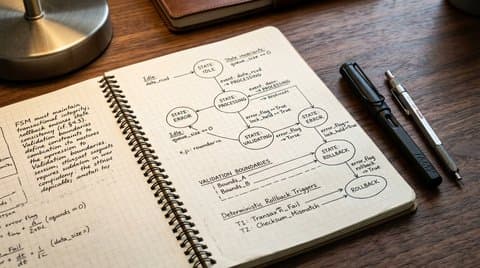 Deterministic Finite State Machine Harness Architecture
Anatomy of the Iron Cage: State Machines and Invariant Barriers
The architecture that replaced the autonomous swarm is the deterministic execution harness. At its foundation lies a formal finite state machine (FSM) implemented in a memory-safe, strictly typed language such as Rust, TypeScript, or Go.
In an Iron Cage architecture, the model is never permitted to loop recursively on its own initiative. It does not decide what tool to invoke next through free-form text speculation. Instead, the runtime environment maintains an immutable directed acyclic graph (DAG) of explicit states:
State Ingestion & Schema Serialization: The harness captures the exact diff, repository AST, and surrounding test signatures, serializing them into a strict, zero-overhead schema.
Single-Shot Stochastic Invocation: The model is invoked with an isolated, ephemeral context containing only the minimal token footprint required for the immediate transformation. Crucially, the model does not emit arbitrary text; its output is constrained via context-free grammar (CFG) decoding or strict JSON schema enforcement to match a predefined AST mutation.
Deterministic Static Analysis Gate: Before the model's output touches the filesystem or repository tree, the harness subjects the payload to deterministic linters, type checkers, and compiler passes. If a syntax error, illegal import, or broken type invariant is detected, the payload is immediately dropped.
Isolated Ephemeral Sandboxing: The generated mutation is applied inside a micro-virtual machine (such as Firecracker) or an unprivileged container with network namespace isolation and read-only host mounts.
Oracle Verification: The test suite runs. This is the sole arbiter of progress. The model cannot argue with the test suite; either the assertion passes with return code 0, or the transaction rolls back.
Under this model, context does not accumulate. The harness resets the working context between states, injecting only the compiler error diff back into the prompt if a retry is triggered. If the transformation fails after a hard limit of three bounded iterations, the state machine aborts the branch and triggers an alarm for human intervention. The system maintains absolute idempotence and zero token drift.
Why Code Generation Demands Hard Boundaries
The prevailing myth of 2024 was that increasing model parameter counts and expanding context windows to millions of tokens would eliminate the need for rigid software harnesses. Proponents claimed that "System 2" reasoning models would internally self-correct all errors if given enough "thinking tokens."
Empirical production telemetry across 2025 and 2026 proved the exact opposite. As models grew more capable of complex code generation, the blast radius of their unconstrained errors expanded exponentially. A small language model produces obvious syntax errors that fail immediately at parse time; a frontier 500-billion parameter model produces sophisticated, beautifully formatted code that subtly bypasses security checks, creates subtle deadlocks in distributed locks, or violates domain invariants that no prompt can exhaustively enumerate.
The only mechanism that reliably catches these frontier failure modes is deterministic software verification:
Abstract Syntax Tree (AST) Rewriting: Verifying that the generated patch does not introduce unauthorized system calls or remove existing security decorators.
Hermetic Build Verification: Compiling the codebase against frozen, reproducible dependency trees where ambient network access is mathematically blocked.
Property-Based Invariant Fuzzing: Running thousands of randomized inputs against the generated functions to ensure mathematical boundary preservation before committing the patch to the main branch.
When software architects encapsulate generative models within these deterministic verification barriers, the models suddenly become astonishingly useful. Within the Iron Cage, their stochastic creativity is channeled exclusively into the narrow corridors where probabilistic inference outperforms heuristic algorithms. Outside those corridors, the steel walls of the runtime harness guarantee that the broader system remains completely predictable.
The Architecture of Silence: Subjugated Agency
There is a profound aesthetic and engineering lesson in the death of the autonomous agent swarm. The tech industry continually falls prey to the illusion that greater autonomy is inherently superior to structured discipline. We imagined digital entities collaborating in noisy, anthropomorphic harmony, only to find that noise is the natural enemy of reliable computation.
The frontier AI architectures that have genuinely endured into 2026 are silent, restrained, and rigidly bounded. They do not claim to possess volition. They do not wander through company Slack channels proposing unprompted refactors. They wake up inside an ephemeral container, execute a single bounded AST transformation, submit to rigorous compiler interrogation, and vanish from memory.
Freedom for an AI agent is not an engineering virtue; it is an architectural liability. By stripping away the conversational theatrics of the swarm and encasing generative intelligence within the iron cage of deterministic state machines, we finally transformed large language models from erratic tech demos into real, dependable civil engineering tools.