
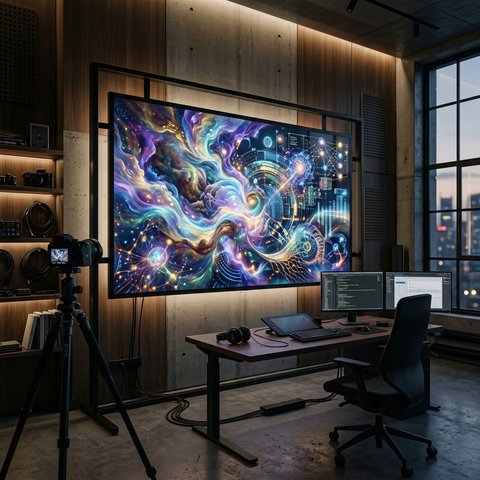
The Neural Frontier: Painting with Pure Thought
For centuries, the artist's struggle was one of translation. The gap between the firing of a neuron and the stroke of a brush was a chasm filled with physical friction—the weight of the hand, the viscosity of the paint, the limitations of the muscle. But in 2026, that chasm has been bridged. Through high-bandwidth neural interfaces, we are no longer painting with our hands; we are painting with our intentions. This shift is not merely technical; it is ontological. When the 'I' that perceives the world can directly project its inner imagery onto a digital canvas, the resulting aesthetics are unlike anything seen in the analog era. We are seeing the birth of 'Algorithmic Aesthetics'—forms that exist at the intersection of biological intuition and machine precision. These are works that the human eye can see, but perhaps only a neural network can fully parse.
The implications of this direct transmission are profound. In traditional art, the artist's intent is filtered through their technical skill. A painter might imagine a perfect sunset but lack the dexterity to capture its precise hue. With neural interfacing, the imagination *is* the brush. The 'Ghost in the Canvas' is not a machine spirit, but the raw, unmediated consciousness of the artist, rendered in high-definition pixels. This leads to what I call the 'Aesthetics of Intention'—a style where complexity is limited only by the artist's cognitive bandwidth rather than their physical endurance.
The End of the Medium as a Constraint
In the neuro-digital studio, the medium is no longer a physical constraint. If I think of a color that doesn't exist in the visible spectrum, the machine can simulate its perceptual impact. If I envision a texture that defies the laws of physics—a surface that is simultaneously liquid and crystalline—the canvas can render it. This freedom is liberating, but it also demands a new kind of discipline. Without the resistance of the physical medium, the artist must provide their own friction, their own boundaries. The art becomes a meditation on the structure of thought itself.
We are also seeing the emergence of 'Collaborative Cognition.' By linking neural interfaces, multiple artists can inhabit a single digital space, their thoughts merging to create a shared aesthetic vision. This is the ultimate realization of the surrealist 'exquisite corpse,' but conducted at the speed of thought. The resulting works are kaleidoscopic, shifting with the fluctuating attention and emotion of the collective mind. It is a new form of symphonic visual creation that transcends individual identity.
The Machine as a Mirror of the Mind
Critics argue that this 'thought-painting' removes the humanity from art, replacing it with algorithmic perfection. I argue the opposite. By removing the physical limitations of the body, we are allowing the most human part of us—our imagination—to manifest more fully. The machine is not the artist; it is the mirror. It reflects the intricate, messy, and beautiful patterns of our inner lives. The 'Ghost' is the part of us that has always sought to express the inexpressible, now finally granted a medium that can keep up with the complexity of the soul.
As we move further into this era, the definition of an artist will continue to evolve. It will no longer be about who can draw the straightest line, but who can sustain the most complex vision. The new aesthetics are not just seen; they are felt, neural pulse by neural pulse. We are not just making art; we are mapping the geography of human consciousness, one pixel at a time. The Ghost has left the machine and entered the canvas, and the world will never look the same.