

The Forgotten Factories
Why the Deindustrialization of the West and the Fantasy of Weightless Capitalism Unleashed the Revenge of the Material Heartland
In the damp basement of the municipal archive in Duisburg, filed under the unpromising classification Gewerbeaufsicht 1978–1984, there is a manila folder tied with faded hemp twine containing the inspection logs of the Meiderich blast furnaces. The ink has faded to the color of dry moss, but the entries maintain the stubborn precision of another epoch: tons of crude iron tapped per eight-hour shift, sulfur content in the metallurgical coke, and the daily tally of men who passed through the turnstiles wearing felt hats and dust masks. Attached to the final sheaf is a mimeographed memorandum from the board of directors, dated October 1982, informing the supervisory council that capital could no longer tolerate the friction of blast furnaces. The future, the memorandum argued in the early dialect of consulting firms, belonged to financial instruments, administrative licensing, and clean services. The furnaces were banked; within a decade, wild birch trees were pushing through the concrete of the charging floor.
For more than three decades, Western economic orthodoxy treated that memorandum not as a localized casualty of trade, but as a universal law of civilizational evolution. A consensus formed across party lines, business schools, and editorial boards: heavy manufacturing was an unsightly, low-margin chore better outsourced to distant sovereign jurisdictions where labor was cheap, environmental liabilities could be externalized, and coal smoke would not taint the clean glass skylights of metropolitan design bureaus. The West would keep the software, the intellectual property, the brand architecture, and the financial derivatives; others would stamp the steel, cast the engine blocks, and breathe the sulfur.
That conceit—what we might call the illusion of weightless capitalism—has now crashed into the hard physical realities of the mid-2020s. From the ammunition shortages that paralyzed European strategic reserves to the sudden discovery that the advanced semiconductor fabs of Saxony cannot operate without specialized high-purity chemical precursors manufactured in single industrial valleys abroad, the post-industrial fantasy has unraveled. The material heartland, dismissed for a generation as an embarrassing rust belt of angry retirees and redundant skills, has returned to extract its geopolitical revenge.
The Mirage of the Weightless Economy
The intellectual foundation of modern deindustrialization was laid in the triumphalist decade following the fall of the Berlin Wall. When political theorists declared the end of history, economists felt licensed to declare the end of physical constraints. Value, the new doctrine asserted, had migrated entirely from the factory floor to the symbolic manipulation of abstractions. A corporation that owned factories was considered clumsy, capital-intensive, and penalized by equity analysts; a corporation that owned merely patents, trademarks, and server contracts was rewarded with staggering price-to-earnings multiples.
This was not merely an economic calculation; it was an aesthetic and moral preference. The managerial elite of the 1990s and 2000s viewed industrial labor with quiet distaste. Industrial work was dirty, loud, rooted in physical place, and bound to labor unions with awkward collective memories. By contrast, the knowledge worker operated in air-conditioned neutrality, unburdened by geographical loyalties, manipulating lines of code or balance sheets across borderless networks. The material base of human civilization—the pipes, the rails, the kilns, the forging presses—was assumed to be an automatic background condition that would perpetually deliver goods on demand at declining marginal cost.
The table below contrasts the governing assumptions that drove thirty years of offshoring with the structural realities that have shattered that consensus.
Dimension | The Post-Industrial Orthodoxy (1990–2020) | The Revenge of the Material Heartland (2026+) |
|---|---|---|
Primary Economic Anchor | Intellectual property, software code, and financial engineering | Tooling capacity, metallurgical foundries, and energy density |
Supply Chain Philosophy | Just-in-time optimization, zero inventory, global single-source | Strategic redundancy, domestic stockpiles, and localized fabrication |
Conception of Labor | Interchangeable units of cost to be minimized or automated | Non-fungible tacit knowledge, artisanal metallurgy, and shop-floor guild craft |
Strategic Vulnerability | Margin compression and patent infringement | Sovereign blockades, maritime chokepoints, and raw material embargoes |
Geopolitical Stance | Frictionless globalization assuming perpetual peace | Sovereign mercantilism, industrial rearmament, and critical infrastructure control |
What the architects of this transition failed to grasp was that manufacturing is not simply a cost center that can be separated from design without consequence. As the economic historian David Edgerton observed in his reappraisal of twentieth-century technology, true technological mastery does not reside in the novelty of patent filings, but in the mundane systems of use, maintenance, and fabrication. When a society abandons the physical capacity to cast, machine, and weld, it does not become a pure society of thinkers; it becomes a society of dependents who have forgotten how their own physical world is sustained.
Tacit Knowledge and the Myth of the Turnkey Factory
The most dangerous assumption of contemporary industrial policy—exemplified by recent frantic legislative attempts to reshore microchips and battery plants through hundreds of billions of euros in state subsidies—is the belief that manufacturing capacity is merely a matter of capital allocation. Governments believe that if one writes a sufficiently large treasury check, buys state-of-the-art Japanese machine tools, and erects a steel-frame hall in an agricultural field, industrial sovereignty will reconstitute itself overnight.
It does not. A factory is not a machine; it is an ecosystem of tacit human memory.
The Industrial Memory Degradation Sequence: Factory Closure → Dispersion of Tool-and-Die Craftsmen → Interruption of Technical Apprenticeship → Loss of Tacit Shop-Floor Heuristics → Irreversible Evaporation of Metallurgical Competence
Consider the craft of the tool-and-die maker or the high-precision machinist. When a machine shop in the English Midlands or the Ruhr Valley closed its doors in 1997, the ledger recorded an orderly write-off of capital assets. The machines were sold at auction to workshops in Dongguan or Bursa. But what actually died on that afternoon was an unbroken chain of oral transmission stretching back to the nineteenth century.
How does an operator know by the pitch of the lathe’s whine that a high-tensile alloy is work-hardening prematurely? How does a foundry master judge the viscosity of molten bronze before pouring an intricate casting? These heuristics do not exist in training PDFs or computer-aided manufacturing manuals. They exist in the fingertips, the hearing, and the posture of men and women who stood at the carriage eight hours a day for thirty years, correcting the minuscule tolerances of machinery through physical instinct.
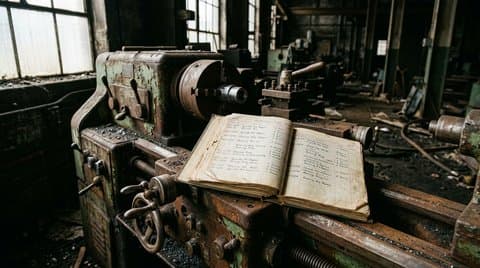 Industrial lathe and historic production archive
When that chain is snapped, capital discovers that money cannot buy back ten thousand hours of shop-floor instinct. Today, European aerospace firms and defense manufacturers report that their primary bottleneck is not access to venture capital or cloud computing, but the catastrophic shortage of qualified welders capable of working with high-pressure titanium joints. You can retrain an advertising copywriter to write prompts for an algorithmic text generator in an afternoon; you cannot train a master toolmaker in less than a decade of daily physical apprenticeship under master craftsmen.
The Political Geography of Abandonment
The consequences of deindustrialization were never distributed equally. The financial windfall of globalization accrued almost entirely to a handful of capital hubs—London, Paris, Frankfurt, Amsterdam, the tech corridors of California—while the material consequences were concentrated in secondary river valleys, coastal dockyards, and mining basins.
In those material heartlands, the closure of the factory was not simply an economic transition; it was the demolition of an entire moral universe. The industrial plant was the civic anchor that funded the local sports club, maintained the polytechnic institute, provided lifelong dignity to families, and created a working-class public sphere capable of collective negotiation. When it was dismantled, nothing replaced it except low-wage retail logistics warehouses where workers are monitored by wrist-mounted radio-frequency scanners, treated as biological telemetry nodes rather than skilled craftsmen.
The metropolitan political class reacted to the resulting social decay with a mixture of moral condescension and bureaucratic indifference. Displaced workers were told to "learn to code," to move to expensive capital cities where they could not afford rent, or to accept their permanent status as recipients of regional development transfers. The psychological wound of being declared civilizacionally superfluous by people who make their living writing slideware was far deeper than any statistical loss of income.
The political revolts that have shaken Western democracies over the past decade—from Brexit and the collapse of the French party system to the rise of populist insurrections across Central Europe—are fundamentally the political roar of these abandoned territories. They are not simply demands for higher transfer payments; they are demands for material relevance. The voter in the deindustrialized periphery understands intuitively what the metropolitan analyst cannot see: that a community that produces nothing tangible is a community with no sovereign leverage over its own destiny.
The Return of the Furnace
History does not move in smooth linear progressions; it moves in violent cyclical corrections. The era of frictionless, weightless globalization was an exceptional interlude enabled by an unprecedented geopolitical umbrella and artificially cheap energy. That interlude is over.
As the international system fragments into rival mercantilist blocs, the balance of power is shifting back from the nations that design the software to the nations that command the physical means of production. A nation that possesses five hundred thousand lines of proprietary artificial intelligence algorithms but cannot forge its own artillery barrels, refine its own lithium, or fabricate its own high-voltage transformers is a nation living on borrowed time. It is vulnerable to every naval blockade, every raw material embargo, and every maritime crisis in distant straits.
Rebuilding the material heartland will not be a sentimental exercise in nostalgia, nor can it be achieved through glossy ministerial brochures celebrating "green tech innovation hubs." It will require confronting uncomfortable truths: that heavy industry requires cheap, abundant, uninterrupted base-load energy; that technical vocations must be accorded higher civic prestige and remuneration than financial speculation; and that sovereign independence cannot be maintained on a foundation of imported steel.
In the archives of Duisburg, the dust settles once more over the inspection books of the Meiderich works. But outside, along the cold banks of the Rhine, the wind carries a different realization. The furnaces were banked forty years ago in the belief that men could live entirely on abstractions and balance sheets. We are discovering now, in the chill of a harsher geopolitical century, that civilization is built of iron, stone, and human hands—and that the forgotten factories will have the final word.