

The First Scratch of the Pencil
There is a distinct, rhythmic sound that fills my classroom in Annecy every morning at quarter to nine, just after the children have hung their coats on the wooden pegs and the autumn mist from the lake still clings to the lower panes of our casement windows. It is the dry, mechanical rasp of an HB graphite pencil cutting into the fibrous grain of unbleached notebook paper.
To an adult accustomed to the frictionless glide of capacitive glass, it is a modest, almost imperceptible sound. But to anyone who understands the delicate, miraculous scaffolding of early childhood neurodevelopment, that scratching sound is the acoustic signature of human thought anchoring itself in physical matter.
This morning, I watched seven-year-old Émile struggle with the letter k. His small brow was furrowed, his tongue protruding slightly against his upper lip in that universal expression of intense motor concentration. His thumb and index finger gripped the hexagonal barrel of cedar wood so tightly that the nail beds were pale with pressure. He pressed too hard; the sharpened point snapped off with a sharp tic, leaving a dark smudge of carbon on the line.
Émile gasped. He looked up at me, startled by the finality of the fracture.
On a tablet screen, an error has no permanence. A child slides an eraser icon across a glowing display, and the failed stroke evaporates without leaving a mark. The glass resets, offering an infinite series of frictionless, consequence-free second chances. But on paper, the snapped graphite cannot be undone with a tap. The smudge remains as a physical historical record of excessive pressure.
Émile had to pick up his red plastic pencil sharpener, insert the broken tip, and turn it slowly, watching the fragrant curls of cedar wood peel away into his palm, until a fresh needle of graphite emerged. When he placed it back on the paper, his grip was five percent lighter. His nervous system had adjusted to the material limits of the world.
The Biomechanical Fallacy of the Glass Interface
For over a decade, educational technology lobbyists have promised ministries of education that replacing analog paper and pencils with digital tablets would accelerate literacy, democratize learning, and prepare six-year-olds for an inevitable technological future.
What they omitted from their glossy whitepapers is that human cognition does not develop in an ether of abstract symbols. It develops through the physical hand: through the somatosensory feedback loops forged between tactile nerve endings, muscle spindles in the palm, and the motor cortex of the brain.
┌─────────────────────────────────────────────────────────────┐
│          The Neurodevelopmental Handwriting Feedback Loop   │
│                                                             │
│   [Graphite Friction] ──► [Mechanoreceptor Spike]           │
│           │                         │                       │
│   (Physical Resistance)     (Proprioceptive Calibration)    │
│           │                         │                       │
│           ▼                         ▼                       │
│   [Parietal Lobe Encoding]──►[Visual-Motor Synaptogenesis]  │
│   (Bilateral Kinesthetic)   (Permanent Semantic Memory)     │
└─────────────────────────────────────────────────────────────┘
When a child writes with a pencil on rough paper, the nervous system receives a continuous stream of rich, high-frequency tactile data. The microscopic friction of the graphite sliding across cellulose fibers informs the brain of the exact speed, pressure, and trajectory of the stroke. The child feels the edge of the line before they even see it.
Dimension | Capacitive Glass Touchscreen | Rough Paper and Graphite Pencil |
|---|---|---|
Tactile Resistance | Zero coefficient of friction; slick, invariant surface | Dynamic mechanical friction varying with pencil angle |
Feedback Loop | Abstract optical flicker, latency delays, false hits | Instantaneous, high-bandwidth proprioceptive return |
Motor Engagement | Tapping, flicking, uniform low-effort swiping | Fine dynamic tripod grasp, muscular calibration |
Spatial Permanence | Disorienting infinite canvas, panning, zoom distortion | Fixed two-dimensional plane with clear margins |
Error Consequence | Frictionless undo button; error erasure without memory | Physical graphite smudge, sensory need to resharpen |
Cognitive Retention | Superficial visual recognition, rapid forgetting | Deep, bilateral sensorimotor encoding in long-term memory |
On a glass tablet, this somatosensory dialogue is completely silenced. A touchscreen has a friction coefficient approaching zero. Whether a child writes an a, an m, or swipes away a notification, the physical sensation transmitted to their fingertips is identical: slick, hard, and emotionally sterile.
The child’s hand is not being trained to sculpt meaning from matter; it is being conditioned to deliver uniform electrical discharges to an operating system.
Motor Dysgraphia in the First Grade
The consequences of this sensory deprivation are no longer theoretical. In classrooms across Europe and North America, occupational therapists and pediatric neurologists are reporting an unprecedented epidemic of motor dysgraphia among children entering elementary school.
Children arrive in the first grade with the hand musculature of toddlers. They cannot maintain a mature dynamic tripod grasp because their thenar and hypothenar muscles have never been strengthened by kneading clay, cutting heavy cardboard, or resisting the pushback of a pencil on paper. Their fingers collapse around the pencil like a fist, fatiguing within three minutes of continuous handwriting.
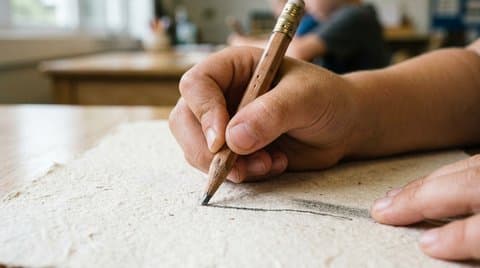 Child hand holding pencil practicing writing
When handwriting fails to become automatic, cognitive capacity is starved.
In developmental psychology, the concept of cognitive load explains that higher-order thinking—formulating a complex sentence, choosing an evocative metaphor, structuring an argument—can only flourish when the mechanical process of inscribing the symbols has been automated into muscle memory. If a child must expend eighty percent of their conscious attention simply trying to control the wobbling trajectory of a pencil, their working memory has zero bandwidth left for composition, spelling, or imagination.
The Sensory Inscription Pathway: Mechanical Resistance → Proprioceptive Muscle Spindle Activation → Motor Cortex Automation → Cognitive Bandwidth Emancipation → Autonomous Expressive Literacy
By removing the physical friction of paper in the early years under the guise of technological modernization, we have not liberated children; we have arrested their cognitive development. We have left them stranded in a state of permanent motor clumsiness, dependent on predictive text algorithms to complete sentences they never learned to form with their own bones and tendons.
Maria Montessori and the Organ of the Mind
A century ago, Maria Montessori made an observation that contemporary EdTech executives would do well to memorize: "The hand is the instrument of the human mind."
Montessori understood that abstract intelligence is not an innate software program running on wetware; it is an emergent property of manual interaction with the environment. When a child handles materials that have varied weights, distinct thermal conductivities, and unique surface textures, the brain builds an internal map of reality grounded in physical law.
A piece of rough wood resists a saw; a lump of terracotta clay yields to thumb pressure; a sheet of cotton paper drinks liquid ink. These material resistances teach the developing child what no digital interface can ever convey: that the world has autonomy, that reality does not bend to our immediate desires, and that creating something beautiful requires patient negotiation with matter.
The digital screen, by contrast, teaches a dangerous, infantile omnipotence. It creates the illusion that the entire universe can be manipulated with a flick of the thumb, without physical effort, without patience, and without consequence. When children raised exclusively on this digital diet confront the real world—where math problems take forty minutes of pencil work, where interpersonal relationships cannot be swiped away, and where building a birdhouse requires blistered palms—they experience acute behavioral collapse.
They have not been taught to endure friction. And without the capacity to endure friction, resilience is impossible.
The Cedar Shavings on the Desk
By eleven o'clock, the sun has burned through the alpine clouds, casting long golden bars of light across the classroom floor. On Émile’s desk, the morning work is finished.
Across the lined page, five lines of lowercase k march in an uneven, determined row. They are not perfect. Some tilt to the left; some have tails that dip slightly below the baseline; and beneath the third one, a faint grey ghost of the snapped graphite point still marks the paper where his mistake occurred.
Émile traces the fifth letter with the pad of his index finger, feeling the slight indentation where the hard lead pressed the fibers down into the desk wood.
He smiles. It is a slow, quiet smile of profound somatic pride. He made that letter. He did not download it; he did not tap an icon to generate it; he wrestled it into existence using his own muscles, his own eyes, and his own patience.
As the children pack their satchels for recess, I sweep the cedar shavings from the desk edges into my hand. They smell of resin, forest air, and honest work.
Let the digital enthusiasts build their synthetic worlds. In this classroom, we will keep our pencils sharp, our paper rough, and our hands firmly planted on the earth.