The Fifty Million Dollar Server Auction
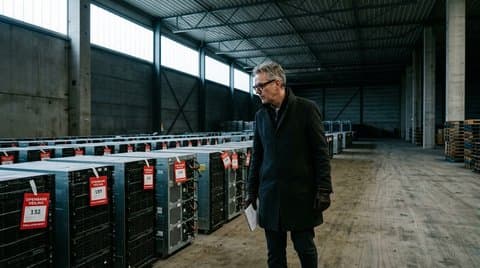
The acoustics of an unheated logistics warehouse in the Waalhaven district of Rotterdam have a way of sobering the most enthusiastic venture capitalist. When eighteen thousand square meters of bare concrete are populated only by silence, damp river air, and two hundred and forty decommissioned compute racks standing in straight, silent regiments, the grand narrative of synthetic superintelligence evaporates into thin air.
As a court-appointed insolvency receiver for the Rotterdam District Court, my job does not involve evaluating pitch decks, discussing artificial general intelligence milestones, or reading founder memoirs about manifest destiny. My mandate under Book 3 and Book 6 of the Dutch Civil Code is singularly unsentimental: inventory the physical assets, verify the lien registrations in the national pledge registry, verify who actually holds title to the copper busbars, and convert the entire estate into cash within ninety days to pay off unpaid severance wages, municipal tax claims, and Secured Creditor Class A debentures.
Eighteen months ago, the company whose silicon now stands in row after row on pallets before me closed a ninety-million-euro Series B funding round. The press release described them as "Europe’s premier sovereign intelligence fabric." Today, each node is tagged with a red plastic tie holding judicial lot label 199. And next Tuesday at ten o’clock, the auction hammer will fall.
The Myth of High-Salvage Hardware
In corporate boardrooms and investment committee memos, hardware is routinely capitalized as a comforting, tangible backstop. The financial models always contain a tidy footnote: “Even in a downside scenario, high-performance computing clusters retain significant liquidation value due to structural secondary market demand.”
This is the accounting equivalent of believing in the tooth fairy.
When a high-density cluster is ripped out of a specialized colocation facility under judicial receivership, its value does not decline gradually along an orderly depreciation curve. It collapses down an elevator shaft.
Capitalized Book Valuation vs. Judicial Liquidation RealitiesAsset Class | Pitch Deck Capitalized Value | Secondary Liquidation Realized Price | Legal & Operational Bottleneck |
|---|---|---|---|
Liquid-Cooled GPU Nodes (H100/B200) | €32,000 per blade (amortized over 36 mo.) | €3,800 – €5,200 per blade (bulk distress lot) | Proprietary manifold leaks; lack of manufacturer firmware warranties |
High-Speed InfiniBand Fabric (NDR/XDR) | €18,500 per director switch | €1,200 per unit | Optical transceiver degradation; zero secondary enterprise demand |
Modular PDU & Busway Infrastructure | €450,000 per row | Scrap copper melt value (€32,000) | Custom facility geometry; prohibitive de-installation labor costs |
Confidential Training Checkpoints | Booked as "Intangible Assets: €42M" | €0 (court-ordered cryptographic purge) | GDPR non-compliance; risk of copyright infringement contagion |
Herman Miller Ergonomic Task Chairs | €1,450 per unit (cost basis) | €85 per unit (bulk office package) | The only lot with consistent retail cash buyers from local co-working spaces |
The table above is drawn directly from the forensic estate audits of three separate enterprise AI insolvencies handled across the Randstad over the past eleven months. The gap between what accountants book under IAS 16 and what commercial liquidation buyers actually wire into the court’s escrow account is not a rounding error; it is a chasm of eighty-five to ninety percent of capitalized equity.
The Paper Trail of Capital Evaporation
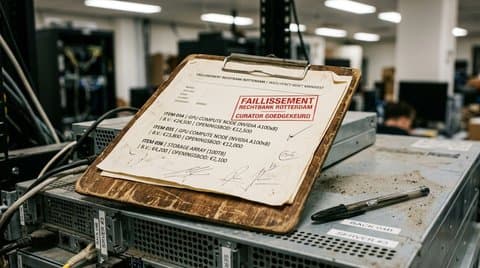 Judicial insolvency asset manifest resting on server chassis
Consider the official manifest resting on the top server casing of Rack 04B. Look at the handwritten pencil annotations under the red seal of the Rechtbank Rotterdam.
When our forensic accounting team unbolted the chassis covers and pulled the serial numbers against the bank collateral registers, we discovered what experienced liquidators have come to recognize as the standard shell game of late-stage artificial intelligence ventures. Over thirty percent of the server nodes were not owned by the debtor company at all. They were leased through a synthetic off-balance-sheet vehicle registered in Luxembourg, which had assigned the receivables to a mezzanine credit fund in London, which in turn had pledged the underlying silicon as security for a short-term liquidity facility issued by a commercial bank in Frankfurt.
The Insolvency Liquidation Cascade: Missed Colocation Utility Payment → Landlord Power Cut & Datacenter Padlock → Emergency Bankruptcy Petition → Forensic Inventory & Title Disentanglement → Scrap & Distress Hardware Fire Sale
When three separate financial institutions hold overlapping junior and senior liens on the same rack of compute hardware, the auction cannot proceed until months of contentious inter-creditor litigation have drained the remaining cash reserves. In the meantime, the hardware sits in an unheated warehouse. Thermal paste dries out; electrolytic capacitors age in damp coastal air; and two newer microarchitecture generations are announced in Santa Clara, rendering the entire lot technologically obsolete before the judge can even approve the sale prospectus.
Clawback Actions and the Dutch Actio Pauliana
Where does the money go when a company burns ninety million euros in eighteen months without delivering a commercial product? As bankruptcy curator, that is the question I spend my evenings answering under Article 3:45 of the Dutch Civil Code—the Actio Pauliana.
In almost every major technology insolvency, the forensic bank reconstruction reveals an unseemly pattern of pre-bankruptcy preferential transactions. Four months before the cash reserves hit zero, when the executive committee already knew that the Series C round was dead on arrival, special bonuses were wired to management consultancy firms owned by the founders' personal holding companies. Expensive software licenses were purchased in advance from affiliate entities incorporated in Delaware or the Cayman Islands.
Under Dutch law, any legal transaction entered into by the debtor prior to bankruptcy that was not strictly mandatory and which resulted in prejudice to general creditors can be voided by the bankruptcy trustee. This means our litigation team files formal clawback summonses against the former executive directors.
We demand the return of corporate funds used to finance private jet charters to Davos, personal advisory retainers, and accelerated vesting payouts. When these founders receive a registered judicial summons at their canal houses in Amsterdam or villas in Wassenaar, their standard response is one of shocked disbelief. They have spent five years being told by venture capitalists that failure is merely an iterative learning experience. In the chambers of a commercial bankruptcy judge, however, negligence and fraudulent conveyance are not called learning experiences; they are called civil torts with unlimited personal liability.
The Intangibles That Worth Less Than Zero
The most comical line item in any tech startup’s pre-bankruptcy balance sheet is always the valuation assigned to "Proprietary Models and Intellectual Property." Founders look at the thirty million euros spent on GPU cloud hours and convince themselves that because electricity was consumed, an asset of equal value must now exist inside the checkpoint weights.
In an insolvency liquidation, unaligned model weights are not an asset; they are a severe legal toxic liability.
No prudent corporate buyer will touch a bankrupt startup’s trained model checkpoint. Why? Because the provenance of the pre-training data is almost invariably undocumented, riddled with scraped copyrighted content, unlicensed academic databases, and private personal data ingested without statutory consent. To acquire the checkpoint is to inherit millions of euros in potential third-party copyright claims and regulatory fines under the European Union AI Act.
As receiver, my standard instruction to the court-appointed forensic IT marshals is straightforward: issue a certificate of definitive cryptographic destruction. We boot the storage arrays into an isolated live environment, overwrite the NVMe drives using multi-pass DoD 5220.22-M sanitization algorithms, and record the SHA-256 erasure hashes in the official bankruptcy record. Thirty million euros of investor capital and seven million kilowatt-hours of grid electricity, reduced to random thermal noise and zeroed bits, so that we can legally sell the bare metal drives for sixty-five euros apiece.
The Auctioneer’s Hammer at Waalhaven
Next Tuesday morning, the auctioneers will set up their folding table at the front of the warehouse. A gas space heater will roar in the corner, smelling of kerosene.
The crowd will not be made up of visionary venture capitalists wearing branded vests. It will consist of hardware brokers from Leipzig, crypto-mining scavengers from Eastern Europe, and local metal merchants who calculate the precise weight of the copper heat pipes and aluminum heatsinks to the nearest kilogram.
They will inspect the cables, tap the fans with screwdrivers to check the ball bearings, and make aggressive, dismissive bids. When Lot 054—eight high-density compute nodes that once powered a company valued at a quarter-billion dollars—comes up on the screen, the bidding will stall at twenty-two thousand euros. The auctioneer will look around the cold room, raise his wooden gavel, and strike the desk with a sharp, dry crack.
Sold.
The proceeds will be transferred into the curator's trust account. After deducting court fees, forensic accounting hours, warehouse storage rent, and priority tax liens, the junior creditors—including dozens of freelance software contractors and junior engineers who accepted equity packages in lieu of market salaries—will receive approximately four cents on every euro owed to them.
Outside, the cranes of the Rotterdam container terminal will continue lifting steel boxes from ships arriving from Shanghai and Singapore. The real economy—the economy of grain, steel, diesel fuel, and physical freight—moves on without pausing. And the empty warehouse will be swept clean, waiting for the next cohort of digital visionaries to mistake other people's money for permanent reality.