
The Energy Trilemma: Reliability, Affordability, and the AI Grid That Demands All Three
Hyperscale AI clusters are pushing national grids to their absolute breaking point, exposing the fragility of our energy infrastructure and demanding a transition to the only ultimate solution: commercial nuclear fusion.
The Raw Mathematics of Compute
In the spring of 2026, the global computing architecture is undergoing a spatial and thermodynamic reconfiguration unlike anything since the Industrial Revolution. For decades, internet and cloud growth was accommodated by incremental efficiency gains—virtualization, optical switching, and the steady march of Koomey’s law. Data centers were quietly integrated into municipal grids, drawing tens of megawatts at most, their cooling towers blending into suburban industrial parks.
Today, that quiet integration is over. The training and continuous inference of frontier artificial intelligence models have broken the traditional relationship between compute output and energy consumption. We are no longer discussing 10-megawatt data centers. The standard unit of deployment for a modern AI factory is now 100 megawatts, with hyperscale campuses in Virginia, Ohio, and Iowa actively planning or constructing gigawatt-scale clusters. To put this in perspective, a single gigawatt is equivalent to the output of a standard commercial nuclear reactor, capable of powering roughly 750,000 homes.
This scaling is brutal. Compute requires physical space, water, and continuous electrons. A modern Blackwell-class cluster does not idle; its power draw is a flat line with a capacity factor near 100 percent, demanding an unwavering baseload.
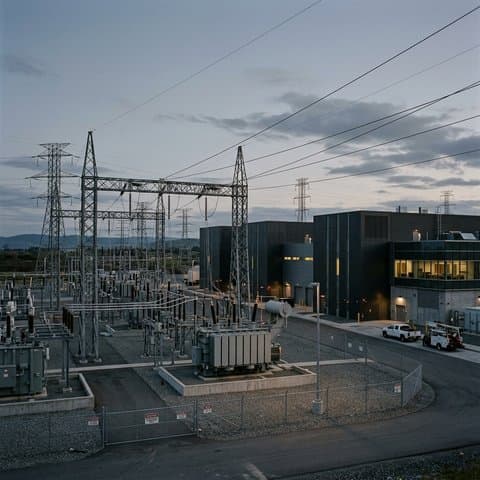
This demand has created a profound temporal mismatch between the digital and physical worlds. A capital-rich hyperscaler can lease land, procure hardware, and erect a shell for a massive data center in twelve to eighteen months. However, the physical infrastructure required to deliver electricity to that shell—the high-voltage transmission lines, the massive step-down transformers, the substation circuit breakers—takes four to ten years to plan, permit, and construct. The queue to connect new high-voltage loads to regional transmission grids has become the single greatest bottleneck in the expansion of artificial intelligence. We are attempting to run a 21st-century software revolution on a physical grid whose core components were designed in the mid-20th century.
This is where the speed-of-compute collides head-on with the speed-of-transmission. Tech companies are discovering that while code is infinitely malleable, grid physics are stubbornly unyielding. The bottleneck is not just the lack of generation; it is the physical capacity of the copper and steel lines suspended above our heads. When a gigawatt of demand is dropped into a localized node of the transmission grid, it does not merely consume local power; it alters the voltage profile and thermal limits of the entire regional network. The resulting congestion prevents cheap power from flowing where it is needed, forcing utilities to run expensive, inefficient local peaking plants just to keep the voltage from collapsing.
The Trilemma Exploded
To understand the scale of the challenge, we must analyze the situation through the classic framework of the energy trilemma: the delicate balance between reliability, affordability, and sustainability. For the last two decades, energy planners operated under the assumption that we could gradually transition our grids to intermittent renewable sources while maintaining affordability and slowly building out reliability. The artificial intelligence boom has shattered this consensus. It is a demand-side shock that requires all three vertices of the trilemma simultaneously, and it requires them now.
The Fragile Vertex: Grid Reliability and Baseload Strain
The first vertex, reliability, is where the immediate physical crisis is unfolding. Traditional grid planning assumes a highly variable load curve: demand peaks in the late afternoon as households run air conditioners and televisions, and falls to a low baseline overnight. This variability allowed grids to integrate growing shares of wind and solar power. When the sun shines and the wind blows, we use the clean energy; when they fade, we ramp down non-essential loads or draw from limited battery storage.
But a generative AI cluster running inference for millions of concurrent users or training a trillion-parameter model cannot adapt to the weather. It requires 24/7/365 power. If the power drops for even a fraction of a second, state-saving operations fail, millions of dollars of compute time are lost, and hardware can suffer thermal shock.
Current lithium-ion battery systems are designed for short-duration grid support—typically four hours of discharge to shave off evening peaks. They are inadequate for sustaining a gigawatt-scale data center through a multi-day winter lull. Consequently, hyperscalers cannot rely on local solar-plus-storage setups; they must plug directly into the transmission grid, demanding constant baseload capacity utilities struggle to provide. In areas like the PJM Interconnection—which spans thirteen states from Illinois to North Carolina—the sheer volume of data center connection requests has created localized grid bottlenecks. The sudden, high-magnitude load fluctuations of these clusters can cause voltage and frequency deviations that threaten cascading outages across the wider network.
The Societal Cost: Affordability and Ratepayer Equity
The second vertex is affordability, and it is here that the energy trilemma ceases to be an engineering problem and becomes a deeply political one. When a utility is forced to upgrade its transmission lines, construct new substations, or acquire emergency generation to support a new data center, those capital expenditures are not paid for solely by the tech company. Under current regulatory frameworks, these costs are entered into the utility’s rate base and distributed among all consumers in the territory.
In 2025 and 2026, we have seen the beginning of a major ratepayer backlash. In regional markets where data center growth is explosive, wholesale electricity prices have spiked. The PJM capacity auction for the 2025/2026 delivery year saw prices surge by over 800 percent, a direct reflection of a tightening supply-demand balance driven by retiring coal plants and skyrocketing load growth from compute hubs.
This price signal is already translating into higher monthly bills for households and small businesses. In effect, domestic ratepayers are subsidizing the massive electrical infrastructure required to train the next generation of large language models. This creates a severe equity challenge. A local grocery store or a low-income household has no interest in training a model to write marketing copy or generate synthetic art, yet they are paying the physical cost of the energy infrastructure that enables it. If this trend continues, we risk a populist rejection of the technology itself, driven not by existential dread of artificial general intelligence, but by the very real dread of utility bills that people can no longer afford to pay.
Furthermore, there is the growing risk of stranded assets. If a utility invests billions of dollars in new transmission lines and gas-fired generation to serve a massive data center complex, and that data center is shut down ten years later due to shifting corporate strategies, algorithmic efficiency breakthroughs, or the bankruptcy of the AI firm, who pays for the remaining debt on those assets? The answer, under current utility law, is the ratepayer. The public is being asked to bear the long-term capital risk of a highly volatile, rapidly evolving technology sector.
The Carbon Relapse: The Illusion of Sustainability
The third vertex is sustainability, where corporate narratives diverge sharply from physical reality. Over the past decade, technology companies built brands on 100 percent renewable energy commitments, signing massive Power Purchase Agreements (PPAs) for wind and solar.
But annual matching is an accounting fiction. A West Texas solar PPA does not deliver electrons to a Northern Virginia data center at 3:00 AM on a calm night. When the sun goes down, those clusters run on whatever the local grid provides—which, in Virginia, is predominantly natural gas and coal.
As compute demand has outstripped the pace of renewable installations, the industry has suffered a severe carbon relapse. To bypass the years-long queues for grid connection, some hyperscalers are turning to "behind-the-meter" fossil-fuel generation. We are seeing data centers co-located with dedicated, on-site natural gas turbines, effectively operating as private, fossil-fueled micro-grids. In other regions, utilities have delayed the planned retirement of coal-fired power plants specifically to keep up with the data center load. The climate goals of the early 2020s are being quietly sacrificed on the altar of speed-to-power. The immediate demand for training capacity has overridden long-term decarbonization commitments, locking in fossil-fuel infrastructure that will operate for decades to come.
The Failure of the Transition
We must be honest: our current energy transition strategy is structurally incapable of handling the compute boom. We spent fifteen years building a system around demand-side flexibility and intermittent supply. We built wind and solar assuming we could shift consumer habits and use batteries to smooth peaks.
But you cannot smooth out a gigawatt that never blinks.
Relying on PPAs has reached its logical limit. The grid has run out of hosting capacity for intermittent renewables in data center hubs. In parts of California and Texas, solar farms are routinely curtailed because transmission lines cannot carry the power. Adding solar panels without thousands of miles of new high-voltage lines does nothing to solve the energy crisis of the AI grid.
To bridge this gap, hyperscalers are engaging in desperate workarounds. We have seen deals to acquire power directly from existing nuclear plants—such as Amazon's purchase of the Susquehanna-linked data center campus or Microsoft's agreement to fund the restart of the Crane Clean Energy Center at Three Mile Island. While these deals secure reliable, carbon-free baseload power for the tech companies, they do not add new clean energy to the grid. Instead, they simply reallocate existing clean power away from the public, forcing the rest of the grid to rely even more heavily on natural gas and coal. It is a zero-sum game of carbon accounting that does nothing to solve the underlying systemic shortage.
Enter Commercial Fusion
If we cannot rely on intermittent renewables, and we cannot afford to burn more fossil fuels, how do we resolve the trilemma? How do we build a grid that is reliable, affordable, and sustainable?
The answer is commercial nuclear fusion.
For seventy years, fusion was the running joke of the physics community: always thirty years away. But in the mid-2020s, the joke finally died. The convergence of three distinct technologies—high-temperature superconducting (HTS) magnets, advanced computational plasma modeling, and the massive influx of private venture capital—accelerated the development of compact magnetic confinement fusion.
Unlike massive 20th-century tokamaks requiring decades of international collaboration, modern startups build modular, high-field tokamaks achieving net energy in devices the size of a shipping container. By using barium copper dyprosium oxide (BCSDO) magnets, these reactors generate magnetic fields over 20 Tesla, confining high-pressure plasma in a much smaller volume.
Fusion is the ultimate solution to the energy trilemma because it represents a complete break from the constraints of traditional energy sources. First, it is absolute baseload. A fusion reactor does not care if the wind is blowing or the sun is shining. It produces high-temperature heat that can run standard steam turbines continuously, day and night, with capacity factors exceeding 95 percent. Second, it is inherently safe and sustainable. It produces no high-level radioactive waste, has no risk of meltdowns, and requires only isotopes of hydrogen—deuterium and tritium—which can be sourced from water and lithium. Third, it is highly dense and scalable. A single gram of fusion fuel contains the energy equivalent of ten tons of coal, meaning that fusion reactors can be located anywhere in the world, completely independent of geographic features like river basins or sunny plains.
The politics of fusion are fundamentally different from those of fission. Traditional nuclear fission has been paralyzed for forty years by public fear, regulatory capture, and the astronomical capital costs of gigawatt-scale construction. Fission reactors are massive, bespoke civil engineering projects that take a decade to build and are highly sensitive to local political opposition. Compact fusion, by contrast, is a manufacturing play. Because these reactors are modular and small, they can be built in factories, shipped by rail, and assembled on-site in a fraction of the time. This shifts the economics of nuclear energy from high-risk capital expenditure to a predictable, declining manufacturing cost curve.
Engineering the Post-Scarcity Grid
To realize the promise of fusion, we must abandon the legacy architectural model of the centralized electrical grid. The traditional model—where power is generated at massive, remote plants and carried over hundreds of miles of transmission lines to distant consumers—is structurally incompatible with the energy density of fusion and the compute density of AI.
We must transition to a container-first, direct-attached energy architecture.
Instead of building gigawatt-scale data centers and waiting ten years for a grid connection, we must build modular data centers directly adjacent to modular fusion reactors. By co-locating the compute load with the generation source, we eliminate the need for long-distance transmission lines entirely. We bypass the grid connection queues, the wheeling charges, and the transmission line losses. The data center and the fusion reactor operate as a single, closed-loop micro-grid.
Here, the fusion reactor provides high-density baseload power directly to the racks, while waste heat runs absorption chillers for cooling. The entire installation occupies a footprint of just a few acres, yet delivers hundreds of megawatts of continuous, zero-carbon compute.
This is the blueprint for the post-scarcity grid. Direct-attached compute hubs protect the public grid from the destabilizing load shocks of AI training, removing pressure on residential ratepayers, stabilizing prices, and eliminating fossil-fuel peaking plants. The public grid remains focused on domestic needs, while compute is supported entirely by its own sovereign energy infrastructure.
The energy trilemma is not an insolvable puzzle; it is a design constraint. The AI grid demands reliability, affordability, and sustainability. If we attempt to satisfy these demands using the tools of the past—intermittent renewables, legacy transmission lines, and fossil-fuel compromises—we will fail, resulting in a fragile, expensive, and high-carbon infrastructure. But if we embrace the engineering reality of compact commercial fusion and co-locating our intelligence factories directly with our energy sources, we will not only solve the trilemma; we will unlock an era of post-scarcity energy that will power the transformation of our planet and the stars beyond.