
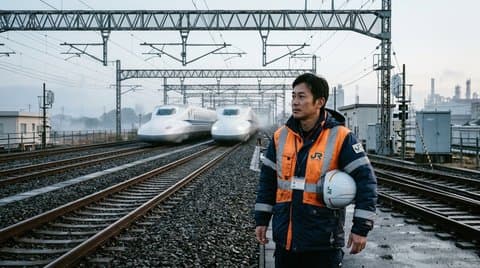
The End of the Regional Flight
At five-forty on a rainy Tuesday morning in Nagoya, the platform at Meieki station smells of ozone, wet concrete, and the clean metallic cold of high-tension electrical copper.
Train 401—a sixteen-car superconducting Maglev formation resting on the elevated guideway of the Chuo Shinkansen line—has no jet engines. It has no kerosene fuel tanks holding twenty tons of volatile hydrocarbons. It has no flight attendants instructing passengers to power down their mobile devices before taxiing for forty-five minutes across congested tarmac.
At five-forty-two, the magnetic levitation coils energize.
Without a jerk, without the roar of an ignition turbine, seven hundred tons of naval-grade aluminum and composite alloy rise exactly ten centimeters off the concrete bed, floating on a magnetic cushion generated by liquid-helium-cooled niobium-titanium superconducting magnets.
Fourteen minutes later, having accelerated smoothly through the Southern Alps tunnel network at five hundred and five kilometers per hour, the train glides to a silent halt at Shinagawa Station in central Tokyo, two hundred and eighty-five kilometers away.
Total elapsed travel time: thirty-two minutes from city center to city center. Total atmospheric carbon dioxide emissions: zero grams at the tailpipe.
Meanwhile, at Haneda Airport, thirty kilometers south of the Tokyo metropolitan core, a regional passenger jet bound for Nagoya is currently completing its third holding pattern in turbulent cloud cover, burning fifteen hundred kilograms of aviation jet fuel per hour while its passengers sit strapped into pressurized aluminum tubes waiting for an open runway slot.
In the boardrooms of legacy aerospace conglomerates and regional airlines, executives still speak of short-haul domestic flights as an essential pillar of modern economic connectivity.
They are looking at balance sheets from the twentieth century. From the perspective of classical thermodynamics and civil network engineering, the regional passenger flight is already an obsolete technological fossil.
The Thermodynamic Absurdity of Regional Aviation
To understand why short-haul commercial aviation is doomed to extinction, one must examine the brutal, unforgiving physics of the flight envelope.
An aircraft is an inherently inefficient vehicle for short-distance continental transport because it must invest the overwhelming majority of its energy expenditure simply overcoming gravity to climb to cruising altitude.
For a five-hundred-kilometer regional flight—such as Paris to Lyon, Frankfurt to Munich, or Tokyo to Osaka—over sixty percent of total mission fuel is burned during three phases: ground taxiing, high-thrust takeoff climb to twenty-eight thousand feet, and descent deceleration. The aircraft barely spends twelve minutes at its optimal aerodynamic cruising altitude before the flight crew must throttle back the turbines and begin descending.
Transport Dimension | Regional Turbofan Aviation (500 km) | Superconducting High-Speed Ground Rail |
|---|---|---|
Primary Energy Vector | Fossil kerosene burned directly in the upper troposphere | Grid-supplied electricity from hydro, nuclear, and renewables |
Terminal Geography | Outer perimeter airports requiring 45-min highway transit | Downtown urban transit hubs connected to metro lines |
Energy Recovery | 100% kinetic energy wasted as thermal brake and drag loss | 85% kinetic energy recovered via regenerative braking into the grid |
Weather Resilience | Vulnerable to crosswinds, fog, de-icing queues, holding stacks | All-weather guideway operations insulated from atmospheric turbulence |
Throughput Density | 180 passengers per departure; 20-min minimum runway separation | 1,200 passengers per train; 3-min moving block headway signaling |
Furthermore, commercial aviation operates on a thermodynamic dead-end: the impossibility of regenerative energy recovery.
When a high-speed electric train decelerates from four hundred kilometers per hour to enter a station, its linear synchronous traction motors act as electrical generators. The massive kinetic energy of the train is converted back into electrical current and fed directly back into the overhead catenary or guideway grid, powering an adjacent train accelerating out of the station.
When an airliner lands on a concrete runway, its kinetic energy is completely extinguished as useless, ambient heat: glowing carbon brakes reach six hundred degrees Celsius, and roaring reverse-thrust cascades dump gigajoules of thermal waste into the airport perimeter.
The regional flight is a thermodynamic machine that maximizes waste to minimize travel speed.
The Geometry of the Ground Network
The decisive advantage of high-speed rail and Maglev over aviation is not merely thermodynamic; it is network topology.
An airline operates on a point-to-point "hub and spoke" architecture that creates catastrophic logistical friction at its terminal nodes. Passengers must arrive two hours before departure to clear security checkpoints, surrender luggage, and navigate sprawling departure gates.
When you add the forty-five-minute ground transit from the city center to the remote suburban airport, a seventy-minute regional flight between European capitals routinely consumes four and a half hours of door-to-door transit time.
The Continental Rail Density Cycle: Urban Hub Proximity → Zero Baggage & Security Bottlenecks → Moving-Block High-Frequency Headways → Total Market Share Inversion
Airport Corridor (Total: 4h 30m):
[ City Center ] --(45m train)--> [ Airport ] --(90m security/wait)--> [ Flight: 60m ] --(35m baggage)--> [ Remote Transit ]

High-Speed Rail Corridor (Total: 1h 45m):
[ City Center Terminal ] === ( Zero Gate Friction: Board in 5m ) ===> [ 400 km/h Direct Rail ] ===> [ City Center Arrival ]
When high-speed rail reduces city-center to city-center travel time below three hours, the economic market share of regional aviation does not decline gradually; it collapses catastrophically.
When the Eurostar high-speed rail line opened between London and Paris, regional air traffic on the corridor collapsed by over eighty-five percent. When Spain deployed its high-speed AVE network between Madrid and Barcelona, cutting transit time to two and a half hours, domestic air travel between the two cities plummeted from five million annual passengers to a marginal commuter stub.
The same structural inversion is now unfolding across East Asia, Scandinavia, and Central Europe.
An airport runway can handle at most sixty aircraft movements per hour under optimal visual meteorological conditions. A modern high-speed rail corridor governed by digital moving-block signaling can dispatch a twelve-hundred-passenger train every three minutes in complete safety, delivering ten times the passenger throughput of a three-runway international airport using a fraction of the territorial land footprint.
The Materials Truth of the Ground Contact
The primary argument long mounted by the aerospace lobby against continental rail expansion was the physical limitation of the wheel-on-rail interface.
At speeds above three hundred and fifty kilometers per hour, traditional steel wheels experience severe physical constraints: critical hunting oscillation, acoustic noise radiation, and extreme mechanical wear on both the steel railhead and the overhead catenary wire.
 Civil engineer inspects high-speed train pantograph carbon contact shoe against catenary wire
These limitations, however, belong to the mechanical era. They are solved by the emergence of magnetic levitation (Maglev) and superconducting linear motor propulsion.
By eliminating physical contact between the vehicle and the guideway, Maglev removes friction entirely from the equation. There are no ballasted bearings to overheat; there are no wheels to deform under centrifugal load; and there is no mechanical catenary wire subject to aerodynamic fatigue and electric arcing.
The only resistance that remains is aerodynamic drag, which can be overcome either through optimized low-drag train nose geometries (such as the biomimetic kingfisher-inspired designs of the Shinkansen) or, ultimately, through partially evacuated low-pressure vacuum tube corridors.
When a transit vehicle floats on a magnetic field, the maintenance cost per seat-kilometer drops by seventy percent compared to both conventional rolling stock and turbofan aviation.
The Quiet Horizon of the Continental Corridor
At eight o'clock in the morning, the rain has stopped over Nagoya.
From the observation bridge above the switching tracks, you can watch the morning rush begin. Every three minutes, an aerodynamic nose slides out of the terminal throat, accelerates down the grade with a soft whoosh of displaced air, and disappears into the mountain tunnels toward Tokyo or Osaka.
There is no smell of burning kerosene. There is no deafening jet roar rattling the windows of surrounding residential neighborhoods. There are no flight delay boards flashing red because of a mechanical air-traffic control bottleneck in a distant airspace sector.
There is only the calm, rhythmic, reliable pulse of high-speed mass transit operating with the predictability of a physical law.
The aviation industry will continue to fight regulatory efforts to ban domestic flights under five hundred kilometers; they will spend millions on greenwashing campaigns promoting "sustainable aviation fuels" that do not exist at commercial scale.
Their resistance is irrelevant.
Physics always wins in the end. The future of continental transit belongs to the ground beneath our feet—to the steel rail, the magnetic guideway, and the quiet triumph of moving human beings across the earth without burning the sky.