

The Delusion of the Inevitable
Among the many intellectual pathologies that characterize the late digital era, none is more insidious—nor more eagerly propagated by those who stand to profit from our exhaustion—than the doctrine of technological inevitability.
We are instructed, with an air of weary condescension by venture capitalists, software evangelists, and university administrators alike, that whatever can be automated must be automated; that human friction is merely an inefficient latency waiting to be eradicated by a neural network; and that to question the wholesale surrender of our cognitive faculties to proprietary data centers in Virginia or Dublin is akin to shaking a wooden walking stick at a tidal wave.
"You cannot stop progress," they tell us with a practiced shrug, mistaking the marketing roadmap of an American semiconductor conglomerate for a fundamental law of physics.
This fatalism is not wisdom. It is an abdication of moral agency dressed in the borrowed robes of historical necessity.
Progress is not an autonomous metaphysical deity marching through history on six-lane optical fiber cables; it is a series of contingent political, economic, and human decisions made by specific men in specific conference rooms, subsidized by specific tax exemptions, and enforced through deliberate institutional inertia.
The moment we accept that technology possesses its own sovereign will to which human judgment must unfailingly bow, we have ceased to be citizens of a republic of letters; we have reduced ourselves to domestic livestock waiting quietly for the next software update.
The Grammar of Fatalism
It is worth examining the rhetorical sleight-of-hand by which this delusion maintains its grip upon the modern imagination.
Whenever a new synthetic utility is released—whether it be an automated prose synthesizer that floods the public square with non-biodegradable epistemic plastic, or an algorithmic surveillance suite designed to monitor the retinal saccades of remote workers—its introduction is invariably accompanied by a peculiar grammatical construction.
The active human agents disappear. We are never told that a consortium of financial executives has chosen to replace three hundred human copywriters to increase short-term enterprise valuation.
Instead, we are informed in the passive voice that "the industry is evolving," that "disruption has arrived," and that "society must adapt to the new reality."
Dimension of Inquiry | Fatalistic Technocratic Accelerationism | Deliberative Human Agency & Philosophy |
|---|---|---|
Ontological Premise | Technology as an autonomous natural force (inevitable wave) | Technology as a contingent human artifact (ethical choice) |
Role of Human Friction | Pathological drag, inefficiency to be eradicated | The essential locus of ethical reflection and artistic judgment |
View of the Past | Obsolete legacy debt awaiting algorithmic refactoring | Living reservoir of human memory, craft, and civic prudence |
Epistemic Standard | Throughput velocity, token generation volume, zero latency | Conceptual depth, dialectical rigor, intellectual responsibility |
Civic Posture | Passive consumer adaptation; inevitable compliance | Deliberate institutional refusal; collective boundary-setting |
Ultimate Criterion | What can be computed and monetized | What is worthy of being loved, remembered, and preserved |
This linguistic laundering was diagnosed with prophetic precision sixty years ago by the French jurist and philosopher Jacques Ellul in The Technological Society.
Ellul observed that when a society elevates technique—the pursuit of the universally most efficient means in every domain—to the status of a supreme value, it gradually strips every other human concern of its legitimacy.
Justice, aesthetic beauty, moral contemplation, and generational memory cannot be optimized according to a metric of throughput. Therefore, in the eyes of the technocratic mind, they appear as defects in the machine.
The Cycle of Epistemic Surrender: Financial Subsidization of Synthetic Utility → Cultivation of Induced Cognitive Dependency → Atrophy of Tacit Human Faculty → Retroactive Justification of Inevitability → Total Cultural Amnesia
When a faculty is surrendered to an apparatus, we do not merely lose a skill; we lose the capacity to judge what the skill was worth.
A generation that never writes a letter by hand, that never wrestles with the agonizing silence of an empty notebook, and that never allows an argument to mature slowly over weeks of solitary reading will not miss those experiences.
They will simply look upon those who remember them as eccentric museum custodians muttering over broken pottery.
The Stone Cottage and the Written Word
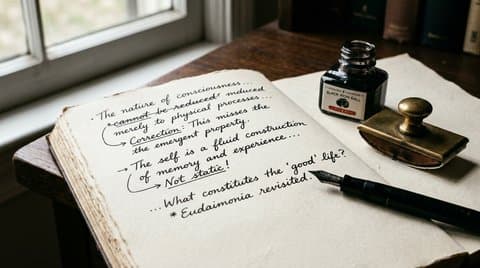 Arthur Pendelton handwritten draft notes on laid cotton paper with fountain pen and iron gall ink
As I sit at this oak desk in my stone cottage in Dorset, watching the October rain darken the limestone walls of the garden outside, I am surrounded by the material witnesses of an older, more durable human compact.
On the shelves rest clothbound volumes printed in Oxford, Tübingen, and Bologna: texts that have survived five centuries of geopolitical turmoil, plague, and institutional collapse precisely because their physical existence was anchored in rag paper, soot-based carbon ink, and human hands that turned the pages one by one.
Beside my elbow sits an open notebook of heavy laid cotton paper, its surface marked by the dark, glistening strokes of an iron gall ink formula mixed according to a recipe from 1840.
A modern engineer, observing me dip a steel nib into an inkwell, would laugh at the absurd inefficiency of the process. In the time it takes me to compose three deliberative sentences, an inference cluster in Frankfurt could synthesize twelve thousand tokens of plausible corporate boilerplate.
What the engineer fails to grasp is that the value of the sentence does not reside in its delivery latency. It resides in the friction of its composition.
The physical resistance of the nib against the laid cotton, the necessity of thinking the entire clause through to its grammatical conclusion before committing it to paper, the impossibility of striking a key to make an error vanish without a trace—these are not obstacles to thought. They are the cognitive crucible in which thought is formed.
When you eliminate friction from writing, you do not make writing better; you make thought weightless. And weightless thought drifts helplessly wherever the ambient winds of marketing and ideological manipulation choose to blow it.
The Promethean Gap and the Manufactured Consensus
In the middle of the twentieth century, the German-Austrian philosopher Günther Anders formulated a concept that has become the defining diagnosis of our present predicament: the Promethean Gap (das prometheische Gefälle).
Anders observed an ever-widening asymmetry between what human beings are capable of producing technologically and what they are capable of imagining, feeling, and ethically integrating.
We can construct global computing architectures that ingest petabytes of electrical energy and process billions of probabilistic associations per millisecond. Yet our biological capacity for moral grief, our psychological tolerance for ambiguity, and our civic institutions for collective deliberation remain anchored in the rhythmic limits of the Neolithic hearth.
Rather than acknowledging this gap with humility, the high priests of technological determinism attempt to resolve the tension by amputating the human side of the equation.
If human beings cannot read twelve thousand pages in an hour, they declare reading obsolete. If democratic assemblies cannot legislate at the speed of algorithmic high-frequency trading, they suggest that governance should be ceded to autonomous agentic swarms.
This is not progress; it is an organized, technocratic mutilation of the human condition.
Every time a university replaces a seminar on Spinoza with an automated course summary module, every time a civic administration replaces public hearings with an algorithmic sentiment dashboard, the Promethean gap widens, and the domain of authentic human freedom shrinks.
The Ethics of Refusal
What, then, is the duty of the thinking person in an age that worships speed as a virtue and treats compliance as destiny?
The first and most urgent duty is the recovery of the power to say no.
We must reject the coward's doctrine that because an artificial capacity exists, we are under some categorical imperative to adopt it. We do not judge a man's maturity by his inability to restrain his appetites; we judge him by his capacity to look upon an open banquet and say: I choose not to eat.
In education, in literature, in the governance of our cities, and in the intimacy of our homes, we must cultivate the courage of deliberate refusal.
We must dare to say to the software vendors: Keep your automated summaries; we prefer the slow, transformative exhaustion of reading the book ourselves. Keep your synthetic companions; we prefer the difficult, jagged friction of loving a flawed human neighbor. Keep your predictive life roadmaps; we prefer the dignity of making our own mistakes in the dark.
This is not luddism. The Luddites, as any serious historian knows, were not irrational opponents of machinery; they were skilled textile artisans who correctly foresaw that the industrial factory system would destroy their communal autonomy, reduce their children to starved mill-hands, and degrade the quality of cloth to line the pockets of absentee capital. Their protest was not against iron; it was against servitude.
Our struggle today is of the same nature, though waged on a vaster and more intimate terrain.
The machine no longer threatens merely the work of our hands; it seeks to colonize the interior sanctuary of our attention, our language, and our existential solitude.
History is not a predetermined script running on an immutable silicon processor. It remains, as it has always been, an unwritten page.
And as long as a single human mind retains the will to lift a pen in the quiet of an unmonitored room, the future is not inevitable. It is ours to refuse, ours to question, and ours to write.