The Cryogenic Bottleneck in Cislunar Orbit
In the cleanrooms of aerospace propulsion facilities, away from the marketing renders of futuristic lunar colonies with glass domes and illuminated regolith roads, engineers spend their working lives obsessing over tenth-of-a-millimeter metal tolerances on cryogenic disconnect valves. When you talk to the mission planners who calculate real propellant mass fractions for cislunar space, the romantic mythology of the frontier evaporates. Spaceflight beyond low Earth orbit is not an adventure; it is a brutal industrial problem of fluid dynamics, thermal radiative balance, and phase-change thermodynamics.
The grand vision of a permanent lunar economy—from scientific outposts at Shackleton Crater to commercial water-ice harvesting operations—rests entirely upon an unheralded, unglamorous mechanical maneuver: the ship-to-ship transfer of thousands of metric tons of sub-cooled cryogenic liquids in the hard vacuum of microgravity. Until we can dock two thousand-ton vehicles traveling at eight kilometers per second, lock their vacuum-jacketed manifolds together without venting a single gram of volatile gas into the void, and transfer boiling liquid methane and liquid oxygen across zero-gravity gradients without triggering pump cavitation, the Moon remains a distant photographic subject, rather than an industrial frontier.
The Physics of the Gravity Well
The tyranny of the rocket equation remains as unforgiving today as it was when Konstantin Tsiolkovsky derived it in 1903. To place one kilogram of payload onto the surface of the Moon and return it safely to Earth requires burning approximately twenty to twenty-five kilograms of propellant in low Earth orbit. A fully fueled heavy-lift rocket leaves the pad at Cape Canaveral weighing three thousand metric tons, but by the time it reaches an orbital altitude of four hundred kilometers, more than ninety percent of its liftoff mass has been discarded in the atmosphere as spent kinetic energy.
To break out of Earth's gravitational embrace and enter a trans-lunar injection trajectory, an exploration vessel cannot carry its departure fuel from the ground. It arrives in orbit empty: an expansive, hollow hull of high-strength stainless steel or carbon composite containing massive tanks that must be filled before the engines can ignite for the Moon.
Orbital Propellant Regime | Storable Hypergolics (MMH/NTO) | Sub-Cooled Cryogenics (CH4/LOX) |
|---|---|---|
Specific Impulse ($I_{sp}$) | Modest (~310–320 seconds) | High (~380–385 seconds) |
Storage Temperature | Room temperature (ambient liquid) | Deep cryogenic (−161°C to −183°C) |
Boil-off Susceptibility | Zero boil-off in vacuum | Constant thermodynamic boil-off from solar radiation |
Toxicity & Handling | Lethal, hypergolic, corrosive | Clean, non-toxic, highly volatile |
Lunar Transfer Utility | Insufficient payload mass fraction | Essential for high-tonnage industrial cislunar transport |
Hypergolic propellants, which remain liquid at room temperature, powered the Apollo lunar module and modern orbital maneuvering thrusters. But hypergolics carry a low specific impulse; you cannot land heavy mining machinery or construction excavators on the Moon using nitrogen tetroxide. High-energy cislunar transportation demands deep-cryogenic propellants: liquid methane and liquid oxygen. And cryogenics in vacuum present an unforgiving physics paradox.
The Zero-Boil-Off Dilemma
Liquid methane boils at minus 161 degrees Celsius; liquid oxygen boils at minus 183 degrees Celsius. In the vacuum of low Earth orbit, an uninsulated spacecraft alternates every ninety minutes between the scorching direct solar flux of plus 120 degrees Celsius on its sunlit side and the cryogenic sink of deep space at minus 270 degrees Celsius in Earth's shadow.
Without continuous active refrigeration, cryogenic propellants absorb thermal energy through radiative transfer, heat up, vaporize, and increase tank pressure until safety relief valves must vent the gas into space to prevent catastrophic structural overpressurization.
The Cislunar Evaporation Invariant: Solar Radiative Flux → Tank Thermal Bridging → Liquid Phase Change → Pressure Excursion → Mandatory Propellant Venting
If an orbital propellant depot loses three to four percent of its mass per day to boil-off, a logistics fleet attempting to aggregate ten tanker flights over four weeks will find that twenty-five percent of its accumulated fuel has evaporated before the expedition even departs for the Moon. The Moon mission starves in orbit while waiting for its own supply chain.
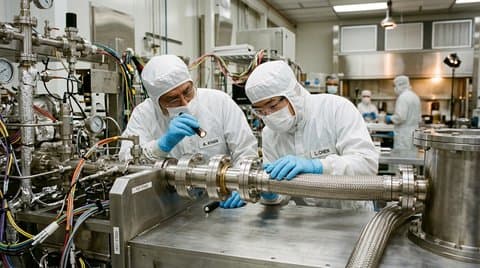
 Aerospace cleanroom with vacuum-jacketed cryogenic plumbing and pressure sensors
To achieve zero boil-off (ZBO), aerospace engineers are developing active cryocoolers based on reverse Brayton and Stirling thermodynamic cycles, combined with forty-layer multi-layer insulation (MLI) blankets and deployable solar sunshades. But active cooling demands continuous electrical power: dozens of kilowatts of dedicated solar or nuclear power that adds mass, complexity, and failure modes to the depot vehicle.
Fluid Transfer in the Absence of Gravity
Even if you can store cryogens without boil-off, transferring them between two free-flying spacecraft in microgravity presents fluid mechanical hurdles that cannot be simulated in terrestrial test stands. On Earth, gravity settles liquid at the bottom of the tank, allowing pumps to draw pure fluid without ingesting vapor bubbles. In microgravity, surface tension and wetting characteristics dominate: the liquid crawls along the tank walls while vapor pockets form unpredictably throughout the core of the volume.
If a high-velocity turbopump draws a slug of gaseous methane into its impeller blades, the pump cavitates, spins up out of control, and shreds itself in a fraction of a second.
To settle propellants prior to transfer, spacecraft must either fire continuous reaction control thrusters to create an artificial micro-acceleration (ullage burn)—wasting precious maneuvering fuel—or deploy internal capillary propellant management devices (PMDs), porous metallic vanes that use surface tension to guide pure liquid toward the tank sumps. Locking the high-pressure disconnect couplings between two vibrating, thruster-firing vehicles requires robotic tolerances measured in hundredths of a millimeter, all while operating under extreme temperature differentials where metal contracts and seals turn brittle.
The Industrial Reality of the Frontier
When the general public imagines space logistics, they picture launch pads with dramatic plumes of orange fire and astronauts gazing out of cupola windows. But the enduring infrastructure of an off-world civilization is not built on theatrical launches; it is built on cold industrial repeatability.
The real pioneers of the cislunar economy will not be celebrity passengers or charismatic founders. They will be the propulsion engineers, thermal technicians, and autonomous docking software developers who master the mundane disciplines of orbital fluid management:
Cryogenic Standard Interfaces: Establishing universally standardized, genderless quick-disconnect couplings that allow any nation's tanker to dock with any depot, ending the fragmentation of proprietary hardware.
Autonomous Relative Navigation: Developing optical and lidar sensor suites capable of sub-millimeter relative pose estimation during docking maneuvers without relying on latency-plagued ground tracking.
In-Situ Re-liquefaction: Deploying space-rated high-efficiency cryocoolers capable of recapturing and re-condensing vented boil-off gas before it escapes into the orbital commons.
Until we solve the cryogenic bottleneck, our presence in cislunar space will remain an episodic, prohibitively expensive stunt: brief footprints planted on the lunar regolith before retreating back to Earth. But once ship-to-ship propellant transfer becomes as routine and unnoticed as maritime bunkering at the port of Rotterdam, the gravitational barrier of our planet will finally be broken. The Moon will cease to be an unreachable monument in the night sky and become what it was always destined to be: the first working dry-dock of an industrial humanity.