
The Cracked Varnish of the Flemish Masters
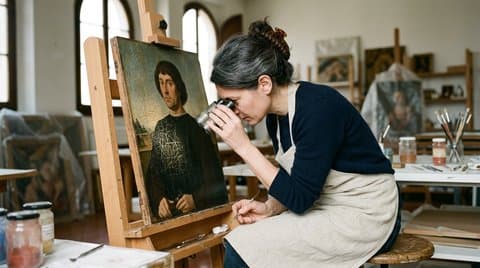
Under the binocular stereomicroscope in this restoration laboratory on the Via de' Bardi in Florence, an oil portrait painted on Baltic oak in 1478 ceases to be an image. It becomes a geological landscape. Raking tungsten light, directed at an angle of fifteen degrees across the gesso surface, transforms what the museum visitor sees as a smooth pale cheek into a network of miniature canyons, tectonic ridges, and crystalline mineral deposits.
This is craquelure—the intricate web of fractures formed across five centuries as Baltic oak planks contracted with seasonal Tuscan humidity while layers of lead white, walnut oil, and copal varnish shrank, polymerized, and cracked at fundamentally different thermodynamic rates.
To an untrained eye conditioned by modern digital imaging, craquelure might appear as deterioration, a flaw to be repaired or smoothed away by aggressive solvent cleaning. To the conservator and the cultural semiologist, however, these microscopic cracks are the physical signature of time itself. They are the irreversible proof that this object has inhabited three-dimensional space, that it has absorbed the smoke of medieval tallow candles, the damp winters of Antwerp, the coal-dust fog of Victorian London, and the breath of twenty generations of human observers.
A digital image cannot crack. It possesses no mineral mass, no drying curve, no thermodynamic friction. And because it cannot age, it can never possess an aura.
The Alchemy of Slow Polymerization
Consider the chemical reality of a Northern Renaissance panel painting. When Jan van Eyck or Rogier van der Weyden prepared a support, they did not reach for an industrialized canvas coated with synthetic acrylic polymer. They began with quarter-sawn Baltic oak imported along the Hanseatic shipping routes—wood that had seasoned in European timber yards for up to twenty years before a joiner plane touched its grain.
The panel was sealed with rabbit-skin glue cooked in copper kettles, then layered with up to eight coats of gesso grosso and gesso sottile—chalk pulverized and suspended in warm collagen. Upon this stone-hard, mirror-smooth ground, the master laid an underdrawing in carbon ink, sealed it with an oily priming coat, and began building the picture through twenty to thirty translucent glazes.
[ Baltic Oak Panel (20-Year Seasoning) ]
│
[ Gesso Ground (Chalk + Collagen Gelatin) ]
│
[ Carbon Ink Underdrawing + Imprimatura ]
│
[ 20-30 Translucent Walnut Oil & Copal Glazes ]
│
[ Lapis Lazuli / Malachite / Madder Lake Pigments ]
│
[ Final Natural Resinous Varnish (Dammar / Amber) ]
Each glaze was composed of mineral pigments suspended in cold-pressed walnut or linseed oil, often thickened by sun-bleaching or boiled with litharge. These oils do not "dry" by evaporation like water or alcohol; they cure through slow oxidative polymerization. Over decades and centuries, atmospheric oxygen cross-links the polyunsaturated fatty acid chains, creating a three-dimensional resinous polymer that becomes progressively harder, more brittle, and more translucent with every passing century.
The Material Invariant of Historical Painting: Natural Mineral Pigment + Polymerized Plant Lipid + Living Wood Substrate = Irreversible Temporal Record
Dimension | The Renaissance Oil Panel | The High-Resolution Digital Sensor |
|---|---|---|
Substrate Physics | Hygroscopic Baltic oak responding to moisture | Silicon photodiode array behind glass filters |
Color Generation | Light refracting through crystalline mineral lattices | Additive RGB emissive subpixels or laser diodes |
Temporal Dynamic | Progressive polymerization, oxidation, and micro-fracture | Zero chemical evolution until catastrophic bit rot |
Optical Depth | Raking reflection through 20 semi-transparent layers | Planar luminance emitted from a single surface |
Ontological Status | Unique physical artifact embedded in human history | Reproducible vector file in volatile volatile memory |
What Machine Sight Cannot Decipher
Modern generative vision models and machine learning pipelines treat art as a flat, two-dimensional array of pixel values. When a computer vision model is trained on two million photographs of museum paintings, it learns statistical correlations between RGB clusters: how a shadow falls across a nose, the compositional balance of a drapery fold, the characteristic sfumato of Leonardo or the impasto of Rembrandt.
Yet the model understands nothing of the painting's reality because a photograph is already an act of violent compression. A digital photograph flattens the thirty layers of van Eyck's glaze into a single optical plane. It replaces the deep, internal refraction of lapis lazuli—where photons penetrate through multiple varnish layers and bounce off crystalline mineral facets before exiting—with the flat, superficial emission of three colored LEDs.
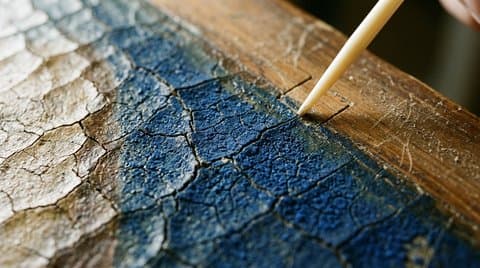 Aged Flemish oil painting craquelure under conservation microscope
When an artificial intelligence generates an image "in the style of the Northern Renaissance," the result is immediately recognizable as a forgery to anyone who has spent an hour in a conservation studio. The software generates surface patterns that mimic the appearance of aging: it draws synthetic cracks on the skin of its subjects, it applies an amber-colored digital filter to simulate aged dammar varnish, and it adds artificial film grain to mimic analog photography.
These synthetic cracks are grotesque because they have no structural logic:
True Aging Craquelure: Follows the grain of the underlying wood, fracturing along the lines of maximum mechanical shear as the panel flexes across seasons.
*True Drying Craquelure (craquelure de séchage)*: Forms when an artist applies a fast-drying glaze over an oil-rich underlayer that hasn't fully oxidized, producing characteristic alligatoring or mud-crack patterns that follow surface tension gradients.
Synthetic "Aging" Filters: Scatter random fractal cracks across the surface with complete indifference to the wood grain, pigment thickness, or chemical composition of the glazes beneath.
The machine produces the caricature of age without having lived a single second. It offers the aesthetic ornament of history stripped of its thermodynamic cost.
The Aura of the Irreversible
In 1935, Walter Benjamin wrote his famous essay on the work of art in the age of its mechanical reproducibility, arguing that modern reproduction techniques stripped the artwork of its "aura"—its unique presence in time and space (hic et nunc). But Benjamin was writing about the lithographic print and the photographic negative, which still required physical paper, chemicals, and mechanical presses.
What would Benjamin say of generative synthetic imagery, where trillions of images are produced by neural networks in seconds, only to disappear into the infinite churn of algorithmic feeds without ever leaving a physical mark on the earth?
The synthetic image is born into total obsolescence. Because it costs nothing to generate, it demands nothing from the viewer. It exists in a permanent present, untethered to any material substrate, immune to dust, unbothered by humidity, and incapable of death.
To look at a 15th-century Flemish portrait through a conservation loupe is to experience the opposite sensation. You are looking at matter that has survived fires, wars, religious iconoclasms, and bureaucratic inventories. You see where a 17th-century restorer added a clumsy touch of varnish that has darkened to amber; you see where a devotional hand touched the painted edge of Christ's mantle during the plague of 1527.
Those micro-cracks are not scars of decay; they are the breathing pores of human memory. They remind us that human beings are physical creatures who inhabit physical materials, and that no digital simulation—no matter how many billions of parameters it contains—can substitute for the tragic, beautiful weight of an object that has endured the passage of time.