

The Child Who Cannot Cut Paper
Yesterday morning at nine o'clock, in the third week of the autumn term at our public elementary school in the Croix-Rousse district of Lyon, I placed a pair of rounded-tip metal safety scissors and a single sheet of green construction paper in front of Antoine.
Antoine is six years and two months old. He has bright, inquisitive hazel eyes, an extensive vocabulary that allows him to discuss the hydraulic braking systems of high-speed trains, and an iPad on which he has navigated complex educational gaming interfaces since the age of two. When he touches a capacitive glass screen, his right index finger glides with the frictionless, lightning-fast economy of a digital native.
Yet when I asked him to cut along a bold, straight black line drawn across the paper, a strange and distressing paralysis occurred.
He did not know how to insert his thumb into the smaller upper loop and his index and middle fingers into the lower oval. When he finally managed the grip with my assistance, his wrist collapsed inward. His hand shook. He did not possess the opposing muscular tension required to open the two stainless steel blades against each other, nor the proprioceptive coordination to stabilize the paper with his left hand while advancing the cut with his right. After ninety seconds of agonizing effort, the paper was not severed; it was crumpled, wet with sweat, and mangled into a jagged tear.
Antoine looked up at me, his lower lip trembling, and said with quiet bewilderment: "Mistress, the paper won't do it."
In his mind, the paper was defective because it did not respond to the light tap of an interface. It did not scroll. It did not resolve itself through an automated gesture. It demanded physical force, opposing mechanical shear, and three-dimensional spatial resistance—capacities that his neuromuscular pathways had never been summoned to construct.
The Mechanical Architecture of the Child's Hand
To understand why a six-year-old child's inability to cut paper is not a minor pedagogical hiccup but a profound developmental emergency, one must examine the functional anatomy of the human hand.
The human hand is not an input peripheral; it is a primary organ of cognition. In evolutionary biology and developmental neurology, the emergence of the opposable thumb and the refined pincer grasp (prehensio) co-evolved directly with the expansion of the neocortex. When a child manipulates physical matter, the sensory mechanoreceptors embedded in the fingertips—Meissner’s corpuscles detecting skin slip, Merkel discs measuring sustained pressure, and Pacinian corpuscles registering high-frequency vibrations—send continuous torrents of afferent electrical telemetry to the primary somatosensory cortex.
Developmental Metric | Capacitive Glass Swiping (Screen Interaction) | Mechanical Scissor & Pincer Resistance (Physical Matter) |
|---|---|---|
Tactile Resistance | Near-zero friction (0.01 N/mm²); static polished glass | Variable dynamic resistance (0.8 to 3.5 N); directional paper shear |
Motor Unit Recruitment | Monotonous planar tapping; isolated single-digit flexion | Complex bilateral synergy; simultaneous stabilization and opposing cut |
Proprioceptive Feedback | Optical and acoustic simulation; zero kinesthetic return | Immediate physical consequence; blade gap, blade alignment, grain resistance |
Pincer Grasp Maturation | Disused; wrist locked in passive pronation | Active distal phalangeal coordination; intrinsic hand muscle hypertrophy |
Frustration Threshold | Instant gratification; infinite painless software rollbacks | Inelastic physical reality; torn paper cannot be undone with an undo gesture |
Cortical Mapping Density | Diffuse, low-density somatosensory representation | Dense, finely differentiated neurological arborization in motor strip |
When a child uses scissors, the brain must solve a formidable multidimensional engineering problem in real time.
The dominant hand must maintain a stable radial-digital grasp while rhythmically opening and closing the intrinsic thenar and hypothenar musculature. Simultaneously, the non-dominant hand must grasp the edge of the paper, rotate it along the curve of the contour, and maintain dynamic tension against the cutting edge.
This is what Soviet neurophysiologist Alexander Luria termed a kinetic melody—a fluid, self-correcting neural circuit where sensory feedback instantly recalibrates motor output.
On a capacitive glass tablet, that kinetic melody is replaced by a monotonous, planar stutter. The glass offers no resistance, no texture, no grain, and no consequence. The screen treats every gesture identically: whether a child taps with frantic aggression or gentle hesitation, the pixels shift across the display with the exact same indifferent velocity.
Inside the Classroom Laboratory
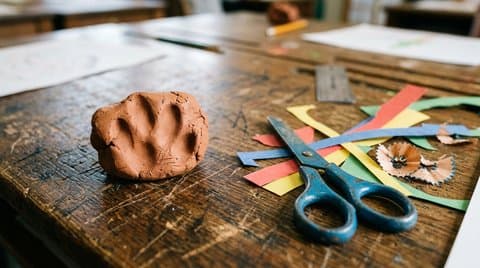 Primary school scissors and construction paper on worn wooden desk
Consider the artifacts resting on our classroom workbench shown above: the blunt steel safety scissors, the strips of folded construction paper, the curled pencil shavings, and the lump of natural clay bearing the deep indentations of human fingertips.
For three generations, these humble materials were regarded as mere kindergarten craft supplies—pleasant diversions to occupy thirty children before the real business of formal reading and mathematics began.
Today, in our research observation cohort in Lyon, we have come to recognize them as irreplaceable orthotic scaffolds for the human mind.
The Neuro-Developmental Feedback Loop: Mechanical Resistance of Dense Physical Matter → Dynamic Muscular Opposition (Pincer Grasp) → Afferent Somatosensory Calibration → Cortical Myelination in Motor Cortex → Structural Capacity for Abstract Symbolic Reasoning
When an infant spends their critical neurodevelopmental window (between eighteen months and four years) swiping illuminated glass rather than kneading bread dough, threading wooden beads, peeling clementines, and manipulating blunt shears, the intrinsic hand muscles fail to develop adequate physiological tone.
The thenar eminence remains flat and hypotonic. The carpal arch lacks skeletal stability. The child arrives in preparatory school at six years old with what pediatric occupational therapists call the tablet hand: a limb characterized by digital hypermobility, wrist instability, and a total inability to sustain the dynamic tripod grasp required to hold a lead pencil without severe physical fatigue.
And when a child cannot comfortably hold a pencil, the psychological consequences are immediate and devastating.
Writing a single sentence becomes an ordeal of muscular cramping and sensory frustration. The child's conscious working memory, which should be liberated to think about grammar, semantic metaphor, and narrative imagination, is entirely hijacked by the grueling biomechanical struggle to keep the graphite tip pressed against the paper.
The Illusion of Early Digital Fluency
For fifteen years, Silicon Valley marketing departments and technocratic education ministries promised parents that giving toddlers tablets was an act of progressive intellectual democratization.
We were told that children who learned to swipe before they could tie their shoes would become the algorithmic architects of tomorrow—hyper-connected, computationally literate, and intellectually accelerated.
That promise was a catastrophic developmental falsehood.
What our longitudinal classroom observations reveal is that passive interface navigation is the opposite of computational fluency. Swiping an icon is a closed stimulus-response loop that requires less cognitive deliberation than a pigeon pecking an illuminated feeder in a Skinner box. It demands no spatial reasoning, no mechanical empathy, and no capacity to endure productive frustration.
When Antoine cannot cut paper, he is not merely lacking a manual craft skill. He is lacking the fundamental neurological conviction that he can physically act upon the material universe, alter its structure through disciplined bodily effort, and overcome the resistance of objective reality.
If the paper does not yield to a touch, he assumes the universe is broken. He retreats into passivity, waiting for an adult or an algorithm to refresh the page.
The Sanctuary of the Chalkboard and the Scissor
In our school in Lyon, we have initiated what our colleagues half-jokingly call the analog counter-reformation.
We have removed the interactive smart-screens from our early-years classrooms. We have brought back heavy slate chalkboards, mechanical pencil sharpeners that turn with a brass crank, wooden building blocks carved from unvarnished beech, natural terracotta modeling clay, and pairs of forged German scissors that require genuine muscular effort to operate.
During the first two weeks of the term, the children wept with frustration. They pushed the clay and cried when it did not light up. They dropped the scissors and pleaded for automated assistance.
Yesterday afternoon, four weeks into the term, I watched Antoine at his desk.
His brow was furrowed in quiet, monastic concentration. His tongue was tucked into the corner of his mouth. With his left hand, he held a strip of blue sugar paper steady against the desk, his thumb positioned firmly above the cutting line. With his right hand, his small fingers squeezed the handles of the metal shears, the blades meeting with a crisp, audible, triumphant crunch.
A clean, straight strip of paper drifted down to the wooden floorboards.
Antoine did not look at a screen. He looked down at his own small hand, then at the paper, and then up at me with an expression of primal, unfeigned pride that no digital interface has ever produced in human history.
"Regardez, Maîtresse," he whispered. "I made the cut."
In that small, perfect physical incision lay the quiet resurrection of a human being.