
The Chemistry of Damp Humus
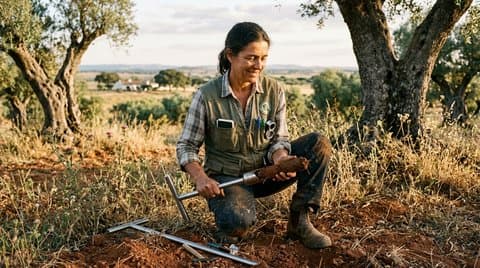
At six-forty on an October morning in a centenary dryland olive grove three leagues south of Évora, in the rolling red plain of the Portuguese Alentejo, the earth smells of iron, crushed rockrose, and the unmistakable, geosmin-rich musk of waking actinobacteria.
I am kneeling in the dew between two knotted trunk bases of Galega olive trees planted during the reign of Dom Luís I. In my calloused, clay-stained hands rests a stainless steel Eijkelkamp pedological soil auger, thirty millimeters in diameter and one meter in length.
When you push the sharpened steel cylinder into the horizon A of an unplowed Mediterranean soil, your arms do not meet the dead, compacted resistance of an industrial monoculture field. You meet a living, resilient sponginess. The steel cuts smoothly down through thirty-five centimeters of dark, friable topsoil before striking the pale, calcareous bedrock below.
I pull the core upward and lay it onto an open linen field notebook.
To a corporate agronomist trained in synthetic chemistry and satellite crop-monitoring dashboards, soil is merely an inert, anchor substrate—a physical matrix whose sole function is to mechanically hold plant roots upright while industrial irrigation tubes inject synthetic ammonium nitrate, diammonium phosphate, and potassium chloride.
To a soil microbiologist, that thirty-centimeter cylinder of dark earth is the most complex, dense, and fragile biological reactor on the planet.
Within that single core sample reside more living cellular organisms than all the humans who have ever breathed upon this Earth: eight hundred million individual bacteria belonging to forty thousand distinct taxonomic phyla; two hundred kilometers of microscopic fungal hyphae; sixty thousand protozoa; and ten thousand beneficial nematodes.
And binding that colossal subterranean metropolis into a stable, water-holding sponge is a miraculous, insoluble biological glue that no software company, no synthetic biology startup, and no hyperscale computing cluster can synthesize in a factory: humus.
The Colloidal Physics of Soil Aggregation
Why does an industrial wheat field in the neighboring irrigated valley wash away into the Guadiana river after forty millimeters of autumn rain, while the unplowed olive grove beneath my boots absorbs every drop without a single gully forming?
The answer lies in the microscopic chemistry of the clay-humic complex.
Mineral soil particles—sand, silt, and crystalline clay—possess net negative electrical charges on their microscopic platelet surfaces. Left to themselves, they repel one another like identical poles of magnets, slumping into a dense, airless paste when wet and baking into an impenetrable brick when dry.
Soil Management Paradigm | The Industrial Precision Monoculture | The Regenerative Living Soil System |
|---|---|---|
Humus Content (Horizon A) | Severely depleted (0.6% – 1.2% organic matter) | High and resilient (3.8% – 5.4% stable humus) |
Water Infiltration Velocity | 8mm – 14mm per hour; catastrophic surface runoff | 65mm – 120mm per hour; total aquifer recharge |
Aggregation Agent | Synthetic synthetic polyacrylamides and compaction | Glomalin glycoproteins from arbuscular mycorrhizae |
Nutrient Cycling Mode | Soluble synthetic salts; massive nitrate runoff | Microbial mineralization through fungal hyphae loops |
Resilience to Drought | Rapid plant wilting within 7 days of rain cessation | Sustained capillary hydration for 45 to 60 dry days |
To convert that mineral dust into a living crumb that breathes oxygen and retains moisture, nature deploys a multi-stage biochemical bridge.
The Humic Mineral Complexation Pathway: Root Exudates & Plant Residues → Actinobacterial Lignin Breakdown → Fulvic and Humic Acid Polymerization → Bivalent Calcium Bridging to Clay Platelets → Water-Stable Macropores
First, bivalent calcium and magnesium ions dissolved in soil water act as electrostatic bridges, binding negatively charged clay platelets to long, complex chains of humic acids. Then, arbuscular mycorrhizal fungi—living in intimate, ancient symbiosis with the tree roots—secrete an extraordinary, hydrophobic glycoprotein called glomalin.
Glomalin is the architectural mortar of the subterranean world. Insoluble in water and resistant to microbial degradation for decades, it coats the clay-humic particles, cementing them into water-stable aggregates ranging from one to four millimeters in diameter.
These aggregates create a labyrinth of interconnected macropores that allow rain to infiltrate at hundred millimeters an hour while capillary micropores hold water against the force of gravity, acting as a subterranean reservoir during four months of scorching Iberian summer drought.
The Fraud of the Algorithmic Harvest
Over the past five years, venture capital funds and multinational agrochemical monopolies have flooded the Mediterranean basin with a narrative they call "Smart Precision Agriculture."
They pitch wireless moisture probes, drone multispectral thermal cameras, and predictive machine-learning dashboards that claim to optimize water and chemical delivery down to the individual tree. The tech companies promise that through algorithmic scheduling, agricultural enterprises can extract maximum fruit yields while drawing millions of liters of fossil water daily from ancient, non-renewable subterranean aquifers.
It is a parasitic, suicidal illusion.
An algorithm cannot manufacture soil structure. When you douse living soil with high-concentration synthetic nitrogen salts, you bypass the plant’s biological need to feed the soil microbiome with photosynthetic carbon sugars. The mycorrhizal fungi starve. The glomalin production halts. The earthworms and collembola flee the acidified rhizosphere.
Within five seasons of "precision chemical optimization," the water-stable aggregates collapse. The soil loses its porosity and slumps into an inert, lifeless mineral pavement. The farm becomes entirely addicted to artificial inputs: because the soil can no longer hold water, the farmer must pump twice as much aquifer water; because the native microbial immune system is destroyed, the farmer must spray three times as many synthetic fungicides.
And when the local water table finally drops below the reach of the deep submersible pumps—as is happening across the Alentejo, Andalusia, and the Central Valley of California—the precision dashboard does not save the orchard. It simply records the exact minute the trees die of thirst.
The Pedological Truth of Time
Looking at the dark crumbly soil resting in my palm, one is confronted with the most humbling invariant of natural science: time.
You can scale up computational power in an afternoon by adding ten thousand graphic processing cards to a data center. You can generate a billion tokens of synthetic text in sixty seconds.
You cannot accelerate the formation of stable humus by a single day.
It takes five hundred to one thousand years of unhurried biological weathering, bacterial colonization, leaf litter decay, and fungal networking to generate a single centimeter of fertile Mediterranean topsoil. That dark humic molecule resting on the tip of my finger contains carbon atoms that were fixed from the atmosphere during the reign of the Roman emperors, bound into stable polyphenolic rings that have resisted oxidation for twenty centuries.
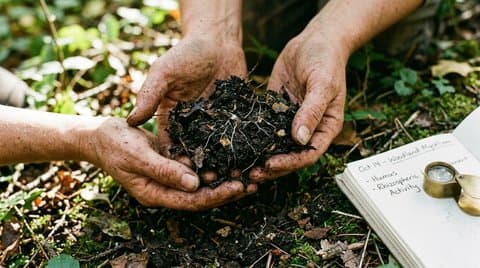 Dark Humus and Living Mycelial Hyphae
When modern industrial society treats topsoil as disposable dirt—stripping it through heavy mechanized tilling, poisoning it with biocides, and paving it over with hyperscale data centers that consume five million liters of potable aquifer water a day to cool silicon chips—it is consuming its own civilizational capital.
Every empire that collapsed in the Mediterranean basin—from the Mesopotamians whose irrigated clays salted over, to the Romans whose North African breadbaskets eroded into rocky desert—collapsed because its ruling elites forgot the physics of the soil beneath their sandals.
Returning to the Root
As the morning sun rises over the cork oaks on the ridge, the cool mist burns away, and the sweet, resinous warmth of the earth fills the grove.
I take the soil core from my notebook and gently slide it back into the auger hole, pressing the surface turf back down with the heel of my boot so the root crowns are protected from the midday heat.
We do not need more algorithmic dashboards telling us how to extract the last drop of water from dying aquifers. We need to remember the ancient discipline of the soil steward. We need to stop plowing the living horizon; we need to return animal manure and composted pruning wood to the earth; we need to let the wild legumes and brassicas fix nitrogen through biological symbiosis rather than chemical factories.
The living soil does not read marketing pitch decks. It asks only for shade, for organic matter, and for the patience to let the fungi weave their quiet, continuous web of life in the dark.
For civilization is not built upon servers, nor algorithms, nor the fluctuating valuations of financial markets. Civilization is built upon thirty centimeters of damp, crumbly humus, and the fact that it still rains.