
The Bread That Refuses to Hurry
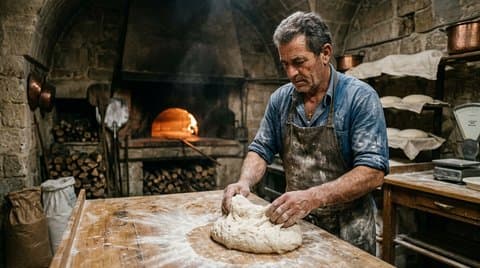
At four-fifteen in the morning, the streets of Ragusa Ibla are still damp with nocturnal limestone mist, and the only sound inside my bakery is the low, rhythmic respiration of three hundred kilograms of Russello durum wheat dough resting in covered beechwood troughs.
If you press the back of your knuckles gently against the surface of the dough, it does not feel like wet flour. It feels like living muscle—warm, elastic, slightly domed, and trembling with millions of microscopic carbon dioxide alveoli generated over thirty-two hours of slow, unhurried lactic fermentation.
When you lift the linen cloth, the aroma that rises into the cool cellar air is not the sharp, beer-like stench of industrial baker’s yeast. It is the complex, unmistakable perfume of wild Sicilian meadows: roasted hazelnuts, ripe apricot skin, lactic yogurt, and damp autumn wheat straw.
Two kilometers down the provincial highway, inside a corrugated steel supermarket distribution facility, a very different substance is being manufactured under the legal name of bread.
There, computer-controlled high-shear mixers whip bleached roller-milled flour at twelve hundred revolutions per minute, injecting synthetic ascorbic acid, soy lecithin, fungal alpha-amylase, and massive doses of compressed Saccharomyces cerevisiae to force the dough from dry powder to packaged loaf in fifty-four minutes flat.
Both objects are sold in paper bags. Both are sliced with a knife. Yet biochemically, metabolically, and culturally, one is the staff of human life, and the other is an indigestible industrial foam that has turned an ancient staple into a modern gastrointestinal pathology.
The Violence of the Fifty-Minute Loaf
To understand why millions of contemporary urban citizens suddenly find themselves unable to digest bread without suffering acute abdominal distension and inflammatory fatigue, one does not need to invent a mysterious genetic epidemic. One need only examine what happened to the fourth dimension of baking—time—in 1961.
In that year, food engineers at the British Baking Industries Research Association in Chorleywood introduced a mechanical protocol designed to eliminate the most expensive line item on a commercial bakery’s balance sheet: the twenty-four hours during which dough sits quietly in a trough doing nothing but maturing.
The Chorleywood Bread Process replaced biological time with mechanical violence and chemical oxidants.
Biochemical & Physical Dimension | The 50-Minute Chorleywood Industrial Loaf | 36-Hour Stone-Milled Lievito Madre Loaf |
|---|---|---|
Microbial Ecosystem | Monoculture Saccharomyces cerevisiae (2.5% by weight) | Symbiotic wild Lactobacillus & wild yeasts (100:1 ratio) |
Fermentation Duration | 25 to 45 minutes forced gas inflation at 38°C | 24 to 36 hours slow cold-cellar maturation at 16°C–22°C |
Gluten Network Fate | Intact, unhydrolyzed 33-mer gliadin peptides; rubbery bolus | Proteolytically pre-digested by bacterial peptidase enzymes |
Phytic Acid (Antinutrient) | 90% intact; chelates iron, zinc, magnesium, and calcium in gut | >95% neutralized by endogenous phytase at pH 4.2 |
FODMAP / Fructan Content | High; unfermented oligosaccharides trigger colonic fermentation | Depleted; consumed by heterofermentative lactic bacteria |
Post-Prandial Glycemic Curve | Rapid insulin spike (GI ~85) followed by reactive hypoglycemia | Slow, sustained glucose release (GI ~52) via organic acids |
Shelf Life & Staling | Requires mono- and diglyceride emulsifiers to prevent crumbling | Naturally preserved for 7 days by acetic and lactic acidity |
Wheat grain was never meant to be eaten raw or semi-raw after forty minutes of hydration.
A kernel of wheat is a botanical fortress engineered by evolution to survive winter dormancy before germinating in the spring. To protect its mineral reserves from premature consumption by soil pests, the grain locks its phosphorus, iron, zinc, and magnesium inside a ring-shaped molecule called phytic acid, while shielding its storage proteins inside dense, proline-rich gluten polymers that human gastric pepsin cannot easily cleave.
In a traditional Mediterranean bakery, we do not ask the human stomach to break down that fortress alone. We delegate the preliminary digestion to an ancient microbial guild that has co-evolved with human granaries for six thousand years.
The Enzymatic Alchemy of the Trough
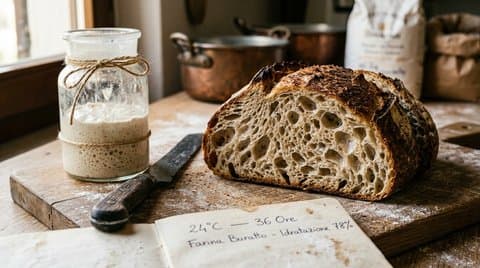 Freshly sliced 36-hour sourdough loaf showing open honeycomb crumb beside a jar of active lievito madre starter
Look closely at the cross-section of the loaf resting on my wooden board above, beside the glass jar of lievito madre that my grandfather brought down from the hills of Modica in 1954.
Notice the translucent, gelatinized sheen of the interior crumb walls and the wild, irregular geometry of the gas chambers. That structure cannot be faked by mechanical whipping. It is the fossilized trace of a slow biochemical symphony.
When we mix stone-ground whole durum flour with spring water and twenty percent mature lievito madre, the wild lactic acid bacteria—predominantly Lactobacillus sanfranciscensis, Lactiplantibacillus plantarum, and Fructilactobacillus Rossiae—outnumber the wild yeasts by a factor of one hundred to one.
Over the first twelve hours in the cool stone vault, as these bacteria metabolize maltose and fructose, they secrete lactic and acetic acids, gradually lowering the pH of the dough from 6.0 to 4.3.
The Biochemical Transformation Cascade: Lactic Acid Bacteria Acidification (pH < 4.5) → Activation of Endogenous Cereal Phytase → Hydrolysis of Phytic Acid & Mineral Liberation → Intracellular Bacterial Peptidase Release → Proteolytic Cleavage of Immunogenic Gliadin Peptides → Digestible, Bioavailable Bread
That specific drop in pH is the master key of cereal chemistry.
At exactly pH 4.5, an endogenous enzyme sleeping inside the wheat aleurone layer—phytase—wakes up. Over the next eighteen hours, phytase systematically dismantles the phytic acid rings, liberating bioavailable iron, zinc, and calcium into the crumb.
Simultaneously, the acidity activates cereal proteases and intracellular bacterial peptidases, which act like microscopic shears, snipping the long, tough chains of proline- and glutamine-rich gliadin proteins into short, benign amino acid sequences and dipeptides.
By the time my peel slides that loaf onto the hot volcanic flagstones of the wood-fired oven at five in the morning, the wheat has already been ninety percent digested inside the beechwood trough. When a customer eats a slice at midday, their digestive tract does not encounter an hostile, rubbery matrix of unfermented fructans and intact gluten; it encounters a pre-digested, mineral-rich nourishment.
Why Chemistry Cannot Simulate Patience
Every few months, a sales representative from a northern European agricultural chemical conglomerate visits my shop in Ragusa.
They arrive in rented sedans, carrying laminated brochures and small plastic tubs of "clean-label dough conditioners." They promise me that if I add zero point three percent of their proprietary recombinant enzyme blend to my mixer, I can cut my fermentation time from thirty-six hours down to three, double my daily output, and reduce my night-shift labor costs by half.
"The consumer won't taste the difference, Maestro," they tell me, smiling across my flour-dusted table. "We have isolated the exact aromatic esters of sourdough in a dry powder."
I always invite them to stay until six o'clock, when the first batch comes out of the brick hearth. I cut a thick heel from a thirty-six-hour loaf, drizzle it with cold-pressed Tonda Iblea olive oil, and hand it to them without a word.
They chew once, twice, and then they stop talking.
You cannot synthesize thirty-six hours of microbial metabolism in a spray-dried powder any more than you can synthesize a thirty-year-old Barolo by dropping oak sawdust and tartaric acid into grape juice.
Flavor is not a superficial perfume applied to food at the end of an assembly line; flavor is the sensory report of deep molecular transformation. The blistered mahogany crust—born from the Maillard reaction between free amino acids and simple sugars released during slow proteolysis—carries a bittersweet depth that no artificial malt coloring can imitate.
The Moral Economy of the Hearth
Our refusal to hurry the bread is not nostalgic romanticism. It is a defense of biological honesty.
When industrial capitalism decided that twenty-four hours of quiet fermentation was an unacceptable waste of capital velocity, it did not eliminate the cost of that time. It simply externalized the cost onto the human body—transforming the time saved in the factory into chronic inflammation, micronutrient deficiency, and digestive misery in the population.
There are processes in this world—the ripening of wheat under the Mediterranean sun, the acidification of a sourdough culture, the healing of a wound, the education of a child—that obey a biological clock older than any balance sheet.
At five-thirty this morning, I pulled the heavy iron door of the oven ajar. A wave of dry, fragrant steam rolled out into the stone room, carrying the ancient scent of caramelized grain and woodsmoke. Across the worktable, the loaves began to sing—that delicate, crystalline chorus of cracking crust as the hot bread cools in the dawn air.
It took thirty-six hours to arrive at that music. Not a single minute was wasted.