
The Ash of Herculaneum Refuses to Burn
In the autumn of 79 CE, a pyroclastic surge of superheated gas and volcanic mud roared down the western flank of Mount Vesuvius, engulfing the seaside town of Herculaneum at three hundred and twenty degrees Celsius. In the library of a sprawling patrician residence overlooking the Bay of Naples—the estate owned by Julius Caesar’s father-in-law, Lucius Calpurnius Piso Caesoninus—eighteen hundred papyrus scrolls sat neatly arranged in cedarwood pigeonholes.
Had oxygen been present in that lethal cloud, the library would have vanished into white ash within seconds, sharing the fate of the lost volumes of Alexandria. Instead, the instantaneous burial under twenty meters of airless volcanic tuff carbonized the organic plant fibers in an anaerobic furnace. The scrolls were transformed into compact, twisted cylinders of brittle black charcoal.
For two hundred and seventy years after Bourbon workmen tunneled into the Villa of the Papyri in 1752, these carbonized rolls represented the cruelest paradox in classical scholarship. We held the lost treatises of Epicurus, Chrysippus, and Philodemus of Gadara directly in our hands—yet to unroll them mechanically was to destroy them. Every physical touch caused the charred layers to flake into black dust. Only now, through the marriage of synchrotron particle physics and patient philological paleography, are the dead speaking again from the ash—offering us a humbling lesson on what actually survives the collapse of an empire.
When the Swiss military engineer Karl Weber directed the subterranean tunneling beneath the gardens of Portici in the 1750s, the Bourbon court initially mistook the blackened cylinders for bundles of carbonized fishing nets or charred garden stakes. Hundreds were burned as torches by workmen or crushed underfoot before someone noticed regular columns of Greek uncial script glinting on a broken cross-section. Even after Padre Antonio Piaggio, custodian of miniature manuscripts at the Vatican Library, invented his ingenious silk-thread traction machine in 1756—attaching tiny patches of ox-gut membrane (goldbeater's skin) to the exterior of a roll and lifting the outer layer millimeter by millimeter over months—the cost remained heartbreaking. The densely compressed core of the scroll could only be reached by scraping away the outer bark layers, sacrificing half a treatise to rescue its conclusion.
The Physics of Black Ink on Black Charcoal
Why could conventional medical X-rays or infrared photography not read the unopened Herculaneum scrolls? The obstacle lies in the chemistry of ancient ink.
Medieval monks wrote on parchment using iron-gall ink, rich in metallic sulfates that absorb X-rays strongly, creating an easy contrast against animal skin. First-century Greek scribes, however, wrote on Nile papyrus using atramentum librarium—an ink compounded from pine soot suspended in gum arabic. When the volcanic heat of Vesuvius carbonized the papyrus reed, the support medium became chemically identical to the ink written upon it: carbon sitting upon carbon.
Archival Recovery Parameter | Mechanical Unrolling (Piaggio Machine, 1756) | Synchrotron X-Ray Phase-Contrast Tomography |
|---|---|---|
Physical Intervention | Invasive application of goldbeater’s skin and mercury glue | Non-destructive high-energy coherent photon beam (70–80 keV) |
Contrast Mechanism | Naked-eye reflection under grazing raking light | Sub-micron phase-shift detection of ink thickness (8–12 μm relief) |
Structural Survival | High fragmentation; outer layers routinely pulverized | 100% preservation of intact carbonized cylinder |
Volumetric Resolution | 2D surface fragments with severe warping | 3D isotropic voxel mesh at 3 to 8 micrometers |
Epigraphic Yield | Disconnected columns; loss of internal stratigraphy | Continuous recovery of complete philosophical treatises |
At the Diamond Light Source in Oxfordshire and the European Synchrotron Radiation Facility in Grenoble, we do not measure simple X-ray absorption. We measure phase contrast. Even though the soot ink and the carbonized papyrus share the same atomic number, the ancient scribe’s reed pen left a microscopic physical ridge—a raised layer of dried gum and carbon particles barely ten micrometers thick resting atop the crisscross grid of papyrus fibers.
When a coherent, monochromatic beam of synchrotron X-rays passes through the scroll, those microscopic density boundaries bend the phase of the light wave. By recording these interference fringes across thousands of rotational angles, we reconstruct a three-dimensional volumetric map of the sealed scroll down to the individual cellular vessels of the ancient reed.
Reading Philodemus Under Grazing Light
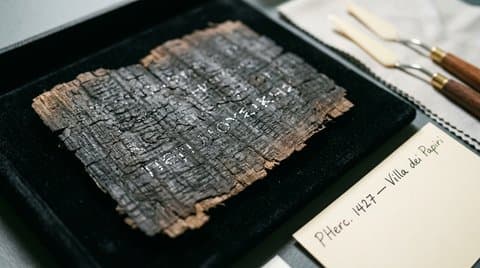 Carbonized Herculaneum papyrus fragment under raking conservation light
In the conservation studio of the Officina dei Papiri at the National Library of Naples, I still spend hours with a binocular microscope and a cold fiber-optic raking light, verifying the digital virtual unwrap against opened fragments like PHerc. 1427.
Look at the photograph above. Against the corrugated, volcanic-blackened plant fibers, the Greek letters—ΠΕΡΙ ΜΟΥΣΙΚΗΣ ("On Music")—glisten with a faint, velvety matte sheen.
The Virtual Unwrapping Pipeline: Synchrotron Phase-Contrast Scan (8 μm Voxel Grid) → 3D Lamina Segmentation of Crushed Papyrus Folds → Surface Flattening Mesh Transformation → Ink Relief Signal Extraction → Philological & Paleographical Edition
It is tempting for technology journalists to celebrate this achievement as a triumph of modern computing over ancient matter. They write breathless articles claiming that artificial intelligence has "solved" Herculaneum. As an epigrapher who has spent forty years reading damaged Greek syntax, I must correct this hubris.
A neural network can detect subtle voxel intensity variations where carbon ink sits on carbonized pith, just as a chemical reagent once enhanced faded palimpsests in the nineteenth century. Statistical pattern matching is a magnificent lantern. But a lantern does not read Greek.
When a papyrus roll was crushed under twenty meters of boiling mud, its internal layers buckled, telescoped, and fused into agonizing topological folds—what papyrologists call sovrapposizioni and sottopassaggi, where a patch of layer fourteen adheres to layer thirteen, jumping across a gap of thirty lines in the middle of a sentence. Deciding whether a Greek participle belongs to the philosophical argument of column twelve or has migrated from the crushed verso of column eleven requires an intimate mastery of first-century Epicurean terminology, Hellenistic prose rhythm, and the physical anatomy of the scribe’s hand.
The Irony of the Volcanic Library
As we read Philodemus’s newly recovered columns on pleasure, friendship, and the freedom from political vanity, a devastating historical irony settles over the laboratory.
Why are we able to read these words two thousand years after Mount Vesuvius buried them? Only because they were written on a physical plant fiber with elemental carbon soot. Had Lucius Calpurnius Piso stored his philosophical library on solid-state NVMe flash arrays, magnetic LTO cartridges, or optical Blu-ray discs, not a single syllable would have survived even five minutes of the eruption—indeed, not a single syllable would have survived two centuries in a dry closet without an eruption at all.
Consider the digital volumetric scans we generate at the synchrotron today. Each high-resolution scroll scan occupies between eight and twelve terabytes of raw 16-bit TIFF stacks. Where are those terabytes stored? On spinning helium-filled magnetic hard drives and cloud object-storage buckets that must be migrated, parity-checked, and re-funded every forty-eight months.
If European research funding were interrupted for a single decade—a blink of an eye in historical time—the digital reconstructions of the Herculaneum papyri would vanish into corrupted bit-rot long before the fragile black charcoal scrolls sitting in their wooden trays in Naples lost a single letter.
What Philodemus Says to the Digital Age
In one of the newly deciphered passages from the Villa of the Papyri, Philodemus reflects on the anxiety of men who spend their lives accumulating vast estates and frantic administrative influence, never pausing to enjoy the quiet conversation of friends in a shaded garden. He writes with the gentle, lucid calm of the Epicurean school: we do not lack time, we waste it in the pursuit of things that neither calm the soul nor satisfy the body.
Standing in the quiet courtyard of the Naples library after eight hours at the microscope, listening to the distant horns of ferries crossing the bay toward Sorrento beneath the silent shadow of Vesuvius, I find myself thinking of our own frenzied civilization.
We build gigawatt data centers that drink rivers dry; we train trillion-parameter models to summarize emails that nobody had the patience to write or the courtesy to read; and we store the whole weightless edifice on silicon gates that leak their electrons in a handful of years. Meanwhile, in a darkened cabinet upstairs, a lump of burned Nile grass, written with lampblack by an unknown slave in the first century before Christ, waits patiently in the silence—still whole, still legible, still teaching us how to live.