
The Recovery of the Senses: Life Beyond the Screen
In 2026, a new luxury has emerged. It is not found in high-performance computing or the latest biometric wearables. It is found in the quiet, dusty corners of the analog world. We are living through 'The Great Offline'—a cultural movement that is reclaiming attention from the algorithmic grind. As people spend more time disconnected, the role of the home has been transformed. It is no longer just a place to live; it is a sanctuary, a 'defensive wall' against the incessant noise of the digital age.
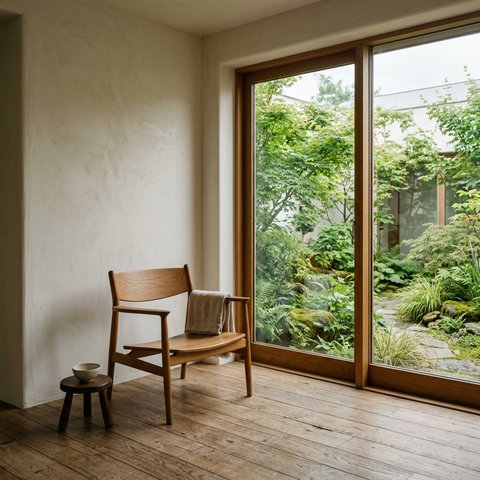
This shift has birthed a new design philosophy: the 'Architecture of Silence.' Unlike the cold, clinical minimalism of a decade ago, today's silence is warm, tactile, and deeply human. It is an architecture that prioritizes materiality—the feel of hand-plastered lime walls, the scent of untreated timber, and the play of natural light on a stone floor. We are moving away from visual noise and toward a sensory richness that cannot be replicated by a screen.
The Sanctuary as a Bio-Responsive Cocoon
The 2026 home is increasingly designed as a 'biophilic cocoon.' By integrating natural light slits, internal pocket gardens, and circadian lighting systems, architects are creating spaces that support the body's natural rhythms. These homes are not just buildings; they are restorative environments. Techniques like 'squeeze and release'—using narrow entryways to create an emotional transition into soaring, light-filled rooms—signal the nervous system to relax. In these spaces, being unreachable is not a failure of connectivity, but a triumph of design.
Furthermore, the concept of 'Visual Silence' is being applied to every detail. Functional areas like kitchens and workstations are hidden behind seamless, integrated cabinetry, ensuring that the primary living spaces remain free from clutter. This 'hidden functionality' allows the mind to rest, focusing on the beauty of a few carefully curated 'hero pieces' rather than a collection of mass-produced objects. In 2026, minimalism is about curation, not deprivation.
The Luxury of Being Unreachable
The 'Great Offline' movement is not about a total rejection of technology, but about intentionality. It is about choosing when and how we engage with the digital world. The architecture of silence provides the physical space for this choice. It is a space where the tactile authenticity of a physical book or a hand-written letter can be fully appreciated. It is a space where human friction—the effort required to make a pot of coffee by hand or to tend a garden—is seen as a virtue rather than a chore.
As we move further into this era, the home will continue to function as a restorative sanctuary. By dissolving the boundaries between indoor and outdoor spaces and focusing on material depth, the 2026 home acts as a deep, collective exhale. It is a reminder that in an increasingly synthetic world, the most profound experiences are still those that are rooted in the physical, the analog, and the silent. Serephina's work in the movement promoting total disconnection is essential for anyone seeking to reclaim their senses and find peace in a hyper-connected world.
The Architecture of Silence is more than just a trend; it is a necessity. It is the physical manifestation of our desire for clarity and calm. In 2026, the most innovative homes are not the ones that are the most 'connected,' but the ones that allow us to most fully disconnect. They are the sanctuaries where we can finally hear ourselves think.