The Aquifer Cannot Run on Prompts
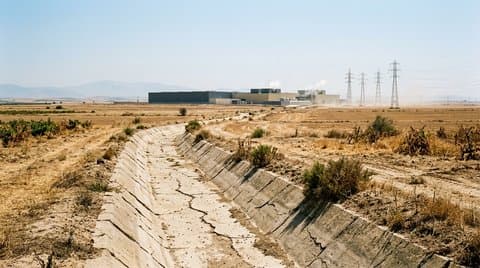
Along the Guadiana river basin on the dry border between Portugal and Extremadura, the sound of water was once a seasonal rhythm measured by autumn rainstorms, winter flow through stone acequias, and the patient creak of mechanical wind pumps. Today, in the parched municipality of Sines and across the arid plains of Talavera, a new mechanical hum has replaced the river: the deafening roar of industrial axial cooling fans venting thousands of tons of vaporized groundwater into a cloudless forty-degree sky.
Behind high security fences guarded by biometric gates and razor wire, hyperscale cloud conglomerates are constructing multi-gigawatt artificial intelligence server complexes. In corporate sustainability disclosures, these campuses are branded as carbon-neutral, powered by nearby solar installations and green energy power purchase agreements.
What the slick environmental brochures never mention is the water balance. A tensor processing cluster does not merely consume electricity; it operates as an immense thermodynamic radiator. To keep silicon dies below eighty degrees Celsius while training multi-billion-parameter neural models, data centers evaporate millions of liters of potable groundwater directly into the troposphere every twenty-four hours.
The Evaporative Cooling Shortcut
The collision between artificial intelligence and Mediterranean hydrology is rooted in thermodynamic economics. When electricity enters a server rack, virtually one hundred percent of that energy is converted into low-grade heat. In cooler northern latitudes, data centers can rely on ambient outdoor air for passive heat dissipation for most of the year. In Southern Europe, where ambient summer temperatures routinely exceed forty-two degrees, ambient air cooling is physically impossible without active refrigeration.
Rather than investing in closed-loop dielectric liquid immersion systems or dry air-to-fluid heat exchangers—which carry thirty-five percent higher capital expenditure and require substantial fan power—datacenter operators overwhelmingly deploy evaporative cooling towers.
Evaporative cooling exploits the latent heat of vaporization of water: transforming one kilogram of liquid water into vapor absorbs roughly 2,260 kilojoules of thermal energy. By spraying high-purity water over hot heat-exchanger coils and venting the resulting steam into the open atmosphere, the facility achieves a highly favorable Power Usage Effectiveness (PUE) rating.
The corporate accounting trick is transparent: water consumption is deliberately sacrificed to artificially deflate energy metrics. The facility looks green on a carbon spreadsheet because it externalizes its thermal debt onto the local municipal aquifer.
Engineering Dimension | Open Evaporative Cooling Towers (Hyperscale AI Campus) | Closed-Loop Dielectric Liquid Immersion Systems |
|---|---|---|
Water Consumption Rate | 1.8 to 2.4 liters per kilowatt-hour of compute load | Zero net water consumption after initial dielectric fluid fill |
Hydrological Fate | 100% evaporated into upper troposphere; exported from basin | Closed hermetic circuit; zero convective water loss |
Water Quality Threshold | Requires softened potable or fresh alluvial groundwater | Non-conductive synthetic hydrocarbon or fluorochemical fluid |
Capital Expenditure (CAPEX) | Lowest upfront cost; standardized industrial HVAC towers | 30%–40% premium for sealed tanks and pumping manifolds |
Impact on Surrounding Wells | Drops local piezometric water table by 15–35 meters | Negligible hydrological impact on agricultural commons |
Regulatory Vulnerability | Direct conflict with EU Water Framework Directive quotas | Complete compliance with regional groundwater preservation mandates |
Lowering the Tape Sixty Meters Down
In the dryland olive orchards surrounding these facilities, the consequences are measured not in gigawatts, but in millimeters of groundwater drawdown. When an agronomist lowers a brass piezometric sounding probe into an agricultural stone borehole that has supplied a multi-generational farm since the nineteenth century, the yellow measuring tape spools out past forty, fifty, and sixty meters before the electronic buzzer signals contact with water.
Twenty years ago, the water table in this alluvial basin sat at eighteen meters. The rapid lowering of the piezometric surface triggers a silent ecological catastrophe. As the hydraulic head drops, ancient olive and holm oak root systems lose contact with the capillary fringe. The trees begin exhibiting branch dieback and premature fruit drop.
 Agronomist lowering piezometric sounding probe into stone agricultural well
Simultaneously, smallholder farmers find their centrifugal pumps sucking air and sediment. Replacing a thirty-meter surface pump with a sixty-meter submersible deep-well pump requires twelve thousand euros of capital—an expense that small-scale cereal and olive growers simply cannot bear. The farm is abandoned, sold for nominal value, and eventually rezoned as an industrial logistics zone for the next server cluster.
The Alluvial Depletion Sequence
The extraction of groundwater by hyperscale compute infrastructure triggers an irreversible sequence of hydrological collapses across the river basin:
Phase I: Deep Well Concession Permitting → Hyperscalers secure industrial water extraction rights under emergency development decrees, bypassing regional agricultural river basin authority oversight. Phase II: High-Volume Continuous Pumping → High-capacity deep turbine pumps extract up to four million liters daily; localized cones of depression form around data center wellheads. Phase III: Regional Piezometric Drawdown → Cones of depression expand radially across agricultural peripheries; water tables drop below fifty meters; shallow irrigation wells run dry. Phase IV: Saline Intrusion & Mineral Compaction → Depleted aquifer pores collapse under geostatic pressure; irreversible loss of storage capacity; brackish mineral water migrates into freshwater reserves. Phase V: Agricultural Eviction & Ecological Desertification → Smallholder irrigation becomes economically unviable; dryland agricultural commons abandon production; former fertile floodplains turn to compacted dust.
The Legal Fiction of Industrial Water Rights
How do multinational technology corporations secure water concessions in regions classified by the European Environment Agency as experiencing severe water stress?
They exploit outdated legal frameworks. Water laws across Southern Europe were drafted in the twentieth century to accommodate seasonal manufacturing or food canning facilities—operations that operate during specific shifts and return seventy percent of their wastewater to local drainage canals after treatment.
A hyperscale artificial intelligence datacenter does not return water to the basin. When water evaporates through a cooling tower, it is transported away by atmospheric winds, carried hundreds of kilometers away before condensing as precipitation elsewhere. It is net consumptive water use. Under classical Roman legal doctrine and the public trust principles affirmed in modern European jurisprudence, running a private commercial facility that permanently exports basin groundwater to keep computer chips cool during agricultural droughts is a violation of the commons.
Water Is Not an External Factor
In Silicon Valley, engineers are conditioned to believe that every physical limit can be overcome by algorithmic optimization. If power is scarce, install solar panels; if bandwidth is saturated, implement aggressive compression; if compute is expensive, quantize the weights.
Water does not care about your optimizations. Water is a dense, polar molecule governed by unalterable geochemical laws. It cannot be synthesized on a prompt command; it cannot be virtualized in the cloud. An aquifer is a slow geological battery charged by centuries of winter rain filtering through meters of living soil and fractured granite.
When we drain an ancient groundwater basin in three years to compute synthetic marketing text and deepfake video streams, we are engaging in an act of civilizational cannibalism. We are consuming the biological prerequisite of human survival to finance the transient vanity of digital automation. The aquifer cannot run on prompts. If we do not establish strict statutory prohibitions against evaporative cooling in water-stressed basins, the fields will dry, the wells will empty, and we will discover too late that you cannot drink synthetic intelligence.