Ten Grams of Living Earth
In the dry montado pastures between Évora and Monsaraz, the August sun bakes the surface of the schist hills until the clay fissures like dry pottery. If you drive past at seventy kilometers per hour in an air-conditioned vehicle, the landscape appears dead—a bleached expanse of desiccated grasses and dormant holm oaks waiting for autumn rains that arrive later and more erratically with each passing decade.
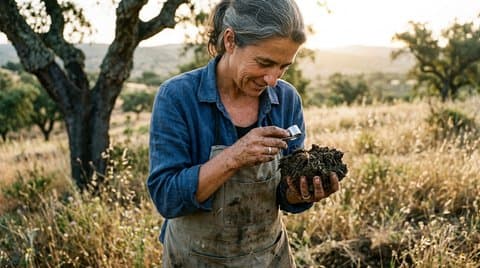
Yet when I drop to my knees with an edaphic auger, bore thirty centimeters into the A-horizon, and lift ten grams of dark, aggregated crumb into my palm, I hold more living biological organisms than the total number of human beings who have ever inhabited the earth. Inside that single handful thrive eight billion bacteria, two kilometers of fungal hyphae, tens of thousands of protozoa, and hundreds of nematodes, all engaged in a relentless metabolic choreography that modern agronomy attempts to bypass with chemical inputs and satellite algorithms.
For eighty years, industrial civilization has operated under the fatal delusion that soil is merely an inert physical anchor—a neutral sponge designed to hold synthetic nitrogen, mined phosphorus, and potassium salts while genetically uniform crops convert kilowatt-hours of fossil gas into edible calories. That delusion is now colliding with the hard thermodynamic limits of the earth.
The Colloidal Architecture of the A-Horizon
The difference between living soil and barren dirt is not a matter of chemical fertility; it is a question of structural architecture. Dirt is a disconnected collection of weathered mineral particles: sand, silt, and clay. Living soil is a self-organizing organometallic colloid bound together by biological secretions.
When plant roots photosynthesize, they do not retain all their carbon within their leaves and stems. Between twenty and forty percent of total fixed carbon is pumped downward through the roots and actively exuded into the rhizosphere as a complex soup of carbohydrates, amino acids, and phenolic compounds. This is not metabolic leakage; it is an economic transaction. The plant is feeding a subterranean army of mycorrhizal fungi and rhizosphere bacteria in exchange for solubilized minerals, systemic pathogen resistance, and moisture.
The architectural linchpin of this underground commonwealth is glomalin—a hydrophobic glycoprotein secreted by the hyphae of arbuscular mycorrhizal fungi (Glomeromycota). Glomalin acts as a biological cement, binding microscopic clay plates and organic matter into water-stable aggregates. These crumb-like aggregates create an intricate porous sponge: macro-pores that allow heavy autumn deluges to infiltrate deep into the aquifer without washing away topsoil, and micro-pores that retain capillary water against gravity throughout months of Mediterranean drought.
Pedological Dimension | Living Colloid Humus (Organic Regenerative Soil) | Inert Hydroponic Mineral Matrix (Industrial Agronomy) |
|---|---|---|
Microbial Biomass Carbon ($C_{mic}$) | > 650 mg/kg soil; stable biodiverse ecological guild | < 80 mg/kg soil; bacterial monoculture dominated by opportunists |
Water Retention Capacity | 180–220 liters per cubic meter of soil volume | < 45 liters per cubic meter; rapid runoff and surface sealing |
Aggregate Stability ($MWD$) | > 2.8 mm; high resistance to raindrop kinetic impact | < 0.6 mm; catastrophic crusting and erosive slaking |
Cation Exchange Capacity ($CEC$) | 35–50 meq/100g; organic buffering via humic acids | 8–14 meq/100g; rapid leaching of soluble nitrate into groundwater |
Fungal-to-Bacterial Ratio ($F:B$) | 0.8 : 1 to 1.5 : 1; mature saprophytic & mycorrhizal web | 0.05 : 1; complete collapse of fungal hyphal networks |
Carbon Residence Time | Centenary humic complexes ($100–1,000+$ years) | Labile carbon oxidized to $CO_2$ within single seasonal tillage |
The Chemical Rupture of the Synthetic Fix
When industrial farming injects synthetic ammonia ($NH_3$) or urea into the soil, this delicate biological economy is instantly destroyed. High concentrations of free mineral nitrogen trigger an explosive bloom of opportunistic copiotrophic bacteria that rapidly consume the soil's residual labile carbon to balance their stoichiometry.
Deprived of carbon, these bacteria begin digesting the soil's stable humic compounds—the very glue holding the crumbs together. Simultaneously, the plant, receiving an artificial flood of free synthetic nitrogen directly at its root surface, ceases exuding carbohydrates into the rhizosphere. The mycorrhizal fungi, starved of plant sugars, wither and die.
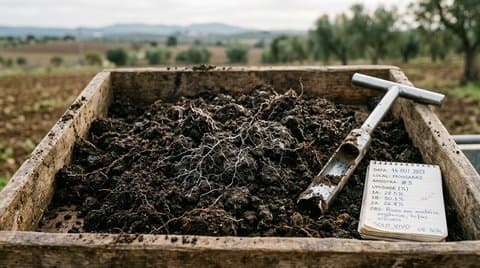 Living dark topsoil showing white mycorrhizal hyphae filaments and field corer auger
Within three decades of continuous synthetic fertilization and deep disc plowing, the organic matter content of Mediterranean soils drops from five percent to less than one percent. The soil ceases to function as a living sponge; it becomes a compacted, mineral dustbowl. When intense autumn rainfalls strike, the water cannot penetrate the compacted plow pan. It sheets across the surface, carving gullies and washing twenty tons of topsoil per hectare directly into the ocean.
The Biological Humus Genesis Cascade
The creation of permanent fertility is an irreversible sequence of biological transformations that cannot be accelerated by mechanical inputs:
Phase I: Deep Root Exudation & Rhizosphere Priming → Deep-rooting native perennials deposit simple sugars and phenolic compounds into subsoil layers, stimulating dormant bacteria. Phase II: Arbuscular Mycorrhizal Inoculation → Fungal hyphae colonize root cortical cells, extending external hyphal networks hundreds of meters through surrounding pore spaces; glomalin synthesis begins. Phase III: Micro-Aggregate Stabilization → Fungal hyphae and bacterial extracellular polysaccharides envelop clay platelets, forming micro-aggregates (< 250 $\mu$m) protected against enzymatic degradation. Phase IV: Earthworm Processing & Humic Acid Polymerization → Epigeic and anecic earthworms ingest mineral particles and decomposing leaf litter, excreting organomineral casts enriched in humic and fulvic macromolecules. Phase V: Deep Humus Stratification & Water Battery Formation → Formation of permanent colloidal humus matrix with cation exchange capacity exceeding forty milliequivalents; topsoil functions as a decentralized hydrological reservoir.
The Mirage of "Smart Agriculture"
In corporate agronomy conferences, software startups promise that satellite multispectral imaging, drone-mounted hyperspectral sensors, and automated robotic tractors will optimize fertilizer delivery and "solve food security."
This is the classic mistake of confusing surveillance with biology. An infrared sensor on a drone can tell you that an olive tree in Ferreira do Alentejo is suffering from acute water stress and nitrogen deficiency. What the drone cannot tell you—and what no predictive language model can execute—is how to reconstitute the mycorrhizal hyphae that have been annihilated by forty years of glyphosate applications and subsoil compaction.
An algorithm cannot manufacture humus. Humus requires living carbon, fungal networks, moisture, and time. To treat farming as an optimization problem where soil is merely an external data stream is an act of intellectual blindness. When an aquifer drops forty meters because super-intensive irrigated olive monocultures are pumping day and night to service global venture funds, no software patch can fill the well.
The Dignity of the Ground
True agrarian resilience does not come from high-bandwidth sensor networks; it comes from the stubborn, physical discipline of returning organic matter to the soil. It means cover cropping with nitrogen-fixing leguminous blends, integrating livestock to terminate green manures with their hooves and dung, eliminating inverted plowing, and honoring the biological sovereignty of the rhizosphere.
When I crush a crumb of living earth between my fingers, it does not smear like lifeless clay, nor does it blow away like dust. It breaks into soft, rounded granules that smell of geosmin—the distinct aromatic volatile produced by Streptomyces bacteria when earth is moist and healthy. That aroma is not poetry; it is the olfactory signature of a functional biosphere.
Civilizations do not collapse because their software becomes obsolete. They collapse when they destroy the thirty centimeters of topsoil that stand between humanity and planetary extinction. It is time we take off our headphones, step away from our screens, and learn once again to read the living language of the earth beneath our feet.