

Synthetic Protein Circuits
Programmable Biological Logic, Epigenetic State Machines, and the Architecture of Cellular Computing
Under the binocular head of our stereomicroscope at ETH Zurich, bathed in cold oblique fiber-optic illumination, the glass microfluidic chip appears deceptively simple. It is a wafer of borosilicate glass scarcely thicker than a microscope slide, etched with micro-channels twelve micrometers wide. Flowing through those channels is a suspension of engineered human HEK293T cells. When we pulse the fluid with a micromolar concentration of an orthogonal small-molecule inducer, a cascading series of fluorescence peaks registers across the photomultiplier array: cyan, then amber, then near-infrared. Within each individual cell, an engineered heterodimeric zinc-finger transcription factor has bound to a synthetic promoter, cleaved an autoinhibitory peptide domain via an orthogonal viral protease, and switched a stable epigenetic locus from transcriptionally silent heterochromatin to active euchromatin.
The cell has executed a biological NAND logic gate. More importantly, it has written the result to its own biological memory without altering a single base pair of its underlying genomic DNA sequence.
For six decades, human computation has been held captive by the Von Neumann architecture: the rigid spatial and functional separation between central processing units and passive memory registers, operating over binary voltages routed through planar copper traces on rigid silicon wafers. We accepted this architecture because silicon is easy to purify, lithography is precise, and electrons move rapidly through metal.
Yet biological evolution solved the problem of computation three billion years before the invention of the transistor. In every cubic micrometer of human cytoplasm, millions of macromolecular protein machines compute continuously through three-dimensional conformational state changes, enzymatic cascades, and chemical free-energy gradients. They process signals with an energy efficiency ten million times greater than the most advanced semiconductor foundry, repairing their own physical substrates in real time.
We are now transitioning from merely sequencing the genome to compiling executable logic directly into living cells.
Silicon Transistors versus Allosteric Protein Gates
To understand why synthetic biology represents a completely distinct computational paradigm rather than a chemical imitation of microprocessors, one must examine the physical physics of the gate.
In digital microelectronics, a logic gate is a voltage-controlled switch: applying a potential to a silicon gate either permits or blocks the flow of electrons between source and drain. The logic is binary, deterministic, and rigidly planar. It requires a continuous dissipation of electrical current and generates significant waste heat.
In molecular biology, a logic gate is an allosteric protein complex. When an input ligand binds to a specific receptor pocket on an enzyme, it induces a mechanical conformational shift across the peptide backbone, altering the spatial geometry of an active catalytic site ten nanometers away. This conformational transition either unmasks an enzymatic cleavage site, exposes a nuclear localization signal, or permits dimerization with a partner protein.
The table below contrasts the architecture of digital microprocessors with that of synthetic macromolecular protein circuits.
Computational Axis | Silicon Microelectronics (CMOS) | Synthetic Macromolecular Circuits |
|---|---|---|
Physical Substrate | Planar crystalline silicon and copper interconnects | Three-dimensional aqueous cytoplasm and chromatin |
Logic Transmission | Electron voltage gradients across wires | Conformational allostery, phosphorylation, proteolysis |
Energy Consumption | ~10⁻¹⁵ Joules per binary switching operation | ~10⁻¹⁹ Joules per enzymatic ATP hydrolysis event |
Memory Storage | Volatile capacitive charge or magnetic polarity | Epigenetic methylation, histone compaction, chromatin loops |
Physical Density | ~10⁸ transistors per square millimeter | ~10¹² macromolecular logic units per cubic millimeter |
Protein circuits do not compute in a two-dimensional plane; they operate within the dense, liquid colloidal architecture of the living cell. A single human cell contains sufficient volumetric space to host thousands of concurrent, independent biochemical logic operations without cross-talk, shielded by lipid membranes and chaperone networks.
The Epigenetic State Machine
The greatest challenge in biological engineering has historically been the problem of memory. Early synthetic biology attempts—such as the genetic toggle switches developed in the early 2000s—relied on continuous transcriptional feedback loops. To remember a state, the cell had to continually transcribe and translate repressor proteins. If metabolic stress interrupted protein synthesis, the memory collapsed.
Modern synthetic protein circuits bypass this vulnerability by writing directly to the epigenome.
The Epigenetic Biological Logic Pathway: Extracellular Ligand Input → Dimeric Protease Cleavage Gate → Epigenetic Editor Recruitment → Targeted Histone Methylation (H3K27me3) → Indefinite Chromatin Compaction Memory
Rather than altering the nucleotide sequence via CRISPR nucleases—which risks double-strand breaks, off-target chromosomal translocations, and irreversible cellular senescence—synthetic chromatin editors operate with surgical epigenetic finesse.
By fusing programmable dCas9 or zinc-finger targeting heads to engineered histone methyltransferases (such as KRAB or G9a domains), an ephemeral protein signal can condense a local chromatin domain into dense, transcriptionally inert heterochromatin.
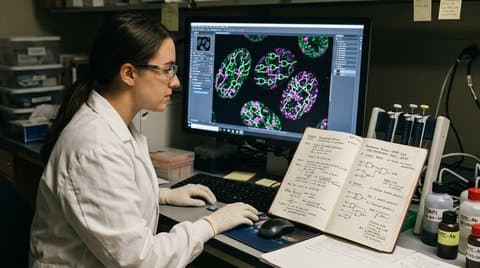 Confocal laser scanning display of chromatin protein circuits
Once methylated, this closed state is self-sustaining. Endogenous cellular machinery—DNA methyltransferases and polycomb repressive complexes—copies the epigenetic marks through dozens of cell divisions. The cell remembers that a logic gate fired weeks after the original chemical trigger has evaporated from the extracellular environment. It is non-volatile, biological flash memory.
Autonomous Therapeutic Logic in Human Tissues
What are the practical consequences of compiling executable protein circuits into living human cells?
In conventional pharmacology, a therapeutic molecule is a blunt systemic sledgehammer. An oral kinase inhibitor or a monoclonal antibody circulates indiscriminately through the bloodstream, interacting with healthy and diseased tissues alike, bounded by the severe constraints of systemic toxicity and maximum tolerated dose.
An engineered cell equipped with synthetic protein circuits is not a drug; it is a microscopic autonomous physician.
Consider an engineered cellular circuit deployed in oncology:
Input A: Elevated intracellular hypoxia characteristic of a solid tumor microenvironment.
Input B: Overexpression of a specific cell-surface oncogenic kinase.
Input C: Absence of a normal tissue-protective HLA surface marker (NOT gate).
Only when the Boolean logical condition [A AND B AND (NOT C)] evaluates to TRUE does the internal protein cascade trigger the secretion of a potent localized cytotoxic payload. If the cell encounters healthy tissue where condition C is present, the circuit remains inert. Toxicity is contained within the micro-anatomic boundary of the disease.
The Boundary of the Living Machine
As we master the compiling of protein logic, we confront an inevitable philosophical threshold: where does an engineered mechanism end, and a living organism begin?
For three centuries, mechanistic reductionism treated the human body as a clockwork engine—a collection of mechanical levers, valves, and chemical retorts. Synthetic biology inverted that metaphor, demonstrating that the clockwork itself is made of living code that can be edited, looped, and recompiled.
Yet we must resist the technocratic hubris that assumes biological systems can be treated with the careless arrogance of software repositories. A software compiler throws a syntax error and aborts execution; a biological system responds to unexpected logical stress through metabolic rewiring, immune rejection, oncogenic transformation, or evolutionary adaptation. The living substrate has its own stubborn wisdom, honed across eons of survival.
In our laboratory, the evening shadows lengthen across the fume hoods and incubator banks. On the display screen, the fluorescent peaks subside as the engineered cells return to their homeostatic equilibrium. The logic gates have fired, the chromatin state has locked, and inside billions of tiny lipid envelopes, life continues to compute.