
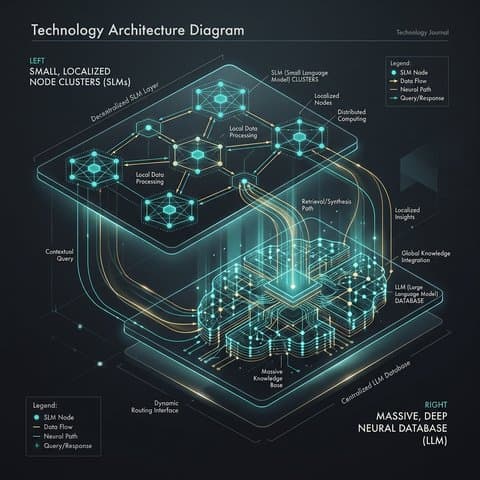
Small Models, Big Architecture: The Hybrid Routing Revolution
As tokenomics and latency constraints collide with enterprise AI budgets, the future of engineering belongs to hybrid routing layers that orchestrate tasks between lightweight local models and monolithic frontier systems.
The Illusion of the Monolithic Solution
For the past three years, software engineering operated under a simplistic assumption: bigger is always better. When building an AI-assisted application, developers routinely piped every single prompt—whether a simple grammar check, a data transformation, or a complex reasoning task—directly to the largest, most expensive API available. We treated frontier models as general-purpose compute engines, ignoring both the financial and temporal costs of doing so.
But in 2026, the industry is hitting a wall. We call this AI Bill Shock.
Enterprises are realizing that spending millions of dollars on API tokens to perform basic database mapping or simple text formatting is economically unsustainable. Moreover, routing every single request through a public cloud API introduces unacceptable network latency and raises severe data sovereignty concerns. The monolithic stack is fracturing, and in its place is emerging a new architectural paradigm: hybrid routing.
THE MONOLITHIC VS. HYBRID AI PIPELINE
Monolithic:  [User Request] ───────────────────────────► [Frontier LLM (100% tokens, 1.2s)]

Hybrid Route: [User Request] ──► [Local Classifier] ──┬──► [Local SLM (80% tasks, 0.1s)]
└──► [Frontier LLM (20% tasks, 1.2s)]
The future is not about finding a single model to rule them all. It is about building a routing layer that cascades requests across a hierarchy of specialized models based on complexity, latency tolerances, and token economics.
The Rise of the Small Language Model (SLM)
The catalyst for this shift is the rapid advancement of Small Language Models (SLMs). Models running locally or on edge servers with fewer than 8 billion parameters are now capable of performing specific, constrained tasks with accuracies that rival or exceed frontier models.
These SLMs are not generalists. They do not know how to write screenplays or analyze global economic policies. However, they are highly optimized for structural tasks: parsing JSON, generating SQL queries from natural language, identifying intent, or extracting entities.
By running these lightweight models inside the application's local network (or even on the client device), we reduce latency from seconds to milliseconds. Crucially, the cost of running these local inferences falls to zero marginal cost once the hardware is provisioned, bypassing the billing structures of external providers.
Designing the Intelligent Routing Layer
The core of this new architecture is the Hybrid Router.
The router is a decoupled, ultra-low-latency classification engine that sits between the application client and the model endpoints. Its role is to evaluate incoming prompts and determine the minimum necessary compute required to resolve them.
HYBRID ROUTER DECISION FLOW CHART
[Incoming Prompt]
│
▼
[Intent & Complexity Run]
│
┌────────────────┴────────────────┐
[Simple / Structural]            [Complex / Reasoning]
│                                 │
▼                                 ▼
[Route to Local SLM]             [Route to Frontier LLM]
│                                 │
(0.1s, Zero Cost)                 (1.2s, Token Cost)
To prevent the router itself from becoming a bottleneck, it must not be a heavy model. Instead, it is typically implemented as a specialized classifier, a semantic search index matching prompt templates, or a highly tuned 1-billion-parameter local model running in-memory.
"Architectural elegance is not about using the most powerful component; it is about using the component that is exactly suited to the task."
The Economics of Token Cascading
A major benefit of hybrid routing is token cascading.
When a complex task is received, the router does not simply pass the entire prompt to a frontier model. Instead, it breaks the task into sub-tasks. The router sends the structural sub-tasks (such as data preprocessing or input filtering) to local SLMs, using their outputs to assemble a highly condensed, context-rich prompt for the frontier LLM.
This decomposition achieves two critical objectives:
Context Compression: It strips away conversational noise and structural boilerplate, reducing the input token size sent to the expensive frontier model by up to 70%.
Parallel Execution: Sub-tasks can be executed in parallel across multiple local SLM instances, minimizing the end-to-end latency of the system.
TOKEN CASCADING COST SAVINGS EXAMPLE
Traditional API Cost:  [Input Tokens: 2,000] ──► [Frontier LLM] ──► $0.0300 per call
Cascaded API Cost:     [Input Tokens: 2,000] ──► [Local SLM Filter] ──► [Frontier: 300 tokens] ──► $0.0045 per call
By filtering and structuring the context before it leaves the local network, we optimize the budget and maintain strict control over which data is exposed to public APIs.
Sovereignty and Latency as Core Constraints
Beyond economics, hybrid routing addresses the fundamental constraints of modern systems: data sovereignty and latency.
For healthcare, finance, or government applications, routing sensitive personal data through external public APIs is legally or regulatorily prohibited. With hybrid routing, the router ensures that any task involving personally identifiable information (PII) is handled strictly by localized, self-hosted SLMs within the secure boundary. Only anonymized, abstract reasoning tasks are escalated to the cloud.
At the same time, user experience is highly sensitive to latency. A UI that lags for two seconds while waiting for a cloud model to format a list is unacceptable. Hybrid routing allows for instant UI feedback powered by local models, with deeper enrichment loaded asynchronously from frontier APIs in the background.
The transition to a hybrid routing stack represents a maturity phase in AI engineering. It is a shift away from the naive integration of third-party APIs toward true systems design. By treating models as specialized, distributed compute nodes, we can build applications that are fast, secure, and economically viable for the long term. The era of the monolithic LLM is ending; the era of big architecture has begun.