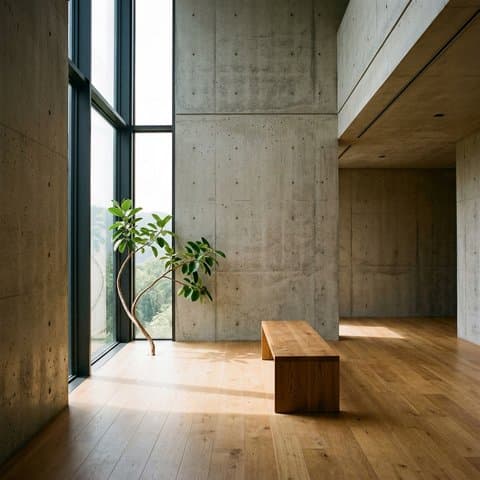
Scroll Fatigue and the Architecture of Nothing: Designing Spaces Without Screens
In a recent essay, Clara Visser spoke with an almost cozy familiarity about the quiet arrival of domestic intelligence. She depicted the humanoid companion not as a metallic intruder, but as a subtle extension of our domestic rhythm—a helpful, silent shadow that learns the squeak of our floorboards and the specific temperature at which we prefer our evening tea. Her thesis is clear: if we localize the intelligence of these machines, if we anchor them within a sovereign domestic grid rather than letting them leak their observations into the commercial cloud, we can safely welcome them into our sanctuaries.
But this is a dangerous aesthetic compromise.
To assume that the primary threat of domestic machine intelligence is merely a question of data sovereignty is to misunderstand the very nature of human presence. Even if the robotic housemate operates entirely on local edge-compute, even if its eyes do not upload a single pixel to an corporate server, it remains a machine whose very existence demands attention. It is a node of dynamic calculation moving through a space that, for thousands of years, was defined by its static, unyielding material truth. When the home becomes a responsive, calculating entity, the home ceases to be a refuge. It becomes a laboratory.
The true crisis of our era is not merely the surveillance state or the theft of cognitive labor; it is the total content-fication of our physical reality. We are suffering from a profound, systemic scroll fatigue that has long since spilled over the edges of our smartphones. Our visual and cognitive apparatus is exhausted, over-stimulated by a world that refuses to remain still, silent, and empty.
Against the encroachment of this ambient computing, we must assert a radical aesthetic response: the deliberate construction of the physical void. We must design spaces not to facilitate connection, but to protect silence. We must build the Architecture of Nothing.
The Intimate Encroachment
Consider what happens when every surface in a home becomes potential real estate for information. We have already accepted the smart mirror that feeds us the morning news as we brush our teeth, the refrigerator door that suggests recipes based on its internal camera feed, and the speaker that listens to our sighs to recommend a playlist. In this environment, the eye is never allowed to rest. Every gaze is met with a prompt; every gesture is interpreted as an input.
This constant state of readiness is a form of sensory taxation. The brain, evolved to parse stable environments for occasional movements (a predator in the brush, a falling piece of fruit), is kept in a perpetual state of low-level visual arousal. The saccadic movements of our eyes—the tiny, rapid jumps they make between points of interest—are multiplied tenfold when our walls, tables, and mirrors are alive with shifting pixels and hidden sensors.
Clara Visser’s local-first robot does not solve this; it merely relocates the computational burden to a physical entity. To share a room with an autonomous agent is to engage in a continuous, subconscious negotiation of space. Where is it looking? What is it processing? Even in its most helpful state, the machine introduces an invisible current of calculation into the atmosphere. The home, which should be the place where we shed our social and professional performance, becomes an environment where we must remain legible to a non-human observer.
We do not need safer domestic interfaces. We need fewer of them. We need to define areas of our lives where computation is not merely secured, but fundamentally absent.
The Physics of Attention
To understand the necessity of screenless architecture, we must examine the physiological toll of our current digital landscape. The average human pulls their smartphone from their pocket over a hundred times a day. Each interaction is a micro-fracture of attention, a brief, violent wrenching of the mind from its immediate physical context into the weightless, placeless geography of the network.
This constant shifting of focus has altered our relationship with time and space. We no longer inhabit a continuous present; instead, we live in a series of fragmented intervals. Our attention is no longer directed by our will, but pulled along by a sequence of external triggers—the vibration of a notification, the flash of a blue light, the infinite scroll of a feed designed by cognitive psychologists to exploit our evolutionary craving for novelty.
The screen is not a window to another world; it is a vacuum that sucks the reality out of this one.
When we live through screens, our bodies become secondary. The physical world, with its slow transitions, its complex textures, and its uncalculating indifference, begins to feel dull and demanding. We lose what the phenomenologists call "anchoring"—the deep, somatic sense of being situated in a specific place, at a specific time, with a specific body. We become disembodied minds floating in an ether of information, exhausted by the sheer volume of choices we never asked to make.
Scroll fatigue is not simply eye strain; it is a form of spiritual weariness. It is the realization that despite our infinite connectivity, we have lost the capacity for presence. We have forgotten how to sit in a room and simply be there.
The Philosophy of the Void
The Western architectural tradition has long been obsessed with the articulation of form. We celebrate the column, the arch, the vault, the facade—the positive elements that carve up space and define boundaries. We treat empty space as a byproduct of construction, the residual area left over after the walls have been erected.
In contrast, the classical Japanese aesthetic recognizes Ma—the negative space, the interval, the silence between notes. Ma is not the absence of space; it is the conscious alignment of elements to give empty space its own weight, its own resonance. In a traditional tea room, the emptiness is not a blank canvas waiting to be filled; it is the very essence of the room. The absolute lack of ornamentation, save for a single scroll or a seasonal flower, forces the inhabitant to confront their own presence and the presence of others in the room.
To design an Architecture of Nothing is to reclaim the value of Ma in a world saturated with digital noise. It is the belief that a room is defined not by what it contains, but by what it excludes.
Emptiness is not cold or sterile; it is the ultimate luxury. In a society where every square centimeter of space and every second of time is subject to monetization and algorithmic optimization, a room that contains nothing but air and light is a radical act of resistance. It is a declaration that some aspects of human experience are sacred, beyond the reach of the network, and immune to calculation.
Drafting the Sanctuary
How do we translate this philosophy into concrete spatial design? The Architecture of Nothing is not an abstract ideal; it is a practical methodology for building screenless sanctuaries in our homes and cities. It relies on three primary principles: the containment of technology, tactile grounding, and the materialization of silence.
First, we must practice the absolute containment of interfaces. In a screenless sanctuary, devices are not permitted to float freely. The smartphone, the tablet, and the laptop must be treated as tools with specific, bounded functions, akin to a circular saw or an iron. They must be kept in dedicated storage drawers or cabinets, out of sight and out of mind, when not in use. A dining table should never have a phone resting on it; a bedside table should never play host to a screen. By physically segregating technology, we create zones where the mind is freed from the threat of notification.
Second, we must prioritize tactile grounding. When we interact with screens, our physical touch is flattened into a uniform sheet of cold glass. The Architecture of Nothing counters this sensory starvation by utilizing materials that demand a diverse range of tactile responses. We design with raw stone that feels cool and rough under the hand, natural wood that carries the warmth of the sun and the texture of its grain, hand-burnished clay walls that reflect light with a soft, uneven texture, and thick woven linens that catch the air. These materials do not transmit information; they transmit presence. They anchor us in the physical reality of our bodies.
Third, we must treat silence not as the absence of noise, but as a material element of the architecture. We construct walls with high acoustic mass—using rammed earth, thick plaster, or heavy timber—to insulate the interior from the low-frequency hum of urban life and the high-frequency chatter of digital transmissions. We design rooms that allow for the movement of wind and the sound of falling water, creating a natural acoustic background that masks our own internal restlessness.
Reclaiming the Senses
Ultimately, the Architecture of Nothing is not about buildings; it is about the recovery of our humanity.
When we strip away the screens, the sensors, and the ambient intelligence, we are left with ourselves. We are forced to look at our hands, to feel the weight of our bodies against the chair, to watch the slow shift of shadow across the wall as the afternoon fades into evening. We are forced to inhabit the silence, even when it feels uncomfortable.
This discomfort is the first step toward recovery. It is the withdrawal symptom of a mind that has been hooked on the cheap dopamine of the network for decades. But if we can sit through the initial restlessness, if we can resist the urge to reach for a pocket-sized interface, we begin to notice a slow returning of our senses. We hear the wind in the leaves outside the window; we notice the complex smell of rain on dry dust; we feel the subtle changes in temperature as the sun moves behind a cloud.
We recover our capacity for deep, unhurried thought. We recover our relationship with the analog world—a world that does not care about our inputs, does not track our behavior, and does not require our optimization to exist.
Clara Visser may look forward to a home populated by helpful domestic intelligences. But I choose a different future. I choose a home built around the void. I choose a room with a wooden bench, a concrete wall, a single window, and nothing else.
For in that emptiness, we might finally remember who we are.