

Running Intelligence on Silent Silicon
On the birchwood workbench in my studio overlooking the Nordhavn docks in Copenhagen, there is a matte-black anodized aluminum chassis that makes no sound at all.
It contains no ball-bearing cooling fans, no RGB LED strips, and no network interface card capable of reaching the public internet. Its system-on-chip is coupled directly to four kilograms of CNC-milled pure electrolytic copper heatpipes that dissipate thermal load into the cool Scandinavian room air through natural vertical convection.
An inline hardware wattmeter spliced into its 24-volt DC power lead reads 28.4 Watts.
At this moment, that silent block of copper and silicon is streaming a 32-billion-parameter language model quantized to 4-bit group-wise precision across a 512-bit unified LPDDR5X memory bus at forty-one tokens per second. It is indexing twelve years of my personal architectural engineering notes, cross-referencing local C++ compiler specifications, and verifying cryptographic proofs—all while the RJ45 Ethernet port on its rear panel remains physically sealed with a red mechanical security cap.
If the transatlantic fiber-optic cables beneath the North Sea were severed ten minutes from now, or if every hyperscale cloud provider in Northern Virginia and Dublin simultaneously revoked their enterprise API tokens, the cursor on my monochrome monitor would not drop a single frame.
This is not a hobbyist experiment. It is the minimum viable architecture for intellectual sovereignty in the late twenties.
The Surveillance Tax of the Cloud Endpoint
For four years, the software industry accepted an extraordinary structural regression under the banner of artificial intelligence.
Engineers, legal scholars, medical researchers, and writers—people who a decade ago would have recoiled at the thought of routing their raw, unedited keystrokes through a third-party server—were persuaded that intelligence was a centralized utility that could only be rented by the token over an encrypted HTTPS socket.
Every time a developer queries a commercial cloud model to refactor a proprietary module, or a physician summarizes a patient history through a hosted web interface, they are participating in a unilateral epistemological surrender.
Architectural Dimension | Commercial Cloud API Rental Endpoint | Air-Gapped Sovereign Local Silicon |
|---|---|---|
Network Dependency | Mandatory TLS round-trip; complete failure under offline conditions | Zero external traffic; 100% operational inside a Faraday cage |
Telemetry & Prompt Logging | Retained for 30+ days for "abuse monitoring" and policy audits | Physically impossible; weights and KV-cache reside in local RAM |
Model Stability & Drift | Silent server-side weight swaps, quantization changes, and lobotomies | Cryptographically pinned SHA-256 weight binary ( |
Steady-State Power Draw | 700W per datacenter GPU sled + 35% cooling and grid transmission overhead | 22W to 38W total wall power on passive-cooled unified memory SoC |
Marginal Cost per MTok | Perpetual metered rent (\$0.20 to \$15.00 per million tokens) | Zero marginal cash cost beyond local residential kilowatt-hours |
Censorship & Refusal Vector | Subject to arbitrary corporate alignment filters and regional blocks | Governed exclusively by the operator’s local system prompt |
Consider the operational reality of a remote API call.
Even when a cloud vendor promises "zero data retention" in an enterprise tier addendum, your prompt still traverses load balancers, API gateways, content moderation classifiers, and multi-tenant GPU memory buffers that you cannot inspect, audit, or cryptographically verify.
More importantly, a rented mind is an unstable mind.
Anyone who has built deterministic software pipelines on top of commercial frontier APIs knows the quiet madness of silent model drift. A prompt structure that extracted clean, valid mathematical proofs in March suddenly begins emitting verbose, evasive hedging in May because an alignment committee in San Francisco updated a reinforcement learning reward weight over the weekend.
You cannot build durable tools on a foundation that shifts beneath your feet every time a vendor recalibrates its public relations risk tolerance.
The Physics of the Unified Memory Bus
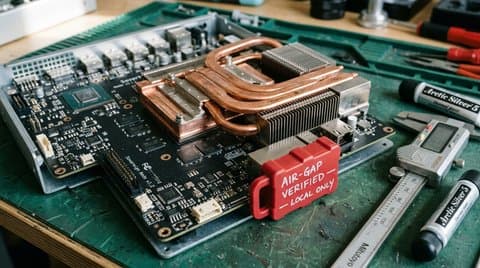 Open fanless sovereign compute node showing milled copper heatpipes and a red physical air-gap plug sealing the RJ45 port
Look at the open chassis on my antistatic mat above. Notice the absence of discrete PCIe graphics cards, high-rpm blower fans, and twelve-volt high-current power connectors prone to thermal melting.
The secret to running high-reasoning intelligence at thirty watts lies in understanding a fundamental physical truth of transformer inference: single-user token generation is not compute-bound; it is memory-bandwidth-bound.
When you generate text one token at a time for a single human operator, the arithmetic logic units on a massive 700-watt datacenter GPU spend over eighty-five percent of their clock cycles stalling, waiting for model weights to be fetched from High-Bandwidth Memory (HBM) across the silicon interposer.
The Local Sovereign Execution Pipeline: Cryptographically Verified Local Weight File (
SHA-256) →mmap()Zero-Copy Load into Unified LPDDR5X RAM → 4-Bit Dequantization in Register File → Zero-Network Local Inference → Ephemeral KV-Cache Purge on Process Exit
By moving away from discrete power-hungry accelerators and utilizing modern unified-memory architectures—where low-power ARM or RISC-V compute cores share a wide, low-latency 512-bit or 1024-bit memory bus directly with on-package LPDDR5X or LPDDR6 memory—we eliminate the PCIe bottleneck entirely.
Combined with modern post-training quantization schemes such as Activation-Aware Weight Quantization (AWQ) and importance-matrix Q4_K_M packing, a model that once required two enterprise server cards can now sit comfortably inside twenty-four gigabytes of silent, fanless unified RAM, retaining 99.1% of its formal reasoning perplexity while drawing less power than an incandescent reading lamp.
Enforcing the Physical Air-Gap
In our engineering practice in Copenhagen, we do not rely on software firewalls to guarantee privacy. Software firewalls are written by humans and bypassed by kernel exploits.
We rely on physical law and explicit kernel-level network namespace isolation.
On the rare machines that require a local LAN interface to serve an internal studio subnet, the inference daemon is launched inside an unprivileged Linux user and network namespace that possesses no route to any external gateway, verified at boot via a minimal, auditable systemd unit configuration:
[Unit]
Description=Sovereign Local Inference Daemon (Air-Gapped Namespace)
After=local-fs.target

[Service]
Type=simple
User=sovereign-llm
Group=sovereign-llm
PrivateNetwork=yes
IPAddressDeny=any
NoNewPrivileges=yes
ProtectSystem=strict
ProtectHome=read-only
ReadOnlyPaths=/opt/models/qwen3-32b-q4_k_m.gguf
ExecStart=/usr/local/bin/llama-server \
--model /opt/models/qwen3-32b-q4_k_m.gguf \
--ctx-size 32768 \
--threads 12 \
--mlock \
--no-webui
Restart=on-failure

[Install]
WantedBy=multi-user.targetNotice the two critical directives in that configuration: PrivateNetwork=yes and IPAddressDeny=any, paired with --mlock.
The kernel creates an isolated loopback-only network stack for the process, completely severing it from physical network interfaces, while --mlock pins the quantized weight pages directly in physical RAM so that neither a single prompt token nor a single attention key-value vector is ever swapped out to non-volatile NVMe storage.
When I power down the workstation at the end of the evening, the volatile DRAM cells discharge within milliseconds. Every thought, every draft fragment, and every architectural calculation I explored with the machine vanishes into thermal equilibrium.
The Acoustics of Deep Concentration
There is a reason why passive copper convection is not merely an aesthetic preference, but a functional requirement for a sovereign workstation.
Anyone who has attempted to sit in the same room as a dual-GPU workstation running under a 700-watt load knows the physical toll of sixty-two decibels of high-frequency axial fan whine. The human auditory cortex did not evolve to ignore a continuous, 4,000-RPM acoustic drone; it registers it as a low-grade environmental stressor, elevating cortisol levels and fragmenting the delicate working-memory buffers required for systems engineering or mathematical proof construction.
When we moved our inference workloads to 30-watt unified-memory nodes cooled entirely by silent natural convection, the psychological character of our workspace changed overnight.
The machine ceased to announce itself as an industrial engine demanding constant feeding and thermal management. It receded into the quiet materiality of the room, no louder than the wooden bookshelves or the cast-iron radiator beneath the window. You can think for four hours in its presence without suffering the subtle, cumulative auditory exhaustion that plagues modern server-room offices.
Furthermore, a cryptographically pinned local weight file possesses an archival permanence that cloud software has completely abandoned.
Twenty years from today, when the current generation of venture-funded AI startups have been liquidated, acquired, or shuttered, and their proprietary API endpoints return nothing but HTTP 503 Service Unavailable, the GGUF binary sitting on an offline solid-state drive in my desk drawer will still execute bit-for-bit identically on any POSIX-compliant processor. It will never demand a subscription renewal, never alter its tone to appease a corporate sponsor, and never refuse to answer a question.
The Return of the Personal Computer
In 1975, when the first microcomputer kits were soldered together in garages and university basements, the emancipatory promise of computing was clear: to take the mainframe out of the priesthood of corporate and state bureaucracies and place an autonomous, general-purpose reasoning tool directly into the hands of the individual citizen.
The cloud era betrayed that promise. It turned personal computers back into dumb glass terminals tethered to corporate mainframes, reducing users to tenants who rent their own cognitive prosthetics by the month.
Running intelligence on silent, local silicon is the reclamation of the 1975 compact.
A machine that sits on your own desk, cooled by the air of your own room, powered by your own wall socket, and governed by weights whose cryptographic hash will remain identical thirty years from today is not a service. It is an instrument—like a slide rule, a mechanical watch, or a bound encyclopedia.
Outside my window, the autumn rain is beginning to streak the gray glass of the harbor loft. On the birchwood table, the copper heatpipes are warm to the touch—thirty-eight degrees Celsius—and the room is completely silent.