
Reading in the Shadow of the Linotype
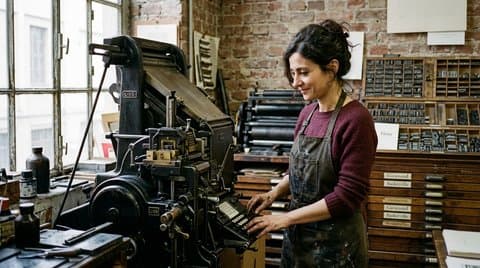
At five-fifteen on a chill November afternoon in our basement workshop on Via San Tommaso in Turin, the Linotype machine sighs like an iron whale waking from sleep.
The electric crucible heating elements have reached two hundred and eighty degrees Celsius. Inside the cast-iron melting pot, a three-kilogram ingot of printing alloy—eighty-five percent virgin lead, eleven percent antimony for hardness, and four percent tin to lower the melting threshold and sharpen the casting boundary—has liquefied into a mercury-bright molten bath that ripples with iridescent lavender oxidation films when stirred with an iron ladle.
When you sit at the ninety-key magazine keyboard of a 1938 Model 8 Linotype, every sentence you compose carries physical inertia.
You tap a brass key with the pad of your index finger. High above your head, in an inclined magazine holding thousands of brass matrices, an escapement lever trips. A small brass matrix—a rectangular piece of cold metal scarcely larger than a postage stamp, with the negative shape of a letter a engraved into its edge—drops through a maze of vertical channels, clattering down an inclined chute with a sharp, percussive musical chime: pling-tink-chime.
As your fingers move across the keys, the brass matrices accumulate in the delivery assembler. When the line is filled, you press the spaceband lever with your left thumb. A set of dual-wedge steel spacebands expands outward, automatically justifying the line of text to precisely twenty-four picas by pushing the words apart with physical mechanical force.
Then you pull the main operating clutch.
The machine’s one-horsepower motor engages a camshaft the size of a locomotive axle. A heavy steel vice clamps the line of brass matrices against the mouth of the mold disk. A cast-iron pump plunger dips into the molten metal bath, forcing a jet of liquid lead alloy into the back of the mold.
Three seconds later, cooled by water circulating through the cast-iron disk, the metal solidifies. The knife trims the foot to exactly 0.918 inches—the universal type-high standard of Gutenberg. A finished, solid slug of lead type, warm as a fevered wrist and bearing a raised line of fresh, razor-sharp typography, drops into the galley tray with a dull, heavy metallic thud: clack.
The Physical Weight of an Irreversible Sentence
To compose prose on a Linotype is to confront the terrifying, intoxicating reality of material consequence.
In the contemporary landscape of digital word processing, text has been stripped of mass, resistance, and gravity. You type a sentence on a glass screen or a plastic chiclet keyboard; if the rhythm is flaccid or the adjective imprecise, your pinky finger taps the backspace key three times, and the error vanishes into the electrical void without leaving a trace, a memory, or an apology.
The frictionless ease of digital writing has produced an unprecedented crisis of stylistic incontinence.
Because sentences cost nothing to generate, duplicate, or delete, we generate billions of them a day—sprawling, unedited floods of synthetic text, corporate memos, and social media commentary that clog the cognitive channels of our civilization with verbal sludge.
Dimension | The Digital Text Stream | The Linotype Lead Slug Matrix |
|---|---|---|
Material Foundation | Fleeting capacitive electrical charges in volatile RAM cells | Solid alloy of lead, antimony, and tin cooled at 280°C |
Correction Dynamic | Infinite, consequence-free keystroke deletion via backspace | Physical re-casting of the entire line; molten metal scrap recycling |
Mechanical Resistance | Zero tactile drag; lubricated glass or membrane bounce | Mechanical lever escapement, brass matrix drop, 1-HP camshaft torque |
The Inherent Rhythm | Rushed, distracted multi-tasking interrupted by notification badges | Rhythmic acoustic cadence dictated by matrix delivery and pump stroke |
Spatial Permanence | Ephemeral pixels overwritten sixty times a second on a screen | A permanent, immovable lead bar with letters elevated at 0.918 inches |
On the Linotype, however, you cannot backspace.
If you commit a spelling error in the ninth word of a line, or if your syntax wanders into an uncoordinated dead end, you cannot simply erase the offending token. You must complete the line, pull the lever, cast the flawed slug into the galley, manually lift the heavy lead bar with your fingertips, and toss it back into the smoking melting pot to be remelted, while your hands re-compose the sentence from the opening capital letter.
That physical friction alters the neurobiology of the writer.
Before your fingers touch the keys of a Linotype, your brain must perform the heavy lifting of composition in silence. You must measure the sentence in your mind; you must listen to its cadence; you must verify its syntactic architecture; and you must ensure that every single word carries its own weight before you commit the molten metal to the mold.
The Bite of the Cylinder into Cotton Rag
The slug of lead, however, is merely the first half of the typographical mystery.
The true encounter occurs when the assembled galley of lead slugs is transferred to the bed of our 1952 Heidelberg cylinder press, inked with cold linseed-varnish pigment, and brought into mechanical contact with a damp sheet of handmade cotton rag paper.
When an offset commercial press or an inkjet printer reproduces text, it deposits a microscopic droplet of liquid toner on the surface of the paper. The text sits on the page, flat and superficial, like oil on water.
When a letterpress cylinder rolls across a form of lead type, it exerts three tons of linear physical pressure.
The Letterpress Mechanical Impression Sequence: Molten Lead Slug Casting → Hand-Inking with Raw Linseed Varnish → High-Pressure Cylinder Impression → Three-Dimensional Cellulose Fiber Bite → Tactile Reading Braille
Letterpress Impression:
[ Heavy Steel Impression Cylinder ]
|  (3 Tons Pressure)
~~~~~~~~~~~~~ [ Damp Cotton Rag Paper ] ~~~~~~~~~~~~~
|
[ A ]    [ B ]   [ C ]   [ D ]  <--- Raised Lead Type (0.918")
The raised metal faces of the letters physically bite into the damp, soft cellulose fibers of the paper, displacing the woodpulp and debossing a three-dimensional crater into the sheet.
When you run your bare fingertips over a page printed by letterpress, you are not merely reading with your eyes. You are reading with your epidermis.
Your skin detects the crisp, microscopic ridge where the metal sheared the paper fiber; you feel the slight raised burr on the verso side where the pressure pushed the cotton outward; and you inhale the dark, earthy perfume of boiled linseed oil, pine resin, and lampblack ink that will remain chemically stable in the paper for five hundred years without fading under sunlight.
 Ink-stained printer adjusting reversed lead movable type in brass composing stick
This is what digital screens can never provide: the tactile braille of historical truth.
A digital screen is a surface of pure simulation. Whether it displays a sacred psalm, an execution warrant, or a promotional coupon for laundry detergent, the physical glass under your thumb feels identical: cold, hard, slippery, and dead.
The letterpress page refuses that false equality. The heavy paper resists your hand; the ink demands your patience; and the physical impression reminds you that an actual human being stood in a cold workshop and spent their bodily strength pressing truth into matter.
The Gutenberg Secession
Over the past three years, an extraordinary underground movement has taken root across the small cities of northern Italy, France, and Catalonia: the Gutenberg Secession.
In Turin, Bologna, Lyon, and Girona, small collectives of poets, novelists, and independent scholars are turning their backs on the digital publishing platforms. They are hunting down abandoned Heidelberg presses in closed provincial printing shops, hauling century-old Linotype machines out of scrap-metal yards, and rebuilding the physical infrastructure of print culture by hand.
They are not doing this out of romantic antiquarianism; they are doing this out of epistemic self-defense.
In an era when artificial intelligence can generate forty thousand pages of fluent, plausible, completely fake historical documents in three minutes, the only defense against total epistemic contamination is the physical difficulty of the medium.
You cannot generate a physical letterpress book with an algorithmic prompt.
You cannot hallucinate forty pounds of cast lead type into an iron chase. You cannot automate the mixing of linseed varnish on a marble slab. And you cannot fake the three-ton bite of an impression cylinder into eighty-pound Arches cotton rag.
When a reader holds a book produced by the Gutenberg Secession, they know with absolute, physical certainty that every word on that page was considered by a living human consciousness, set by human hands, and printed through honest physical labor.
Standing by the Crucible
At eight in the evening, the street outside the workshop has fallen quiet.
The last galley of type for our autumn pamphlet of contemporary poetry has been cast and locked in the chase. I switch off the Linotype motor, and the great cast-iron beast rolls to a silent stop. The red glow of the heating elements fades into the shadows, smelling of warm metal and hot lubricating oil.
On the wooden drying rack beside the press, three hundred sheets of damp rag paper are resting in the dim light, their freshly inked lines of text gleaming like wet pitch.
Tomorrow, when the ink has oxidized and the fibers have dried, a reader in Milan or Paris will open the volume, run their thumb along the embossed margin, and feel the living pulse of a thought that refused to become a pixel.
Turn off the blue light. Step into the shadow of the press. Feel the lead.
The word made flesh has not perished; it is merely waiting for those who have the courage to get their hands dirty.