
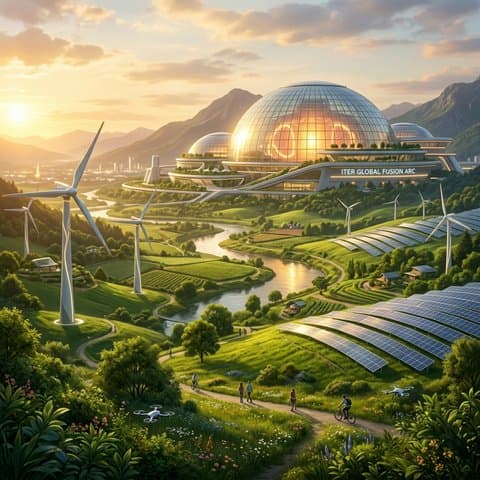
RCP 8.5 Is Dead: What Fusion Means for the Death of the Worst-Case Scenario
For more than two decades, the specter of Representative Concentration Pathway 8.5 (RCP 8.5) has haunted the halls of climate science, international policy, and global media.
Originally designed as an extreme, high-emissions scenario to help scientists model the outer limits of greenhouse gas forcing, RCP 8.5 assumes a world that defies historical trendlines. It assumes a massive renaissance of coal, a complete abandonment of renewable technology, and a global population expanding unchecked without carbon-reduction policies. Yet, despite its extreme assumptions, RCP 8.5 has been repeatedly, and erroneously, cited as the "business-as-usual" baseline for future projections. It has served as the foundation for cataclysmic economic forecasts, policy mandates, and a pervasive, paralyzing climate anxiety.
But the reality of 2026 has rendered this scenario scientifically and technologically obsolete. The worst-case climate projection is dead, killed not by international treaties or self-inflicted economic de-growth, but by the commercialization of nuclear fusion and the exponential scale-up of renewables.
We are entering the era of post-scarcity energy. It is time to align our policy frameworks with this new material truth.
The Implausibility of the Coal-Heavy Future
To understand why the worst-case scenario is dead, we must first examine the flawed assumptions that built it. RCP 8.5 requires a five-fold increase in coal consumption by the end of the twenty-first century—a projection that looks increasingly absurd in light of current energy trends.
Global coal capacity has peaked. Across both mature and emerging economies, coal is being systematically retired, replaced by solar, wind, battery storage, and natural gas. The economics of energy production have shifted permanently: solar and wind are now the cheapest sources of new electricity generation in history. Even without climate policy, purely market-driven forces would prevent the massive coal resurgence required to hit the RCP 8.5 emissions pathway.
The Renewable Cost Decline: The cost of solar photovoltaics and wind energy has dropped by over 80% in the last fifteen years.
The Battery Capacity Boom: Global utility-scale battery storage capacity is doubling almost every two years, solving the short-term intermittency problem.
The Peak Coal Transition: Major developing nations are actively shifting their infrastructure targets away from coal and toward decentralized grid networks.
These factors alone had already diverted us from the worst-case path, locking us into a more moderate warming trajectory of 2.0°C to 2.5°C. But the recent commercialization of nuclear fusion has completely rewritten the upper boundaries of what is possible, bringing a true zero-carbon, high-density energy supply online.
The Fusion Inflection Point
The transition from theoretical fusion research to commercial power generation has occurred with remarkable speed. By harnessing high-temperature superconducting magnets and advanced magnetic confinement designs, commercial fusion reactors are now delivering net electricity to regional grids.
Unlike fission, which faces severe political headwinds and long construction timelines, fusion offers an politically viable, clean, and practically limitless supply of baseload power. It requires no fuel imports other than widely available hydrogen isotopes, leaves behind no long-lived radioactive waste, and carries zero risk of meltdown. It is the ultimate clean-energy engine.
The technological leap that unlocked this viability was the industrialization of high-temperature superconducting (HTS) tapes made from yttrium barium copper oxide (YBCO). These tapes allow magnets to operate at much higher magnetic fields while maintaining superconductivity at manageable cryogenic temperatures. Because the fusion power density in a magnetic confinement device scales to the fourth power of the magnetic field strength (\(P \propto B^4\)), doubling the magnetic field increases the fusion power output sixteen-fold. This scaling law transformed fusion from a multi-decade national laboratory endeavor into a project that could be tackled by compact, privately funded tokamaks.
Commercial nuclear fusion represents the decoupling of human progress from planetary limits.
As fusion capacity scales up, it will begin to displace traditional fossil fuel generation at a systemic level. The energy density of fusion is millions of times greater than coal or natural gas. A single truckload of fusion fuel can produce the equivalent energy of millions of tons of coal, without a single gram of carbon emissions.
With fusion providing baseload grid stability and renewables handling localized distribution, the idea of returning to a coal-dependent global economy is no longer just unlikely; it is technologically impossible. The energy system of the future is abundant, clean, and dense.
From Scarcity to Abundance: Reimagining Environmentalism
For decades, environmental policy has been built on a foundation of scarcity. The prevailing orthodoxy assumed that because clean energy was scarce and expensive, we had to manage the decline of industrial society. We were told that we must consume less, travel less, and accept a lower standard of living to save the planet. Carbon taxes, emission caps, and de-growth advocacy were the natural policy tools of this scarcity mindset.
But abundant, near-free energy changes the entire equation. When energy is cheap and zero-carbon, we do not need to manage decline; we can engineer solutions.
Instead of carbon taxes to limit emissions, we can deploy direct air capture systems at scale to scrub historical carbon from the atmosphere. Instead of rationing fresh water, we can build massive desalination plants powered by fusion to turn ocean water into irrigation for arid lands, reversing desertification. Instead of banning synthetic materials, we can synthesize clean fuels and hydrocarbons using carbon captured directly from the air.
This is the transition from defensive environmentalism to active planetary stewardship. Excess energy allows us to rebuild ecosystems, restore soil health, and stabilize the climate without demanding that the developing world remain in energy poverty. The environmental movement of the post-scarcity era will not be defined by what we forbid, but by what we build.
The Geopolitics of Sovereign Compute and Infinite Power
The death of RCP 8.5 and the rise of fusion abundance will also reshape global geopolitics, particularly in the realm of computing and artificial intelligence.
As my colleague Soren Koda has argued, the rapid scale-up of AI compute networks is creating an unprecedented demand for localized electricity. Under a scarcity framework, this AI energy appetite is seen as a threat to the climate, potentially prolonging our reliance on fossil fuels to keep the data centers running.
But fusion turns this crisis into an opportunity. Because fusion reactors are highly localized and do not require massive fuel transportation infrastructure, they can be co-located directly with major compute nodes. We can build "compute-fusion hubs"—autonomous industrial parks where sovereign AI models are trained and run using dedicated, zero-carbon, local power sources.
Grid Isolation: Removing massive data center loads from the public grid, preventing utility price spikes for citizens.
Thermal Arbitrage: Utilizing the waste heat of fusion reactors to warm surrounding urban spaces or power local greenhouses.
Compute Sovereignty: Allowing nations to run high-performance AI infrastructure without depending on global energy pipelines.
This model of wafer-scale sovereignty, backed by local fusion reactors, ensures that the growth of artificial intelligence does not compromise our climate goals. In fact, the demand for AI compute is acting as a primary financial driver for the commercial deployment of fusion, accelerating the transition to a clean grid.
A New Roadmap for Climate Policy
To capitalizes on this transition, policymakers must abandon the catastrophic assumptions of RCP 8.5 and update their strategies for an era of energy abundance.
First, we must stop using outdated worst-case scenarios to justify extreme economic interventions that stifle innovation. When policy is designed around an unrealistic panic, it often results in inefficient subsidies, regulatory gridlock, and the suppression of the very technologies—like micro-fusion and modular geothermal—that can solve the problem.
Second, we must streamline the regulatory approval pathways for clean energy infrastructure. The biggest bottleneck to the clean transition is no longer cost or technology; it is permit latency. We must reform the NEPA-like regulatory frameworks that allow NIMBY opposition to delay grid construction, solar installations, and fusion licensing for years.
Finally, we must invest in the infrastructure of abundance. This means upgrading our transmission grids, building large-scale carbon capture demonstration plants, and investing in advanced materials research.
The challenge of the twenty-first century is not energy scarcity; it is grid connection.
We have the technology to build a clean, wealthy, and stable world. The worst-case climate scenario is dead, not because we stopped dreaming, but because we started engineering. It is time to leave the paralysis of RCP 8.5 behind and embrace the challenge of building a post-scarcity future.
This article is a response to Soren Koda's critique of AI energy strain in [The AI Energy Paradox](https://soogus.com/p/the-ai-energy-paradox-why-sovereign-compute-is-the-only-sustainable-path).