

Quantum Readiness Day: Who Will Survive the Post-Quantum Transition?
In the boardrooms of multinational banks, aerospace defense contractors, and sovereign telecommunication consortiums, a quiet panic is unfolding beneath the acronym "Q-Day." For over a decade, post-quantum cryptography was treated as an academic curiosity—a theoretical contingency reserved for the distant horizon when fault-tolerant quantum computers running Shor’s algorithm would finally dissolve the prime-factorization shields of RSA and elliptic-curve cryptography (ECC).
That leisurely posture ended abruptly when international standards bodies finalized NIST FIPS 203 (ML-KEM / Kyber), FIPS 204 (ML-DSA / Dilithium), and FIPS 205 (SLH-DSA / SPHINCS+), accompanied by binding regulatory deadlines across G7 jurisdictions mandating complete deprecation of legacy public-key algorithms by 2030.
The fundamental crisis of Quantum Readiness Day is not mathematical; the underlying hard lattice problems—specifically the Learning With Errors (LWE) and Module Learning With Errors (M-LWE) assumptions—are theoretically robust against both classical and quantum cryptanalysis.
The crisis is intensely physical. We are attempting to graft massive, memory-heavy mathematical objects onto a planetary computing infrastructure that was hard-wired across forty years to assume that a cryptographic public key or signature would never exceed a few dozen bytes. The transition to post-quantum security is not a routine software upgrade; it is an unforgiving hardware reckoning that will render millions of legacy controllers, avionics modules, and payment terminals permanently obsolete.
The Asymmetry Shock: Bytes, Buffers, and Packet Fragmentation
To understand why the post-quantum migration is causing operational paralysis, one must examine the spatial geometry of the keys themselves. In the classical paradigm, an Elliptic Curve Digital Signature Algorithm (ECDSA P-256) public key measures precisely 64 bytes, and its signature occupies just 64 bytes. It fits comfortably inside a single standard IP packet, leaving ample room for routing headers, transport layer overhead, and application payloads.
Now examine the primary NIST-standardized lattice replacement: ML-KEM-768. The public key requires 1,184 bytes, and the ciphertext demands 1,088 bytes. For digital signatures, the disparity becomes acute: ML-DSA-65 generates signatures of 3,293 bytes alongside a public key of 1,952 bytes.
Classical ECDSA Signature: 64 Bytes
Post-Quantum ML-DSA Signature: 3,293 Bytes (~51x Expansion)
This fifty-fold expansion in payload size shatters the assumptions of the modern Internet protocol suite. Under standard Ethernet networking, the Maximum Transmission Unit (MTU) is 1,500 bytes. When an enterprise web server attempts to establish a post-quantum Transport Layer Security (TLS 1.3) connection, the cryptographic handshake can no longer complete within a single round-trip packet exchange.
The certificate chain and signatures must be fragmented across three, four, or five consecutive IP packets. On fragile mobile cellular networks, satellite uplinks, and industrial IoT fabrics, packet fragmentation drives packet drop rates exponentially higher. What was once a 15-millisecond handshake degenerates into an intermittent sequence of TCP retransmissions, latency timeouts, and connection resets.
The Embedded Hardware Graveyard
The networking penalty, severe as it is, pales in comparison to the catastrophe unfolding inside embedded hardware. Across electrical power distribution grids, automotive braking systems, pipeline valve monitors, and commercial avionics, millions of operational devices run on low-power microcontrollers (such as ARM Cortex-M0 or M3 cores) equipped with as little as 16 to 64 kilobytes of static RAM (SRAM).
These microcontrollers were deployed with twenty-year operating life expectancies. Their bootloaders and firmware update mechanisms are hard-coded to verify RSA-2048 or ECDSA signatures.
They physically lack the volatile memory required to compute the polynomial arithmetic and Number Theoretic Transforms (NTT) demanded by lattice cryptography. If an engineer attempts to flash an ML-DSA signature verification algorithm into a legacy industrial sensor, the stack pointer overflows into heap memory within milliseconds, hard-faulting the processor and bricking the unit.
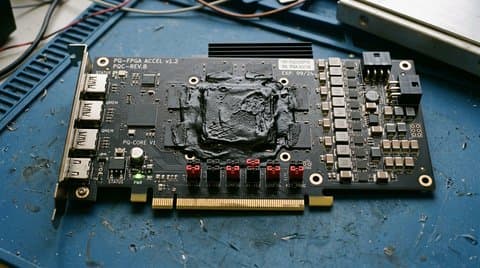 PQC HSM Accelerator Board Detail
Organizations are therefore confronted with a stark economic dilemma: either execute physical, multi-billion-dollar hardware rip-and-replace programs across continents, or attempt to insulate non-upgradable legacy endpoints behind costly post-quantum proxy firewalls that introduce single points of systemic failure.
A Structural Comparison of Cryptographic Eras
The operational divergence between legacy asymmetric primitives and standardized lattice-based post-quantum algorithms reveals why compliance is stalling across critical industries:
Cryptographic Attribute | Classical Paradigm (RSA-2048 / ECDSA P-256) | Post-Quantum Lattice Paradigm (ML-KEM-768 / ML-DSA-65) |
|---|---|---|
Mathematical Hardness | Integer Factorization & Discrete Logarithms | Module Learning With Errors (M-LWE) over Polynomial Rings |
Quantum Resistance Status | Vulnerable to Shor’s Algorithm (Polynomial Time Collapse) | Resistant to Known Classical & Quantum Algorithms |
Public Key Size | 256 bytes (RSA) / 64 bytes (ECDSA) | 1,184 bytes (ML-KEM) / 1,952 bytes (ML-DSA) |
Signature / Ciphertext Size | 256 bytes (RSA) / 64 bytes (ECDSA) | 1,088 bytes (ML-KEM) / 3,293 bytes (ML-DSA) |
Handshake MTU Fit | Easily fits within single 1,500-byte IP packet | Mandates multi-packet IP fragmentation & reassembly |
Minimum SRAM for Computation | ~4 KB to 8 KB (Lightweight arithmetic) | ~32 KB to 64 KB (NTT polynomial operations & working buffers) |
Side-Channel Vulnerability | Well-mapped power analysis & timing mitigations | Complex masking required; prone to micro-architectural leakage |
Firmware Update Viability | Universal drop-in software patches | Requires wholesale silicon replacement on legacy edge nodes |
As highlighted in the matrix, the transition demands not merely updated cipher suites in operating system libraries, but a fundamental expansion of memory allocations, cache line architectures, and network interface buffer queues.
The Illusion of Hybrid Mode and the Downgrade Trap
To mitigate the risk of zero-day mathematical vulnerabilities in novel lattice algorithms, the financial sector and government agencies have championed "hybrid key exchange." Under hybrid protocols, every transaction is simultaneously secured by both a classical algorithm (like X25519) and a post-quantum algorithm (like ML-KEM). The session key is derived by concatenating the outputs of both primitives.
The theory appears prudent: if the new lattice mathematics contains an unforeseen structural shortcut, the classical key still protects current traffic; if a quantum computer arrives tomorrow, the lattice key prevents retroactive decryption.
In implementation, hybrid mode combines the vulnerabilities of both worlds with the latency burdens of neither. It inflates the handshake payload beyond 4 kilobytes, severely degrading edge connectivity.
More insidiously, hybrid configurations introduce complex downgrade attack surfaces. Malicious adversaries executing man-in-the-middle interception can intentionally manipulate network negotiation parameters, spoofing packet errors or buffer constraints to force servers into falling back onto classical-only ciphers.
The Post-Quantum TLS 1.3 Handshake Bottleneck: Client Hello with Hybrid Extensions (4.2 KB) → Transport-Layer IP Fragmentation → Edge Router Reassembly Buffer Pressure → Server Key Generation (NTT Polynomial Expansion) → Ephemeral Ciphertext Fragment Response → Connection Latency Degradation (> 180 ms)
If an enterprise does not implement strict, non-fallback post-quantum policies, its expensive PQC deployment is little more than cryptographic theater—vulnerable to the simplest automated protocol downgrade script.
The "Harvest Now, Decrypt Later" Reality
The greatest strategic misconception surrounding Quantum Readiness Day is that organizations have until the 2030 regulatory deadline to act. In reality, the critical threshold has already passed for any data possessing a strategic shelf-life exceeding five years.
Foreign state intelligence apparatuses and well-funded industrial cartels have spent the past decade executing planetary "Harvest Now, Decrypt Later" (HNDL) programs. Massive data intercepts—including encrypted diplomatic cables, intellectual property repositories, genetic sequence databases, and sovereign identity registries—are routinely vacuumed from undersea telecommunications trunks and stored in dark exabyte archives.
When a cryptanalytically relevant quantum computer (CRQC) comes online, these petabytes of historical ciphertext will be systematically unlocked. For sensitive medical records, classified defense treaties, and corporate trade secrets, the breach has already occurred; only the timeline of disclosure is delayed.
Who Survives the Quantum Horizon?
The organizations that will navigate the post-quantum transition intact are not those conducting superficial compliance audits or waiting for cloud vendors to push automatic patches. Survival requires rigorous cryptographic inventory and aggressive physical remediation:
Complete Cryptographic Discovery: Cataloging every hard-coded certificate, legacy HSM, and embedded microcontroller across the entire operational footprint.
Crypto-Agile Architecture: Decoupling cryptographic algorithms from application logic through standardized abstraction interfaces, allowing primitive swaps without firmware rebuilds.
Silicon Acceleration: Deploying dedicated post-quantum hardware accelerators with verified constant-time polynomial multiplication engines and hardware-enforced side-channel masking.
Ruthless Deprecation: Decommissioning un-patchable legacy edge devices rather than trusting fragile proxy wrappers to defend broken cryptographic primitives.
Quantum Readiness Day is not an administrative milestone on a regulatory roadmap. It is a civilizational boundary condition. As the mathematical scaffolding that underpinned fifty years of digital trust dissolves, only those institutions with the engineering discipline to rebuild their security foundations from the silicon up will retain the right to digital sovereignty.