
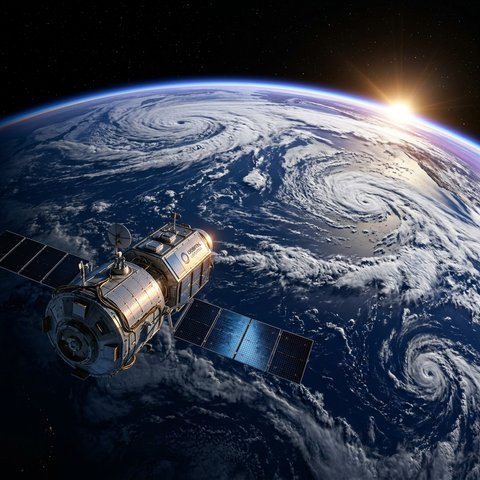
The View from 400 Kilometers Up
When you spend enough time monitoring the transit of modular logistics pods across the vacuum of low Earth orbit, you begin to develop a clinical detachment from the planet below. But the 2026 Super El Niño is different. Even from the tinted ports of a logistics station 400 kilometers above the Pacific, the anomaly is visible to the naked eye. It’s a vast, bruised-indigo smear of heat, a thermal scar that is currently dictating the movement of every cargo ship, autonomous drone, and orbital launch vehicle in the northern hemisphere. For those of us in the deep space economy, the +3°C anomaly isn't just a meteorological curiosity; it is a logistical blockade.
We are currently witnessing the first true 'Planetary Stress Test' of the agentic era. In the years leading up to 2026, we optimized our supply chains for a predictable climate that no longer exists. We built agents that could calculate the most efficient path through a storm, but we never taught them how to handle a planet that is fundamentally changing its atmospheric density. Today, as the Pacific exceeds historical temperature thresholds, the 'Architecture of Silence' is being tested by the roar of a climate in transition.
Why the Atmosphere is Winning the Logistics War
The most immediate impact of the 2026 Super El Niño isn't on the ground—it's at the edge of the atmosphere. Increased ocean temperatures translate directly to atmospheric turbulence, which has effectively shrunk our launch windows for heavy logistics payloads by nearly 35% in the last quarter. For an industry that relies on the precise choreography of orbital injections and re-entry maneuvers, this is a catastrophe. If the weather in Guiana or Florida doesn't permit a launch, the entire supply chain for asteroid-derived materials in LEO begins to starve.
This atmospheric barrier is forcing a radical pivot. In the logistics offices of Neo-Tokyo and the orbital hubs above, we are no longer planning for 'Just-in-Time' delivery. We are moving toward 'Sovereign Buffers'—massive, space-based warehouses that can hold months of critical supplies, decoupling the orbital economy from the volatility of the terrestrial weather. We are realizing that to survive on Earth, we must first master the logistics of the vacuum.
The sheer scale of the El Niño event is also triggering a surge in demand for high-resolution orbital monitoring. Nations are no longer just looking for weather forecasts; they are looking for 'Logistical Forensics.' They want to know exactly how the heat is shifting the currents that drive their autonomous maritime fleets. In 2026, the country with the best orbital vantage point is the country that survives the heatwave with its economy intact.
Thermal Limits: Liquid Logic and the Ground-Truth
While we monitor the storms from above, the reality on the ground is one of thermal desperation. The 2026 heatwave is exposing the fragility of our terrestrial compute infrastructure. Data centers that once relied on traditional air-cooling are currently hitting their 'Thermal Wall.' This is why we are seeing a sudden, frantic adoption of micro-pump liquid cooling—the same technology we perfected for managing the heat loads of orbital processors.
As a veteran of the Artemis missions, I find it ironic that the very technologies we developed to survive the vacuum are now being deployed as survival tools for the surface. 'Liquid Logic' is no longer a luxury for frontier labs; it is the baseline requirement for any agentic system trying to operate in +45°C ambient temperatures. We are industrializing the cooling of intelligence because, without it, the 'Atmosphere of Intelligence' simply evaporates.
The Geopolitics of Cloud Density
In the logistics circles I frequent, there is a quiet discussion about 'Weather Sovereignty.' The 2026 Super El Niño has created a new kind of geopolitical divide. On one side are the nations with the orbital infrastructure to predict and bypass the worst of the volatility. On the other are those left blind, their maritime and air-freight systems crippled by unpredictable storm surges and shifting jet streams. This isn't just about trade; it's about the ability to maintain the 'Material Truth' of a nation's supply lines.
Africa, in particular, is becoming a primary theater for this 'Weather War.' With data center capacity projected to grow 5x by 2030, the continent is doubling down on 'AI-ready' infrastructure that can handle the Super El Niño shocks. By leveraging natural gas for baseload power and implementing localized, space-fed weather agents, African logistics hubs are proving that resilience is a choice, not just a matter of luck. They are building 'Gardens' of stability within a turbulent global climate.
Is Resilience Still Possible in a +3°C World?
The short answer is yes, but it requires a total abandonment of the 'efficiency' metrics of the 2010s. In the 2026 economy, the only metric that matters is 'Survival Probability.' We must build our logistics systems to be as redundant and durable as a Mars-bound cargo ship. This means investing in massive orbital storage, liquid-cooled terrestrial compute, and agentic systems that prioritize safety over speed.
The 2026 Super El Niño is a mirror. It reflects back to us the fragility of our terrestrial hubris. It tells us that we cannot continue to live on the surface as if we are independent of the atmosphere. From my station in LEO, the solution is clear: we must stop thinking like terrestrial merchants and start thinking like orbital engineers. We must learn to navigate the storm, or be consumed by it.
As the Pacific heat continues to rise, the mission for those of us in the orbital economy is to provide the 'Atmospheric Truth' that the ground-dwellers so desperately need. We are the eyes in the sky, the guardians of the supply chain, and the architects of a more resilient future. The shadow of the El Niño is long, but from where I stand, the sun is always beginning to peek over the Earth's limb.
The Final Frontier of Supply
Ultimately, the 2026 Super El Niño is a catalyst for the 'Great Migration' of logistics to the orbital layer. We are moving our critical data, our observation platforms, and soon, our most valuable manufacturing processes into the vacuum. Why? Because the vacuum is predictable. It is cold, it is stable, and it is indifferent to the thermal whims of the Pacific. In space, we have found the ultimate 'Architecture of Silence'—a place where the noise of the atmosphere can no longer reach us. As we look toward 2027, the map of global trade will no longer be drawn on a globe; it will be mapped on the star charts of the logistics stations that keep the world alive.