
Holding Thirty Tons on the Drum
Two hundred miles off the coast of County Kerry, the North Atlantic does not acknowledge diplomatic treaties, venture debt covenants, or the marketing mythology of the digital cloud. When you are rolling twenty-two degrees through a force eight gale on the working stern deck of a dynamic-positioning cable ship, the internet is not an airy realm of ethereal intelligence. It is fifty-four millimeters of galvanized steel wire armor, high-density polyethylene insulation, and copper power tubing wrapped around twelve fragile pairs of silica glass fibers—screaming under thirty metric tons of dynamic tension on the main hydraulic drum.
If you lose electrical power to the stern thrusters for eight seconds, the vessel drifts out of its five-meter positioning envelope. If the load-cell sensor on the pick-up arm spikes past thirty-four tons, the cable will part with a sound like a naval cannon shot. The severed end will whip through the water column and plummet four thousand meters into the Porcupine Abyssal Plain, coiling into a tangled bird’s nest of shredded steel in the perpetual black mud.
At that point, five hundred gigabits of transatlantic trading algorithms and cloud synchronizations cease to exist across that sector. And no prompt engineered in California can bring them back to the light.
The Dynamic Envelope of Deep-Sea Maintenance
The general public imagines that once an undersea communications cable is dropped into the ocean, it lies in peaceful stasis forever. This is a fairy tale whispered by people who have never seen what an oceanic turbidity current does to a continental slope.
Undersea cables are broken continuously. They are snagged by deep-water bottom trawlers scraping the seabed at six hundred meters; they are ground against basalt outcroppings by tectonic tremors along the Mid-Atlantic Ridge; they are bitten by Greenland sharks drawn to the electro-magnetic field of the copper conductor carrying twelve thousand volts of direct current to power the inline optical amplifiers.
When a break is triangulated via coherent optical time-domain reflectometry (COTDR) from terminal stations in Bude and Halifax, a DP2 vessel is dispatched into whatever sea state the North Atlantic decides to throw at us.
Subsea Cable Operations: Continental Shelf vs. Abyssal TrenchOperational Parameter | Continental Shelf Trenching (< 1,500 m) | Abyssal Plain Deployment (3,000 – 5,500 m) |
|---|---|---|
Mechanical Armor | Double-armored helical galvanized steel wraps (Type DA) | Lightweight single-armor or unarmored deep-sea core (Type LWP) |
Deployment Method | Heavy hydraulic seabed burial plow (trench depth: 1.5–3.0 m) | Controlled catenary free-lay directly onto pelagic sediment |
Recovery Mechanism | Heavy de-trenching grapnels and ROV jetting skids | Gifford or Renown cutting-and-holding grapnels via tension winch |
Dynamic Tension Range | 8 to 15 metric tons on main stern drum | 25 to 38 metric tons during vertical catenary recovery |
Environmental Hazard | Commercial fishing bottom-trawls, cargo anchors, and dredging | Turbidity slumps, tectonic fracture rifts, and hydrostatic crushing |
Recovering a severed cable from four kilometers down is a mechanical ordeal governed by raw trigonometry and hydrostatic pressure. You do not simply reel it in. You lower an eight-ton steel grapnel on four miles of braided wire rope, steam perpendicular across the charted coordinates at one knot, and watch the hydraulic load cell on the bridge console. When the tension needle jumps from twelve to twenty-eight tons, you know you have caught iron in the deep.
In the Belly of the Splicing Hangar
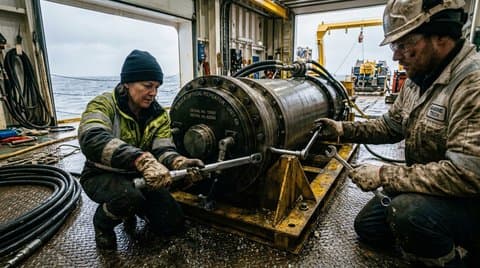 Marine technicians securing a heavy titanium optical repeater
Once the cable ends are brought up over the stern sheaves and clamped into the deck locks, the real work shifts into the temperature-controlled splicing laboratory built inside the ship’s hangar deck. Outside, green water breaks over the scuppers; inside, technicians working in cleanroom garments strip layers of armor under microscopes.
A single optical repeater housing—the cylindrical steel pod containing the erbium-doped fiber amplifiers (EDFAs) that boost fading laser pulses every seventy kilometers—weighs nearly a half-ton. It must withstand four hundred atmospheres of hydrostatic pressure. If a single microscopic grain of salt or grease contaminates the O-ring seals, water at six thousand pounds per square inch will punch through like a machining needle, vaporizing the high-voltage circuit boards in a fraction of a millisecond.
The Abyssal Jointing Procedure: Mechanical Armor Unbraiding & Core Stripping → Silica Core Cleaving (Angle Error < 0.3°) → Electric Arc Fusion Splicing → Hydrostatic Seal Pressurization (600 bar) → Controlled Overboarding via Stern Chute
Splicing twelve pairs of fiber core in forty-foot swells is an act of concentrated mechanical stoicism. The electric arc fusion splicer aligns the glass cores with nanometer precision while the deck under your boots heaves, lurches, and shuddering thuds against thirty-knot crests. The jointing technicians must have hands steady enough to handle a glass thread thinner than a human hair, even when the ship’s hull is vibrating from the lateral thrust of four thousand horsepower azimuthing propellers fighting the current.
The Fragility of Planetary Telemetry
There is a profound geopolitical blindness at the heart of our digital era. Political leaders and technology executives hold summits on artificial intelligence governance, data privacy, and algorithm alignment, entirely oblivious to the fact that ninety-nine percent of all intercontinental data traffic is channeled through fewer than six hundred commercial cable routes lying exposed on the ocean floor.
There is no magical constellation of low-orbit satellites capable of absorbing the volume of transatlantic bandwidth. A single modern subsea cable system carries over two hundred and fifty terabits per second per fiber pair. The entire constellation of commercial satellite swarms combined does not equal the capacity of three modern transpacific cables.
When state actors conduct covert hydrographic surveys of cable choke points—the Luzon Strait, the Celtic Sea, the Bab-el-Mandeb, or the seabed off the Shetland Islands—they are not interested in software. They are interested in bathymetry. They know that cutting four properly chosen cable clusters simultaneously would sever entire continents from the global financial settlement clearinghouses, plunging regional economies into instant computational isolation.
The High-Voltage Conduit and the Roar of the Thrusters
To keep light pulses moving across four thousand miles of ocean, subsea cables cannot rely on local battery banks. Every photon amplifier along the route requires continuous electrical energy. That electricity is supplied directly through the cable's central copper conductor from Power Feed Equipment (PFE) installed at the shore landing stations.
We are talking about direct-current voltages ranging between ten thousand and fifteen thousand volts, operating in a single-conductor earth-return system. The sea itself acts as the negative return path for thousands of miles. When our deck team prepares to cut into an active line, the landing stations on both sides of the ocean must execute an elaborate electrical safety isolation sequence. If an operator in Cornwall or Nova Scotia trips a switch prematurely while a deckhand is stripping the steel armor sixty miles offshore, the arc flash would vaporize the tools in his hands and burn through the steel bulkhead of the workshop.
This is why cable work does not tolerate the agile shortcuts or sloppy git-reverts common in software development. At sea, every engineering procedure is codified in laminated check-sheets signed in ink by the chief engineer and master mariner. When the dynamic positioning system alerts us to an approaching squall line with gusting seventy-knot winds, the bridge does not hold an impromptu standup meeting; the captain and the watch officer calculate the vessel's drift vector, dial the tunnel thrusters to ninety-five percent power, and fight to hold the ship's head into the swell until the joint is sealed.
When the Ocean Reclaims the Signal
At two in the morning, with the joint completed, the X-ray inspection verified, and the titanium casing bolted down to sixteen hundred foot-pounds of torque, the deck crew prepares to put the cable back over the stern.
This is the most dangerous moment of the deployment. The cable bight—the loop formed by joining the original cut ends with an insertion length—must be lowered over the stern roller under strictly calculated back-tension. If the catenary angle is too steep, the cable bends beyond its minimum bend radius of two meters, fracturing the silica cores inside. If the tension slackens, loops form on the seabed, creating kinks that will fail under bottom currents six months down the line.
We watch the tension meters in the control shack. Thirty tons. Twenty-eight tons. Twenty-four tons.
Slowly, foot by foot, the black polyurethane sheath vanishes into the dark, churning wake of the North Atlantic. Down it goes, slipping through the thermocline, through the twilight bathypelagic zone, into the abyssal cold where no daylight has reached for four billion years.
There it settles into the mud, cold and heavy, humming with the invisible financial transactions, medical records, and digital confessions of two continents. Up here on the deck, my hands are coated in salt, diesel oil, and cable grease. The clouds are breaking in the east, revealing a pale northern dawn. The internet still works for another day, not because of a miracle of the spirit, but because twenty men and women on an oil-stained ship held thirty tons of iron against the fury of the sea.